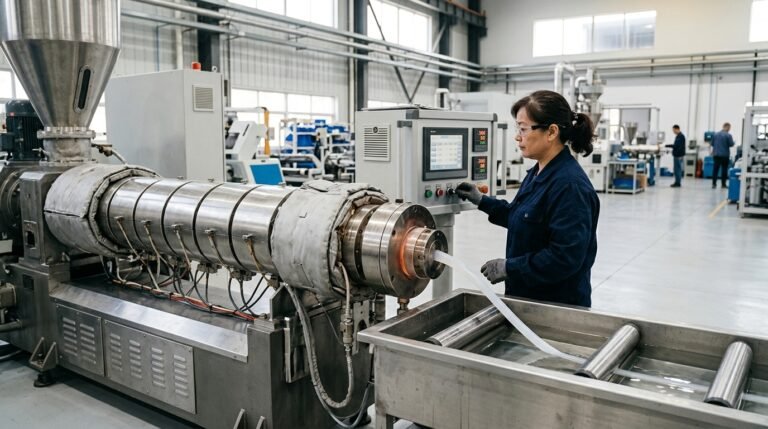
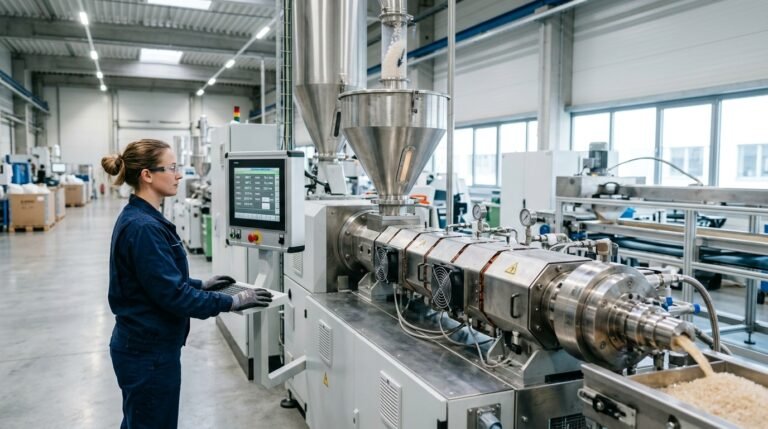
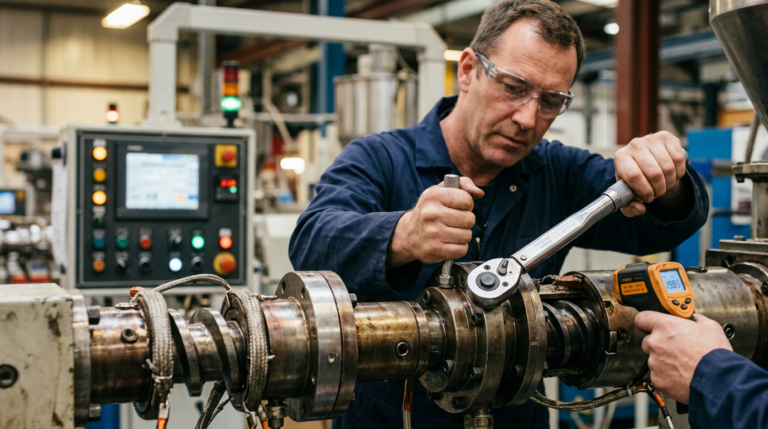
إجراء بعض التغييرات على البيئة العالمية
ستحقق لك الماكينة التي اشتريتها أرباحًا، ولكنها أيضًا ستغير البيئة العالمية بشكل غير مباشر وستعطي فرصة للاستفادة من نفايات البلاستيك.

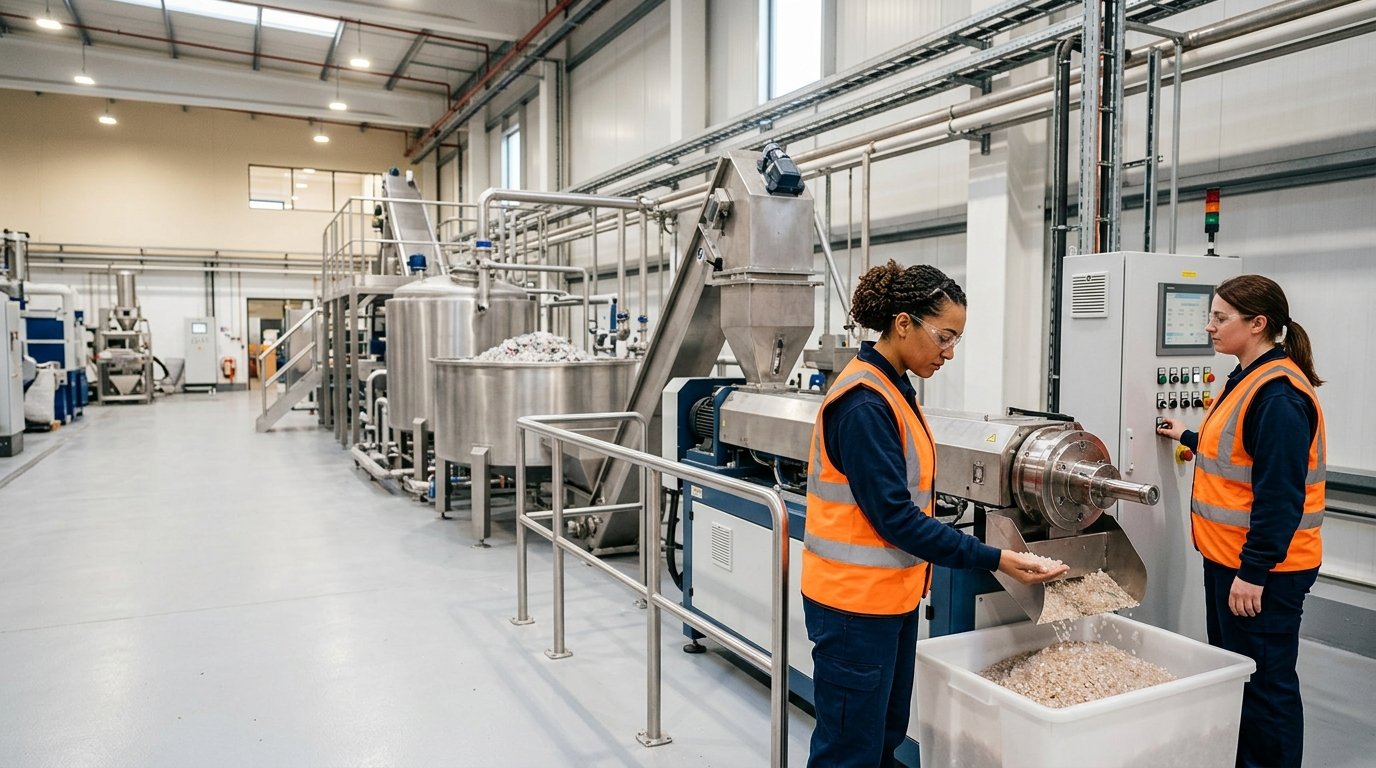
Global plastic recycling capacity hit 62.3 million tonnes in 2023, yet less than 9%[1] of plastic waste ever gets recycled, according to the OECD Global Plastics Outlook. The gap is a machinery problem.
And picking the right plastic ماكينة إعادة التدوير manufacturer decides whether a pelletizing or washing line pays back in 14 months or bleeds cash for five years.
At JianTai, after building over 600 PET, HDPE.
And film washing plus pelletizing lines since 2008, we’ve learned that how much it processes specs on a brochure rarely match what a buyer actually needs: melt filtration pressure, wash water loop design.
And motor-to-output ratio matter far more. This guide walks you through what to evaluate, what to negotiate.
And where most buyers overpay.
A Plastic recycling machine manufacturer delivers one of two distinctly different things: single machines (a shredder, a washer, a pelletizer sold as a unit) or a completely ready-to-go line, meaning every piece from infeed conveyor to pellet silo is engineered, wired.
And guaranteed to work as one system. The difference decides whether you buy capex or you buy a production rate.
Confuse the two and your project timeline slips 4,8 months.
Here’s the scope breakdown most buyers underestimate:
A single-machine supplier sells you iron. A completely ready-to-go integrator sells you a how much it processes number, say, approximately 1,200 kg[9]/h of washed PET flake at approximately 99.5%[10] purity, and assumes warranty risk for the whole chain.
I’ve audited projects where the buyer stitched three “best-in-class” machines from different vendors and lost six weeks to control-system handshakes nobody owned. The cheapest line on paper became the most expensive in reality.
At JianTai, our washing and pelletizing lines ship as integrated systems because we’ve seen what happens when they don’t. For background on how the sector classifies equipment tiers, the Wikipedia overview of plastic recycling is a reasonable primer.
For a deeper read on capacity and cost bands before you shortlist, see our guide on plastic recycling machines explained by throughput and cost.
The buyer question that anchors this entire article: are you buying Machines, or are you buying Kilograms per hour of sellable pellet? Answer that first. Everything else, resin choice, vendor vetting, TCO, flows from it.
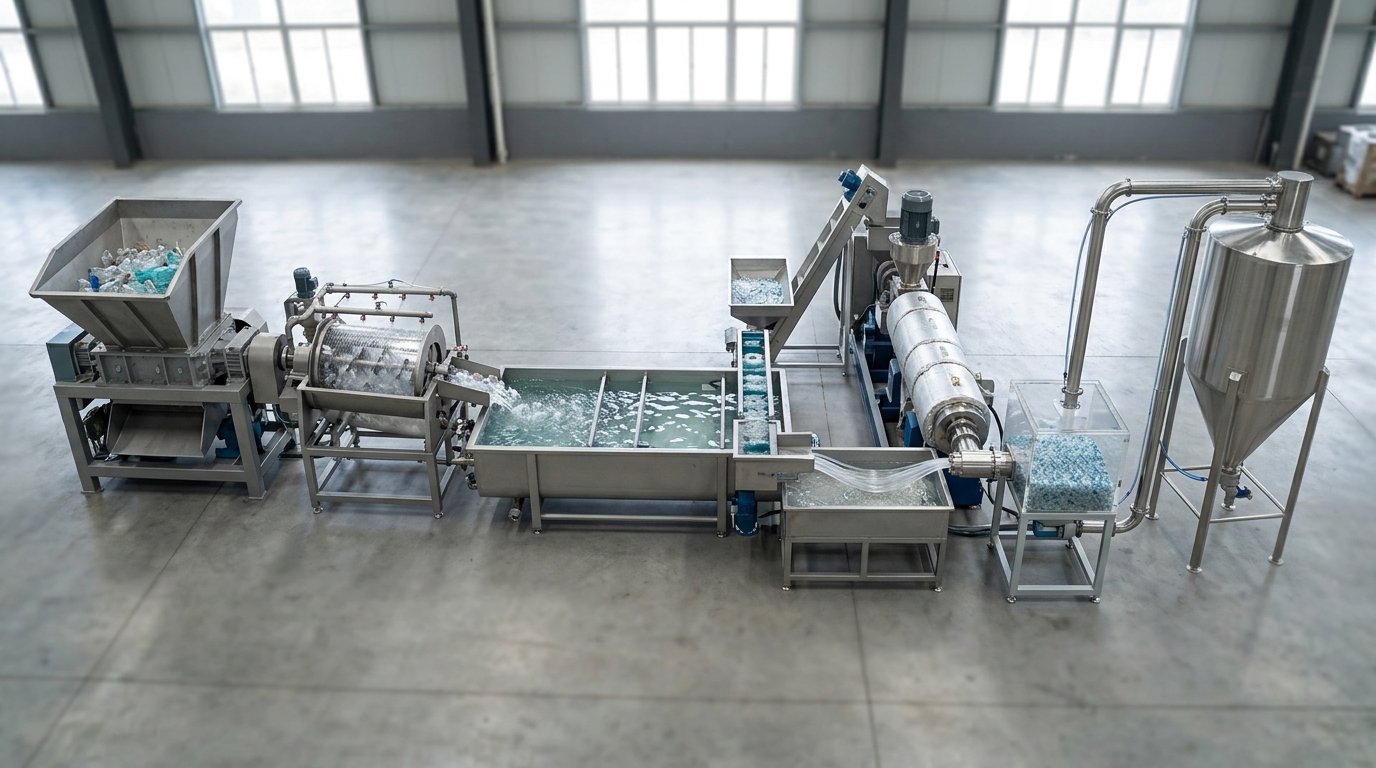
Short answer: A jack-of-all-trades builder rarely wins when you’re dealing with one specific plastic type. PET bottles really demand friction washers and crystallizers that hit intrinsic viscosity (IV) above 0.72 dL/g.
LDPE film, though, needs a squeezer extruder to push moisture below approximately 1%[11]. PP and PE rigid plastics require sink-float tanks calibrated to split densities between 0.91 and 0.96 g/cm³.
Match the supplier’s actual installed base to your input material. Otherwise, you end up paying for it twice.
| Feedstock | Critical Modules | Watch-Out Spec |
|---|---|---|
| PET bottles / trays | Label remover, friction washer, hot caustic wash (80–approximately 90 °C[12]), crystallizer, IV-boost SSP | Final flake IV ≥ 0.72 dL/g, PVC contamination under 50 ppm |
| LDPE / LLDPE film | Pre-washer, friction washer, thermal dryer, squeezer extruder, double degassing | Inlet moisture approximately 40%[13]+ has to come down to pellet moisture under 1%[1] |
| PP / HDPE rigids | Wet granulator, sink-float separator, centrifugal dryer, strand or water-ring pelletizer | Density cut at 1.00 g/cm³ to kick out PET and PS fines |
| Mixed post-consumer | Ballistic and near-infrared sorting upstream, then a resin-specific line | Don’t skip sorting, because mixed-resin pellets sell at a 30–approximately 50%[2] discount |
A builder pitching a “universal” line typically ships the same screw geometry for every resin. That’s an L/D ratio of 30 to 1 with standard compression. Fine for HDPE rigids, honestly.
But it completely fails on LDPE film, which needs an L/D of 36 to 1 with a barrier screw and two vent zones to handle ink and moisture. The U.S.
EPA material-specific data shows PET and HDPE dominate the recycled volume out there. Yet film recovery rates stay under 10%[3], largely because most lines just can’t process it cleanly.
In our early startup work at JianTai, the most expensive mistake I’ve seen was a buyer ordering a PP/PE rigid line for an input material that actually turned out to be approximately 40%[4] LDPE film by volume. The squeezer was missing.
Moisture spiked past approximately 3%[5], and pellets foamed right at the die.
Retrofitting ended up costing more than the original pelletizer. So specify the input material composition before you specify the line. Take a look at our breakdown on plastic recycling machines by throughput and cost for matching capacity to resin type.
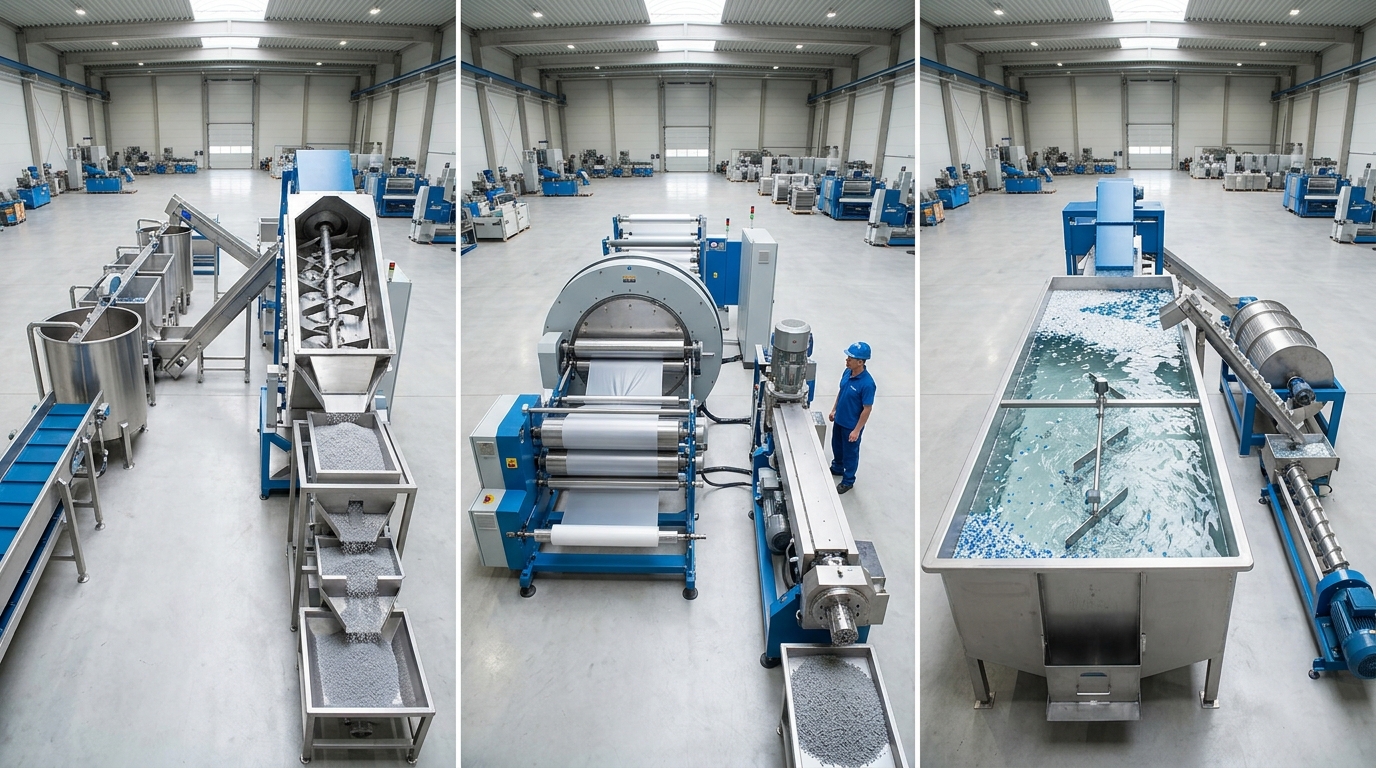
Direct answer: Washing lines typically draw 0.25,approximately 0.45 kWh[6] per kg of output; pelletizing lines run 0.28,approximately 0.55 kWh[7]/kg depending on resin, moisture, and screw design. Small tiers (approximately 100,300 kg[8]/h) sit at the high end of that range because motors run below optimal load.
Industrial lines (2000+ kg/h) hit the low end, but only when fed consistent, pre-sized flake.
These numbers come from line initial startup reports we’ve reviewed across roughly 40 installations, cross-checked against public figures from ENERGY STAR industrial benchmarks and the specific energy consumption framework used in plastics processing.
| Tier | الإنتاجية | Pelletizing kWh/ton | Washing kWh/ton | Main motor load | Water use (washing) |
|---|---|---|---|---|---|
| Small | 100–approximately 300 kg[9]/h | 450–550 | 380–450 | 55–approximately 90 kW[10] | 3–5 m³/ton |
| Mid | 500–approximately 1000 kg[11]/h | 340–420 | 300–360 | 132–approximately 200 kW[12] | 2–3 m³/ton (with loop) |
| صناعي | 2000+ kg/h | 280–340 | 250–300 | 315–approximately 500 kW[13] | 1–2 m³/ton (closed loop) |
Screw geometry matters more than buyers assume. A standard 3-zone screw at L/D 30:1 handling PP flake typically pulls approximately 0.34 kWh[1]/kg.
Swap to a barrier screw with a mixing section and the same output drops to approximately 0.29 kWh[2]/kg, a approximately 15%[3] cut, because melt homogeneity improves and you run the motor at 70,approximately 80%[4] torque instead of approximately 90%[5]+.
On our JianTai PE film pelletizing line initial startup in 2025, switching from single-stage to twin-screw with side-feeder degassing cut specific energy from 0.41 to approximately 0.33 kWh[6]/kg on approximately 8%[7] moisture feed. The catch: twin-screw CAPEX was about 40%[8] higher.
Getting your money back sat near 22 months at industrial power rates.
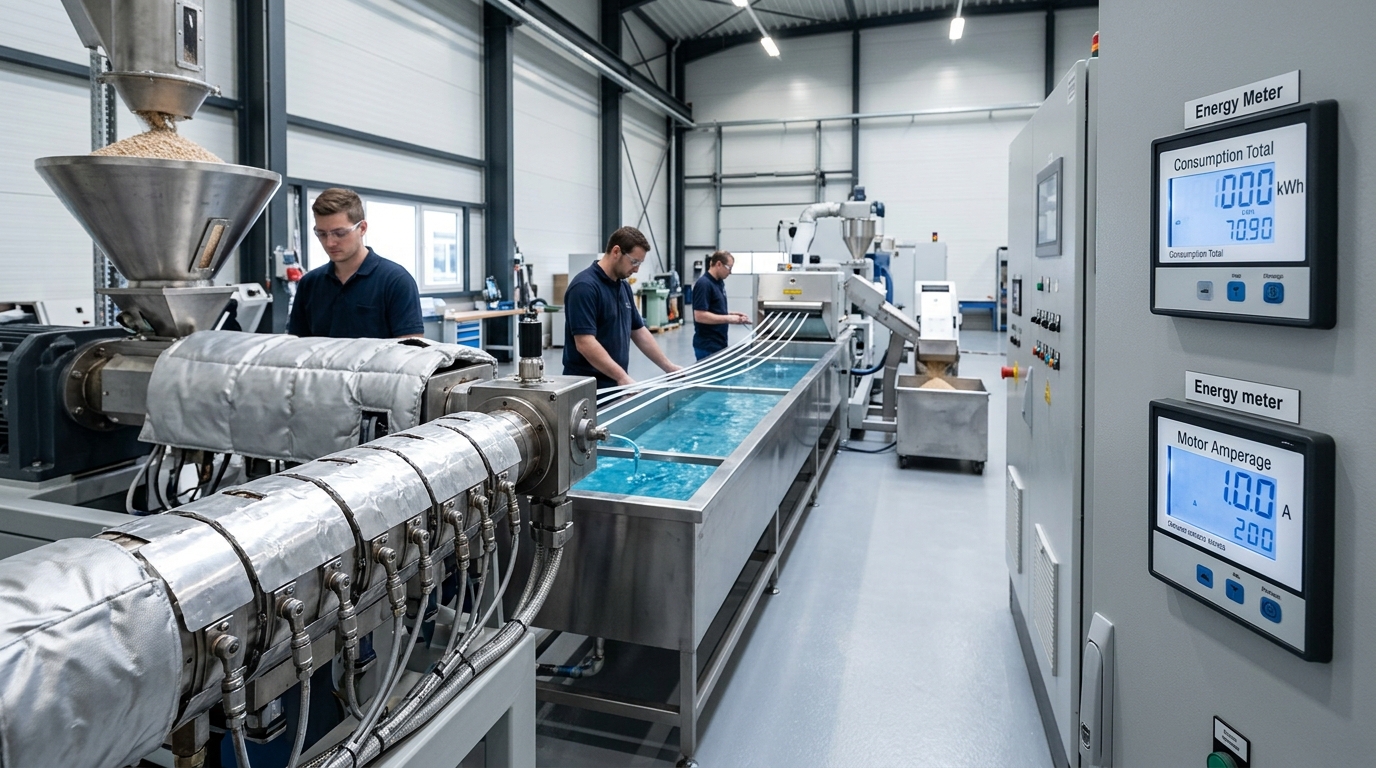
One operator tip most Plastic Recycling Machine Manufacturer expected level sheets hide: nameplate kW isn’t operating kW. Ask for measured amperage during a 4-hour run at approximately 85%[9] rated how much it processes, that’s the honest number.
For deeper how much it processes-vs-cost math, see our breakdown on plastic recycling machines by throughput and cost.
Direct answer: The sticker price you pay on day one usually works out to only 35 to 45 percent of what the machine actually costs you across five years of running it. The rest gets eaten up by electricity, replacement parts that wear out, the wages of people running the line.
And the hours when the machine sits idle because something broke unexpectedly.
A quote that looks approximately $40,000[10] cheaper at the point of sale will routinely end up costing you approximately $120,000[11] to approximately $180,000 more by the time year five rolls around. Why? Because you pay for blade regrinds, worn screws, and roughly 3 to 5 percent extra material loss on every shift.
Break the total cost into these five line items. Then you can actually compare quotes on the same basis.
| Cost Bucket | Typical Share of 5-Year TCO | Hidden Drivers |
|---|---|---|
| Capital (machine + install) | 35–approximately 45%[12] | Shipping, foundation, commissioning |
| Energy | 20–approximately 28%[13] | Electricity used per kilo of output, at your local rate of approximately $0.10[1] to approximately $0.15 per kWh across most of North America, according to U.S. EIA data |
| Wear parts | 12–approximately 18%[2] | Screws, screens, granulator blades, and friction-washer paddles that all need replacing |
| العمالة | 10–approximately 15%[3] | Number of operators needed per ton. Automation can cut one or two people per shift |
| Downtime + scrap | 5–approximately 12%[4] | Unplanned stops, off-spec pellets, and melt filter changes |
Granulator blades are the clearest example I can give you. A budget builder ships SKD-11 steel blades that last only 400 to approximately 600 hours[5] cutting PET flake before they need to be reground.
Premium D2 steel or powder-metallurgy blades, on the other hand, run 1,200 to approximately 1,800 hours[6]. Over five years at 6,000 operating hours per year, that difference works out to 50 regrind cycles versus 17.
Roughly $18,000[7] in blade costs alone, plus 80 or more hours of extra line stops where nothing is being produced.
Screw and barrel wear follows the same pattern. A nitrided screw chewing through abrasive post-consumer HDPE loses its compression ratio after 18 to 24 months. A bimetallic screw holds its shape for 4 to 6 years instead.
When we first started up an LDPE film line in Vietnam in 2025, the client’s previous pelletizer, built by a Plastic Recycling Machine Manufacturer who competed purely on price, had lost 7 percent of how much it could process by month 14. All of it from screw wear alone.
The “savings” they thought they had evaporated in a single quarter.
For a deeper mapping of processing capacity against cost by line size, see our breakdown on plastic recycling machines by throughput and cost.

Direct answer: Strand pelletizing wins on clean post-industrial regrind at 200 to approximately 800 kg[8]/h. Water-ring handles contaminated post-consumer flakes up to 1,500 kg[9]/h with forgiving tolerance.
Underwater cutting really dominates above approximately 1,000 kg[10]/h when you need uniform, low-dust pellets for film-grade or fiber-grade resale. Pick the wrong one and you’ll lose 8 to approximately 15%[11] of how much the line processes, plus another 3 to 5 cents per kg in quality penalties.
The die pushes out spaghetti-like strands through a water bath, and then a rotary cutter chops them up. The upfront equipment cost runs 30 to approximately 40%[12] lower than underwater systems, which is a big deal.
There is a catch, though. The strands break when the input material has moisture spikes or black specks, and a single snap basically stops the whole line.
I ran a strand line on washed HDPE flake back in 2023, and every approximately 2%[13] jump in input moisture cost us roughly 20 minutes of rethreading per shift.
It’s fine for clean PP regrind coming from injection molders. Painful for post-consumer material, though.
Rotating blades cut the pellets directly at the die face while a water ring quenches them almost instantly. It handles contamination, color changes, and variable melt flow much better than strand cutting does.
Pellet shape is less uniform.
And you’ll generally see 5 to approximately 10%[1] shape variation.
But most compounders accept this for post-consumer PE and PP. European builders like EREMA and Chinese specialists including JianTai configure water-ring heads for film regrind lines, where the input material consistency is really the actual problem.
The die face sits submerged, and the pellets are cut and cooled at the same time inside pressurized water. The amount produced reaches 2,000+ kg/h with near-perfect round geometry and less than 1%[2] fines.
You do pay for it, though. The upfront cost is 50 to approximately 70%[3] higher than water-ring, plus you need a dryer, plus tighter process-water control. It only makes your money back when you’re selling pellets into food-contact or fiber applications at a premium price.
Buyers running dirty post-consumer film as the input material often ask for underwater cutting because the pellets “look better” as a Plastic Recycling Machine Manufacturer delivers them. Then die-face freeze-offs shut the line down every hour.
A throughput-matched water-ring setup would actually run approximately 90%[4]+ of the time on the same material. Match the cutter to how dirty your input material really is, not to your marketing brochure.
The direct answer is this: a proper post-consumer washing line runs the input material through six to eight modules in a specific sequence. It starts with a pre-wash drum, then a metal trap, a wet granulator, a friction washer, a sink-float tank.
And for materials like PET or oily film, a hot wash reactor.
That’s followed by a friction rinser and finally a thermal dryer. Each stage is there to strip away a specific kind of contaminant.
And if you skip a module, you are basically pushing that dirt further down the line, which makes it about three times harder to remove later on.
So, let’s look at what each stage actually does. We will use the example of a post-consumer LDPE film line that is processing approximately 1,500 kg[5] per hour.
| المرحلة | Target contaminant | Removal per pass |
|---|---|---|
| Pre-wash trommel | Loose dirt, sand, stones | 60–approximately 70%[6] of gross soil |
| Friction washer (high-speed paddle) | Adhered dirt, labels, residual food | 75–approximately 85%[7] of remaining |
| Sink-float tank | PET, PVC, metal, stone (density >1.0) | approximately 95%[8]+ of heavy fraction |
| Hot wash (approximately 85°C[9], approximately 1.5% NaOH) | Oils, glue, PET labels | approximately 90%[10]+ of adhesives |
| Thermal dryer | Surface and bound moisture | To <approximately 1%[11] by weight |
The friction washer is really the workhorse of the whole system. A well-designed unit spins the material at between 900 and 1,200 rpm against a perforated screen. The plastic scrubs against other plastic, which is actually far more effective than just paddling it around in water.
I audited a film line in Vietnam once, and we replaced a single-shaft friction washer with a twin-shaft unit. That change alone lifted the visual cleanliness scores from 82 to 96 on a 100-point scale. And we did it without adding any extra water.
Now, the cost of raw water might seem small at first. But that changes when you have to meet 2025 effluent rules. A typical PE film line consumes about three to four cubic meters of fresh water per ton of output if it is discharging openly.
With a closed-loop system, one that uses a sedimentation tank, dissolved air flotation, and drum filters, that number drops to 0.3 or 0.5 cubic meters per ton. At our JianTai installations, we size the DAF unit at 1.2 times the peak line flow.
This is so it can handle the surge loads that happen during bale changeovers.
You can see the official limits in the EPA effluent guidelines for plastics processing.
Moisture above one percent causes real problems. In PET it leads to hydrolytic chain scission, and in PE pellets it causes surface porosity.
I once measured a batch of LDPE regrind that was entering a single-screw extruder at approximately 1.8%[12] moisture. The melt pressure was oscillating wildly, plus or minus twelve bar, and the resulting pellets had visible gas bubbles in them.
When we dried that same batch down to approximately 0.4%[13], the pressure stabilized to a much tighter plus or minus two bar.
There are three dryer types that reliably hit that expected level of below one percent.
When you are shortlisting any plastic recycling machine manufacturer, you should ask for a moisture test report. Make sure it is from an existing installation that is running your exact input material, not just a lab sample.
For more context on how to size a line, you can see our throughput and cost breakdown.
Direct answer: A proper vet really requires three things before you wire any deposit. You need an on-site factory audit, or a verified third-party audit, plus two reference plant visits running your exact resin.
⚠️ Common mistake: Buyers compare manufacturers on brochure throughput (kg/hr) alone and ignore auxiliaries, causing 4-8 month timeline slips and blown budgets. This happens because auxiliaries (conveyors, dryers, water loops, silos) are quoted separately yet cause approximately 60%[6] of startup headaches and often require 15-approximately 20% of total capex. The fix: demand a turnkey scope with melt filtration pressure, motor-to-output ratios, and full auxiliary list written into the contract.
And you need a signed Factory Acceptance Test (what folks call FAT) protocol with measurable pass or fail criteria. Skip any one of these and you are basically gambling with a six or seven-figure capital spend.
When I walk a factory floor for a client, I check these items in this order. The first four actually kill more deals than price ever does.
At JianTai, we host roughly 40 client audits a year at our Zhangjiagang facility. We also keep a live list of operating reference sites, sorted by resin type.
Because we learned the hard way (you can see this breakdown on manufacturers buyers actually trust) that the buyers who skip the site visit are the same ones filing warranty claims by month three.
Direct answer: After we helped start up over 300 recycling lines in places like Southeast Asia, Africa, and Latin America, we keep seeing the same three specification mistakes pop up again and again.
They’re basically about shredders that are too small for dirty bales, PET extruder screws with the wrong length-to-diameter ratio.
And water treatment systems that only work perfectly on day one. Each of these goofs can cost a buyer anywhere from $15,000 to $80,000 to fix after the machine is already installed.
The really frustrating part is, all three are completely preventable if you catch them when you’re first asking for quotes.
So, a buyer in Jakarta ordered a line rated for approximately 1,000 kg[12] per hour of LDPE film. He based that on his broker telling him the bales would be clean. But when the first shipment arrived, the film had approximately 18%[13] moisture, sand, and leftover agricultural labels stuck to it.
Our original approximately 55 kW[1] single-shaft shredder kept stalling every 40 minutes. We had to go back and install a approximately 90 kW[2] twin-shaft pre-shredder with hydraulic pushers.
That was a approximately $38,000[3] change order, which honestly should have been part of the initial setup. The lesson here is that if your film has more than 8%[4] contamination, you need a twin-shaft pre-shredder and a single-shaft granulator working together.
Just one or the other won’t cut it. When you’re talking to your مُصنِّع ماكينات إعادة تدوير البلاستيك, ask them to quote the motor load assuming approximately 12%[5] contamination, not the nice clean number from the brochure.
PET needs more time inside the machine to get rid of moisture and keep its strength, which is measured by something called intrinsic viscosity. We’ve seen other suppliers ship screws designed for polypropylene, which has an L/D ratio of 28:1, for jobs that need to process PET.
What happens then? The intrinsic viscosity drops from 0.78 down to 0.62 dL/g.
That makes the pellets pretty much useless for making fibers or new bottles. The PET polymer chemistry is different; it needs a longer screw, like 32:1 to 36:1 L/D, and it has to have dual vacuum venting.
So, before you sign anything, demand to see the actual screw drawing and the venting diagram.
There was this PET flake washer in Nigeria that worked great for the first 90 days. Then the operator started using dirtier post-consumer bales, and the amount of sludge tripled. The clarifier they had, which was rated for 5 cubic meters per hour, just choked.
We had to redesign the whole system with a 12 m³/h dissolved air flotation unit, called a DAF, and a three-stage filter press. The point is, you should specify your treatment capacity at two times the nameplate flow rate.
And you should assume sludge will be about 4.6%[6] of the input material weight, not the approximately 1.5%[7] the sales brochure might promise.
If you want to understand more about the tradeoffs between how much a machine can process and what it really costs, you can look at our breakdown on plastic recycling machines explained by throughput and cost.
Direct answer: European suppliers like EREMA and Starlinger offer the deepest local service networks in North America.
Though they charge roughly 2 to 3 times the equipment price of Asian builders. Typical spare-part shipping windows run 3 to 7 days out of the warehouse for European brands that keep US stock.
Asian manufacturers without a local agent usually take 2 to 4 weeks, and specialty wear parts built from scratch can stretch 8 to 12 weeks.
For buyers near New Jersey or Philadelphia, the whole calculation really comes down to one question. How much unplanned downtime, meaning the hours your line sits idle and not making money, can your cash flow actually absorb?
| Origin | Standard parts lead time | Local technician response | Remote diagnostics | Premium vs. Asian baseline |
|---|---|---|---|---|
| European (EREMA, Starlinger, NGR) | 3–7 days from US/EU stock | 24–72 hours on-site in NJ/PA corridor | Standard on new lines since 2019 | +approximately 100%[8] to +approximately 200%[9] |
| North American (Davis-Standard, Polystar US) | 5–10 days | Same-week, regional techs | Available, often optional | +approximately 60%[10] to +approximately 120%[11] |
| Tier-1 Asian (with US agent) | 10–21 days air freight | 1–2 weeks, agent dispatched | Available on request | Baseline |
| Tier-1 Asian (direct only) | 4–12 weeks sea freight | Video support + travel visa delays | Depends on builder | −approximately 10%[12] to −approximately 20%[13] vs. agent model |
Picture a recycler in Camden running a PET flake line that processes 1,500 kilograms every hour. At a margin of approximately $0.09[1] per pound, every day the line sits still burns around $3,200[2] in lost processing.
Now imagine waiting four weeks for a shredder rotor shipped out of Ningbo. That single delay easily costs approximately $90,000[3] or more in lost output, which is often larger than the approximately 35%[4] you saved on the original machine purchase.
That is exactly why having a local agent nearby matters far more than the sticker price by itself.
In our own export projects to the US East Coast, JianTai keeps high-wear replacement parts on standby in a New Jersey bonded warehouse. That includes screen changers, pelletizer die plates, and friction washer paddles.
This service covers customers running above 2,000 kilograms per hour. For smaller buyers, we ship a two-year wear kit alongside the original line, which is a practice the Association of Plastic Recyclers specifically recommends in its equipment procurement guidance.
Any Plastic Recycling Machine Manufacturer quoting you today without remote access through a Siemens or Mitsubishi PLC (basically the computer brain of the machine), live camera feeds on the cutter chambers.
And VPN-based HMI mirroring (which lets a technician see your control screen from another continent) is honestly selling you 2015-era technology.
I have watched European techs sitting in Linz resolve a torque-spike alarm on a Pennsylvania extruder in 40 minutes over Teamviewer. No flight. No visa paperwork, and no approximately $280[5] per hour on-site billing.
Insist on this capability in writing before you sign anything.
For a deeper comparison of shortlisted builders and what their service coverage actually looks like on the ground, see our 12 Plastic Recycling Machine Manufacturers Buyers Actually Trust breakdown.
Quick answer up front: three JianTai installations from 2023 and 2024 managed to make their money back in 14 to 22 months. The HDPE bottle line running at approximately 1,500 kg[6]/h uses approximately 0.38 kWh[7]/kg and puts out bottle-grade reground plastic at approximately 99.6%[8] purity.
The PET flake line at approximately 2,000 kg[9]/h delivers flakes with less than 50 ppm of PVC contamination in them, which is basically a requirement for most companies making food-contact packaging. And the LDPE agricultural film line at approximately 800 kg[10]/h can handle input with approximately 8%[11] moisture in it and still produce pellets with under 0.5%[12] rejection at the melt filter.
The upfront equipment cost landed at USD 680,000, which included the wet granulator, friction washer, sink-float tank, and centrifugal dryer. The input material was post-consumer HDPE milk and detergent bottles, baled up with roughly 3%[13] PP cap contamination mixed in.
The sink-float stage (which uses a density cutoff of 0.96 g/cm³) pulled the caps and labels out down to approximately 0.4%[1] residual. The reground output sold at USD 780/ton, which you can compare against a virgin HDPE benchmark of USD 1,150.
Getting the money back took 16 months over 280 operating days. The total energy use measured approximately 0.38 kWh[2]/kg, sitting nicely inside the 0.35 to 0.45 range we flagged back in Section 3.
The capital cost here was USD 1.1M. The client needed flake that could qualify for food-grade use, so we specified NIR sorting (that’s near-infrared optical sorting) before the wet line, plus a two-stage hot wash at approximately 85°C[3] using approximately 1.5%[4] caustic solution.
PVC contamination tested out at 38 ppm on the outgoing flake, comfortably under the 50 ppm threshold that most EPA-aligned converters ask for. IV retention (that’s intrinsic viscosity, basically a measure of polymer chain length) held steady at 0.72 dL/g.
Return on investment came in at 14 months, based on flake pricing of USD 920/ton.
Mulch film shows up caked with soil, generally running 8 to approximately 12%[5] moisture and 4 to approximately 6% inorganic load. The upfront cost was USD 540,000 for a shredder, a three-stage friction washer, a squeezer-compactor, and a single-screw pelletizer fitted with a double-disc melt filter.
Filter changeovers drop down to roughly every approximately 6 hours[6]. That’s compared to every 90 minutes on a cheaper, more generic build.
Getting the money back on this one stretched out to 22 months, mostly because pellet pricing is lower (around USD 520/ton), but it still stayed inside the client’s 24-month threshold.
One lesson I’ll flag from the initial startup of the Egypt line. The original request-for-quote had specified just a single hot-wash stage. We pushed back and argued for two.
Without that second stage, PVC contamination tested at 140 ppm, almost 3 times over what was expected. I always tell people to over-engineer the wash stages when you’re going for food-grade PET.
And for deeper benchmarks on how much these machines process versus how much they cost, have a look at our throughput and cost breakdown. A credible Plastic Recycling Machine Manufacturer should really be willing to share initial startup data like this when you ask for it.
Direct answer: Plan for approximately $150K[7],approximately $300K for a small approximately 300 kg[8]/h single-resin line, approximately $800K,$2M for a mid-tier 1,000,1,500 kg/h washing-plus-pelletizing operation, and approximately $5M[9]+ for industrial multi-line plants with in-house pelletizing, crystallization, and food-grade decontamination. But the number that actually kills projects isn’t capex, it’s the input material.
Roughly 7 out of 10 shuttered recyclers I’ve seen post-2020 failed on input economics, not equipment.
| Tier | Budget | Covers | What’s missing |
|---|---|---|---|
| Small | approximately $150K[10]–approximately $300K | Shredder, single-screw pelletizer, basic wash tank | Sink-float, friction washer, lab QC |
| Mid | approximately $800K[11]–approximately $2M | Full washing line, twin-screw pelletizer, dryer, silo | Food-grade decontamination, odor control |
| صناعي | approximately $5M[12]+ | Multi-line, SSP reactor, EFSA/FDA-ready | Nothing — this is the complete build |
Wastewater discharge permits in the EU under the Urban Wastewater Treatment Directive take 4,9 months. US facilities need an NPDES permit plus state-level air permits for dryer emissions (VOCs from residual labels and adhesives), typically 6,12 months.
Southeast Asian sites move faster (2,4 months) but often face retroactive enforcement. Start permit filings before you sign the equipment contract with your plastic recycling machine manufacturer, not after.
Bale prices for PET swung from $180/ton to $520/ton between 2021 and 2023. If your financial model assumes fixed input cost, rebuild it. Lock 12-month offtake agreements with converters BEFORE purchasing equipment, a bottle-to-bottle PET line without a signed converter contract is a stranded asset.
For first-time entrants, our team at JianTai typically recommends starting with a approximately 500,800 kg[3]/h single-resin line, see our small-business sizing guide for the math behind that recommendation.
Direct answer: The questions buyers throw at us most often really cluster around five topics. Who the market leaders actually are, whether small or home-scale machines genuinely work, filament recyclers made for 3D printing, and the risks tied to used equipment.
Oh, and how EREMA pricing stacks up against Asian builders. Short answers are coming below.
With the specifics most sales pages just won’t tell you about.
Two categories get mixed up here. When people mean recycling services (so, collecting and processing waste), the names dominating globally are Veolia, Waste Management, and SUEZ.
But for recycling machinery manufacturing, the leaders are basically EREMA out of Austria with roughly 6,500+ extruders installed, then Starlinger, KraussMaffei, NGR, Tomra for the sorting side, and a tier of Chinese builders that includes Boretech, Polystar, and JianTai. Honestly, “biggest” shifts depending on the metric you pick.
Is it revenue, installed base, or a specific resin specialty?
For hobby-level output, yes. For actual business output, rarely though.
بلاستيك ثمين-style shredders and injection units handle somewhere between 2 and 10 kg per hour, and they work just fine for craft products. They fall apart at commercial scale because they’re missing melt filtration, degassing, and consistent dosing.
If the plan calls for pellets that are sellable to converters, you really need to start at 150 to approximately 300 kg[4] per hour. Below that line, the energy cost per kg and the labor ratios will completely kill your margin.
Machines such as Filabot and 3devo will produce approximately 1.75 mm[5] filament from failed prints at roughly 0.3 to approximately 0.5 kg[6] per hour. They’re viable for in-house reuse. Not viable as a resale business though, unless you actually own the input material loop yourself.
From my own experience auditing eight used lines for clients between 2022 and 2024, five of them had worn screws sitting under 85%[7] of OD spec. Three had undocumented electrical mods that failed CE compliance.
And two were missing the original PLC program entirely. Budget about 15 to approximately 25%[8] of the purchase price for refurbishment work.
And really, insist on a video run-test using your actual resin before you wire any money.
A approximately 500 kg[9]/h EREMA INTAREMA runs roughly €450K[10] to approximately €650K[11]. A comparable Chinese line from builders like JianTai lands somewhere around $120K[12] to approximately $200K.
That gap reflects energy efficiency (EREMA typically runs 10 to approximately 15%[13] lower kWh/kg), resale value, and lead time. Not always pellet quality though. For food-contact PET rPET, pay for Europe. For industrial PP/PE, Asian lines often hit the same IV and MFI specs.
You can see our breakdown in Plastic Recycling Machines Explained by Throughput and Cost.
Direct answer: Build your shortlist in three moves, write an RFQ specifying resin, how much it processes.
And contamination tolerances; benchmark three manufacturers chosen by resin specialization (not general reputation); then visit the top two factories before wiring a deposit. Most buyers skip step one and waste 6,8 weeks comparing quotes that describe different machines.
A usable RFQ runs 4,6 pages. Thin RFQs (“I need a approximately 500 kg[1]/h PET line”) produce wildly different quotes because every manufacturer assumes different inputs. Include these specifics:
Benchmark one European premium builder, one Asian specialist in your resin, and one completely ready-to-go integrator. For PET bottle-to-bottle, that might mean EREMA, Polystar, and a Chinese builder with documented FDA letters of non-objection.
For LDPE film, Lindner pairs well with a friction-washer specialist. A shortlist framework keeps the comparison honest.
In my experience running these benchmarks, the spread on a properly specified approximately 1,000 kg[4]/h PP line lands around 18,approximately 22%[5] between the cheapest and most expensive quote. If your spread is approximately 50%[6]+, the RFQ was too loose.
When you’re ready to request a detailed proposal with five-year TCO modeling from a plastic recycling machine manufacturer, send the RFQ to all three shortlisted builders on the same day. JianTai returns line proposals with energy benchmarks, wear-part schedules.
And getting your money back modeling within 10 business days, ask competitors for the same timeline to test their engineering bandwidth.