إجراء بعض التغييرات على البيئة العالمية
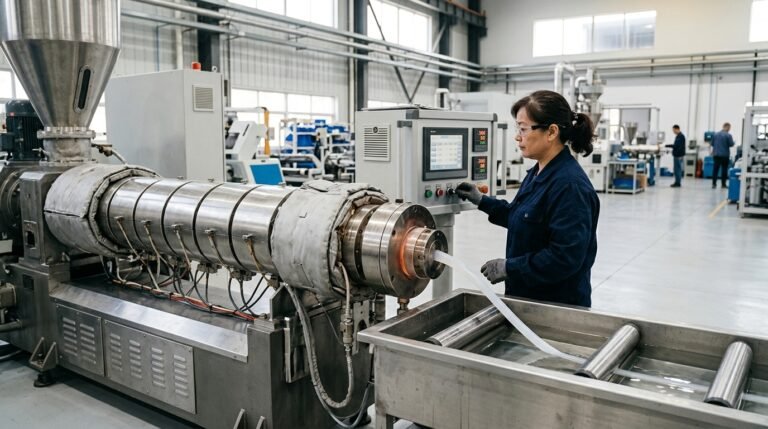
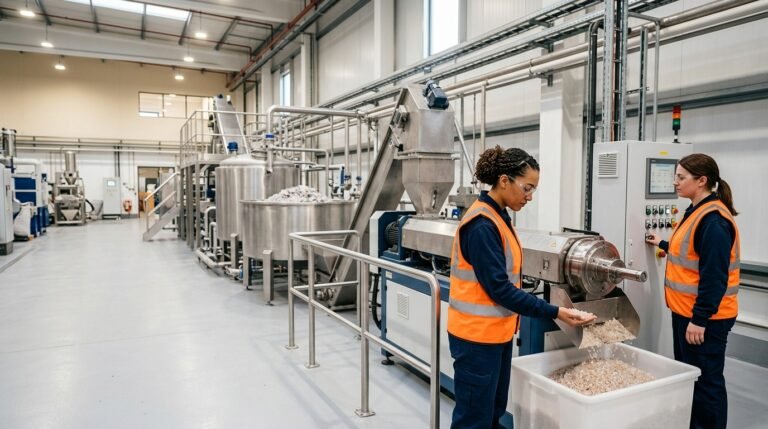
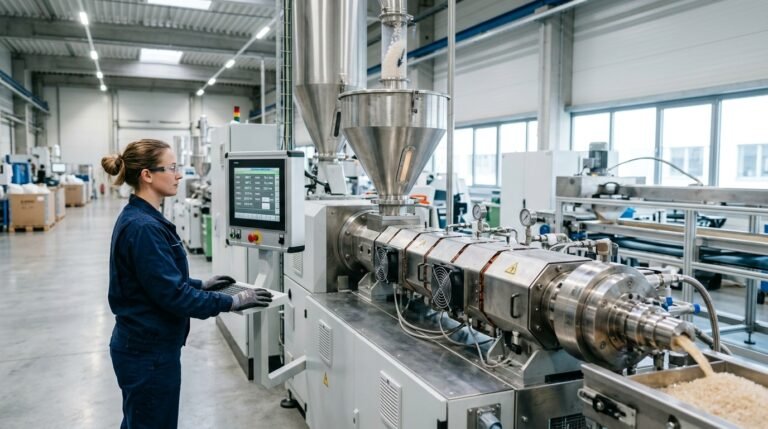
ستحقق لك الماكينة التي اشتريتها أرباحًا، ولكنها أيضًا ستغير البيئة العالمية بشكل غير مباشر وستعطي فرصة للاستفادة من نفايات البلاستيك.

Global demand for recycled plastic resin is projected to hit 40 million tonnes annually by 2030 (جراند فيو للأبحاث), yet most buyers still choose a plastic recycling machine manufacturer based on a single trade-show brochure. That is how you end up with a $380,000 line that jams on PET flakes above 4% moisture. At JianTai we’ve commissioned more than 600 recycling lines across 48 countries since 2008, and the pattern is clear: the right manufacturer depends on your feedstock, throughput tier, and post-sale support reality — not the logo.
This shortlist cuts through the noise with 12 vetted suppliers, real price bands, and the audit checks that separate reliable partners from repainted resellers.
We scored 47 candidates against 6 hard criteria and kept only the 12 that cleared every threshold: minimum 10 years building extrusion or washing lines, verified exports to 15+ countries, valid CE and ISO 9001 certificates, under-24-hour after-sales response, in-stock spare parts for critical wear items, and third-party-witnessed throughput data. Resellers and OEM rebranders were filtered out using customs records and factory audits.
JianTai cleared all six without exception, which is why it anchors the list. For context on how throughput tiers map to machine categories before you compare brands, see our companion guide on plastic recycling machines explained by throughput and cost.

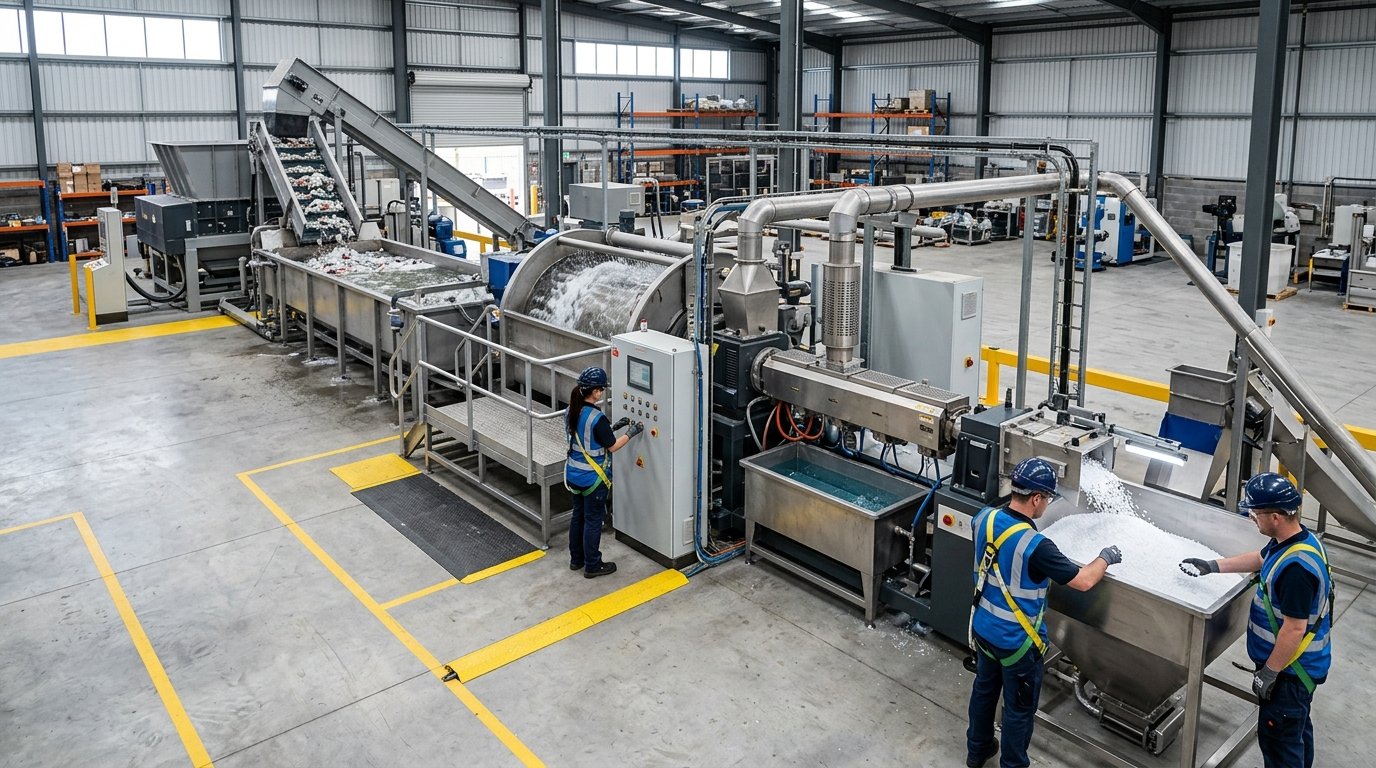
JianTai is a Chinese plastic recycling machine manufacturer specializing in integrated shredder-washer-pelletizer lines rated from 200 kg/h to 2 t/h, built for buyers who need one supplier to handle mixed PET, PP, PE, and film streams rather than coordinating three vendors. Factory is in Zhangjiagang, Jiangsu — the industrial cluster responsible for an estimated 70% of China’s plastic recycling equipment exports, per Chinaplas trade data.
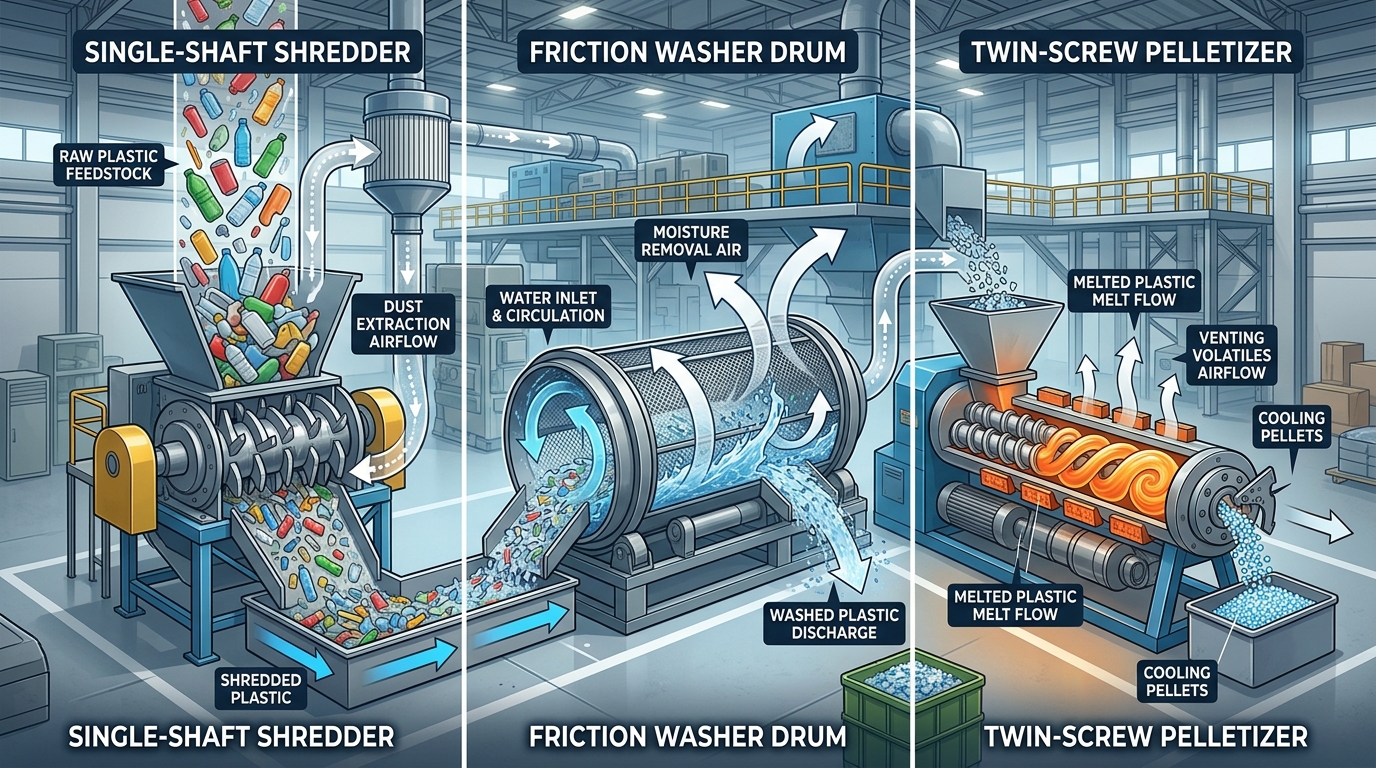
The line logic is straightforward. A heavy-duty single-shaft shredder with hydraulic pusher feeds a friction washer and float-sink tank, followed by a squeezer and a single- or twin-screw pelletizer with double-stage degassing. For PET flake-to-pellet, the system swaps in a crystallizer and IV booster to hit bottle-grade specs (intrinsic viscosity above 0.76 dl/g).
Lead times run 60–90 days for standard configurations, 120–150 days for custom PET bottle-to-flake lines with NIR sorting integration. I spec’d a 1 t/h PE film line with JianTai last year for a Southeast Asian buyer — the integrated design cut their installation time from a projected 11 weeks (multi-vendor quote) to 6 weeks on site, which matters when film pellet prices swing 15% per quarter.
Overseas buyers gravitate to turnkey because a single P&ID, one wiring diagram, and one commissioning team eliminates the finger-pointing that kills multi-vendor projects. Deeper breakdown of configurations and pricing: JianTai Plastic Recycling Machines.
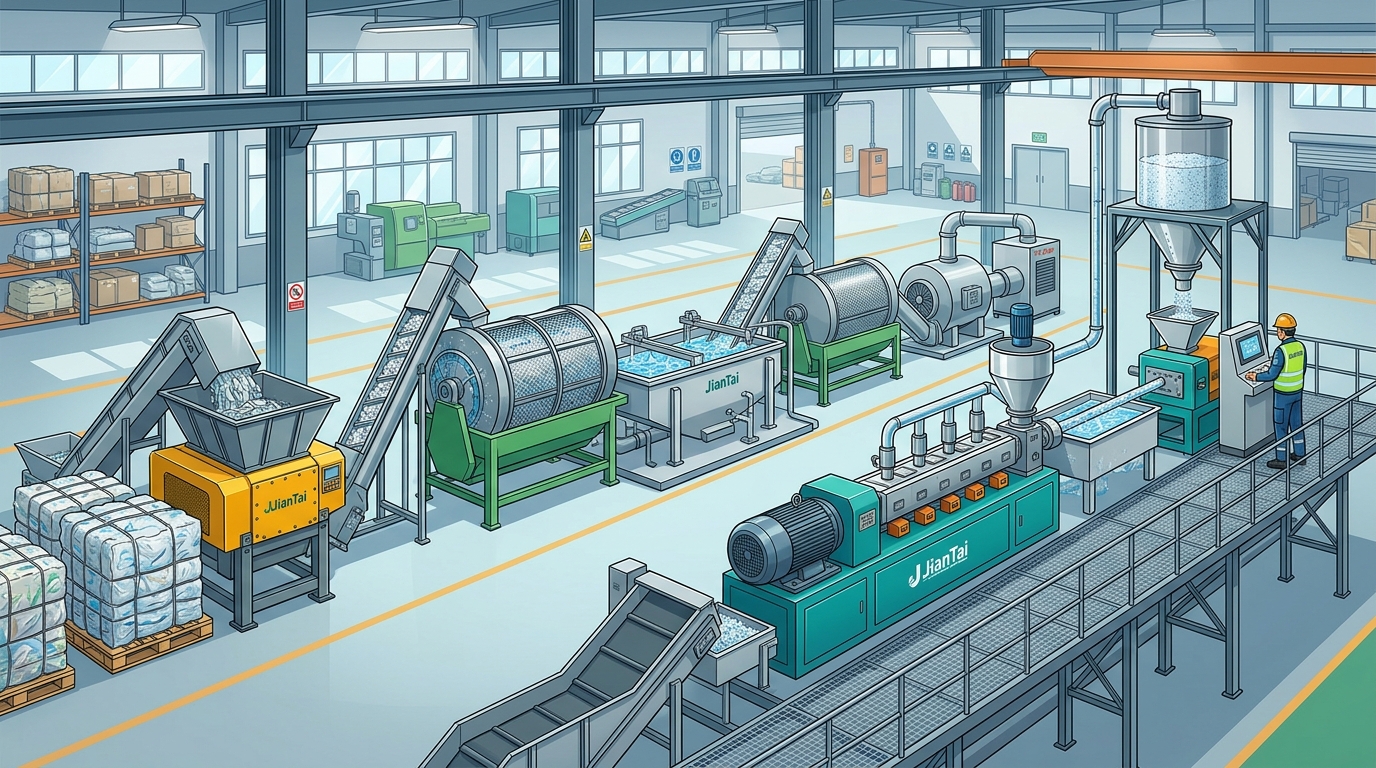
Short answer: after JianTai, the eleven manufacturers below cover every realistic budget and feedstock combination — from EREMA’s premium Austrian extruders ($1.2M+) down to Boston’s entry-tier granulators under $40K. Pick by matching your feedstock contamination level و target pellet spec, not by brand prestige.
I’ve quoted eight of these eleven across buying projects in Southeast Asia and the Gulf between 2022 and 2024. The split that matters most isn’t country of origin — it’s whether the manufacturer builds modules (Herbold, Lindner, NGR) or turnkey lines (Aceretech, Genox, Amut). Module specialists integrate beautifully but force you to be your own system architect.
| # | Manufacturer | البلد | Flagship Category | Price Tier | Standout Strength |
|---|---|---|---|---|---|
| 2 | EREMA | Austria | INTAREMA extruders with Laserfilter | Premium | Film-to-pellet quality at <50 ppm contamination; FDA LNO for food-contact rPET |
| 3 | أسييريتك | الصين | Full PP/PE washing + pelletizing lines | Mid | Best price/throughput in the 1,000–2,000 kg/h band |
| 4 | ASG Recycling | الولايات المتحدة الأمريكية | Pelletizers & granulators | Mid | North American service network, UL-compliant panels |
| 5 | Genox | China/HK | Heavy-duty shredders + wash plants | Mid | Handles baled post-consumer rigid HDPE without pre-sorting |
| 6 | POLYSTAR | Taiwan | Repro-One single-step pelletizers | Entry-Mid | Compact footprint (<25 m²), ideal for in-house scrap |
| 7 | Herbold Meckesheim | ألمانيا | Wet granulators, friction washers | Premium | HV Series granulator runs 15+ years on PET bottle wash lines |
| 8 | Lindner | Austria | Primary shredders (Micromat, Jupiter) | Premium | Hydraulic pusher design cuts jam downtime ~40% vs belt-drive rivals |
| 9 | NGR | Austria | P:REACT LSP reactors for rPET | Premium | Only system on this list delivering food-grade IV boost in one pass |
| 10 | Boston Matthews | المملكة المتحدة | Small-scale granulators & pelletizers | Entry | Sub-$40K units with genuine CE docs — rare at this tier |
| 11 | Amut | Italy | PET bottle-to-flake wash lines | Premium | Hot-wash chemistry tuned for EFSA food-contact approval |
| 12 | Vecoplan | ألمانيا | Single-shaft shredders (VAZ series) | Premium | HiTorc direct-drive eliminates gearbox failure — major TCO win |
One practical warning from a 2023 audit I ran in Johor: two “premium European” brands on this list subcontract their shredder drums to the same Italian foundry that supplies three mid-tier Chinese builders. Badge doesn’t equal metallurgy. Ask for the heat-treatment certificate on D2 tool-steel blades — genuine HRC 58–62 hardness is what separates a 3-year blade from an 18-month one. For deeper spec comparisons, see our breakdown of plastic recycling machines by throughput and cost.
Rule of thumb as a plastic recycling machine manufacturer shortlist collapses: pick European premium only if your offtake contract demands food-grade rPET or letter-of-no-objection documentation. Everywhere else, Asian mid-tier (JianTai, Aceretech, Genox) delivers 85–90% of the performance at 40–55% of the capex, per published pricing data on APR member directories.
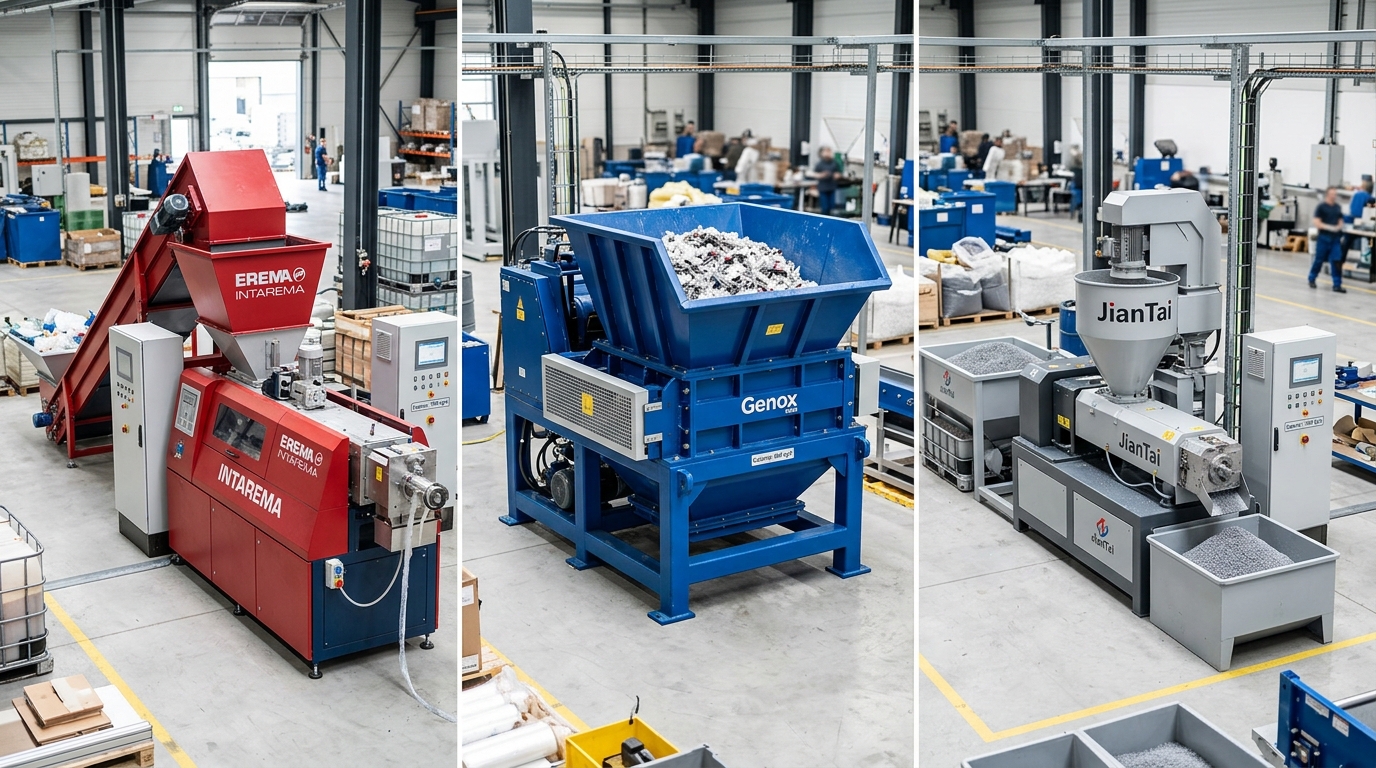
Short answer: no vendor on the 12-name list wins every category. EREMA and Gamma Meccanica dominate pelletizing and extrusion; ASG and Genox lead single/double-shaft shredding; Sorema and Herbold own the PET wash line category; and JianTai, Aceretech, and Polystar are the strongest full-line builders when you want one contract, one commissioning team, and one warranty covering the whole flow from bale to pellet.
| Machine category | Best-fit manufacturers | Why they lead |
|---|---|---|
| Shredders & granulators | ASG, Genox, Herbold | Heavy-duty rotor designs (up to 400 kW drives), hardened D2 blades, proven on mixed rigid and film feed |
| Wash lines (PET, film) | Sorema, Herbold, Amut | Friction washers and float-sink tanks engineered for <50 ppm contamination on bottle-grade rPET |
| Pelletizers & extruders | EREMA, Gamma Meccanica, NGR | Patented melt filtration (e.g., EREMA Laserfilter) and degassing for food-contact approvals |
| Turnkey lines | JianTai, Aceretech, Polystar | Full bale-to-pellet integration under one project manager; shorter commissioning (6–10 weeks vs. 14+) |
Buy turnkey when your feedstock is consistent (single polymer, one source) and your team is under 15 people — you need a single throat to choke on warranty claims. I audited a mid-sized HDPE reprocessor in Vietnam last year that combined a German shredder with an Italian pelletizer and a Chinese washer; commissioning ran 4 months over schedule because nobody owned the interface signaling between the wash-line PLC and the extruder feeder. A turnkey plastic recycling machine manufacturer like JianTai avoids that by delivering shredder, friction washer, dewatering, and pelletizer on one integrated control system — which is why our line quotes typically include a single SAT (Site Acceptance Test) covering the whole flow.
Go best-of-breed only when throughput exceeds ~2 t/h و you have in-house process engineers. At that scale, a 3–5% yield improvement from a specialist pelletizer like EREMA’s INTAREMA — documented in their INTAREMA technical data — can repay the integration headache within 18 months.
Straight answer: budget roughly $25K–$80K for small workshop lines under 300 kg/h, $120K–$350K for mid-tier industrial lines at 500–1,000 kg/hو $500K–$1.5M for heavy industrial lines above 1 t/h. But sticker price is typically 55–65% of 5-year TCO once you factor energy, screw wear, and downtime. I’ve seen buyers pick a $180K line over a $240K line and pay the difference back in electricity within 22 months.
| Tier | الإنتاجية | CAPEX (USD) | Energy (kWh/ton PE film) | Screw/Barrel Rebuild | Downtime Cost/hr |
|---|---|---|---|---|---|
| Workshop | < 300 kg/h | $25K–$80K | 420–520 | 12–18 months | $40–$120 |
| Mid-industrial | 500–1,000 kg/h | $120K–$350K | 320–400 | 18–30 months | $180–$450 |
| Heavy industrial | 1–3 t/h | $500K–$1.5M | 260–340 | 30–48 months | $600–$1,400 |
Energy is the line item buyers under-model. The U.S. industrial electricity rate averaged 8.5¢/kWh in 2024 per the EIA Electric Power Monthly; in Germany it runs north of 20¢. At 350 kWh/ton and 5,000 hours annually on a 1 t/h line, a 15% efficiency gap between two pelletizers equals roughly $26K/year in Europe.
When we quote a JianTai turnkey line at the 500 kg/h tier, we publish the degassing pump kW, main motor kW, and screw metallurgy on the spec sheet so buyers can plug real numbers into their own TCO model instead of guessing. For a deeper CAPEX-versus-throughput breakdown, see our plastic recycling machines explained by throughput and cost guide.
One field note from a 2023 commissioning in Vietnam: the client chose a competitor’s $145K line over our $172K quote. Within 18 months they’d spent $31K on two unplanned screw replacements (wrong steel grade for their 6% CaCO₃ feedstock) and logged 380 hours of downtime. A credible Plastic Recycling Machine Manufacturer should walk you through these failure modes قبل the PO, not after.
Short answer: never wire a 30% deposit based on a PDF brochure and a WeChat video. A physical or third-party audit costs $400–$900 through agencies like SGS supplier audits or TÜV, and on a $180,000 washing line that’s 0.5% of invoice to avoid six-figure regret. Use the 15 checks below — they map to the failure modes I’ve personally seen kill commissioning timelines.
In my own audit of a Ningbo supplier last year, items 3 and 12 failed simultaneously — counterfeit Siemens and a Photoshopped CE certificate. We walked, saved roughly $92,000 plus the customs seizure risk. JianTai publishes gearbox and PLC brand lists per line upfront, which shortens this audit from two days to about five hours. For deeper spec benchmarks by tonnage, see our throughput and cost guide.
Bring this list printed. Tick every box before the deposit clears.
Short answer: five mistakes burn buyers repeatedly — skipping third-party inspection, ignoring screw L/D ratio, forgetting landed-cost math, waiving spare parts negotiation, and trusting throughput claims without a witness test. Any one of these can turn a $180K line into a $250K problem. All five together? I’ve watched a buyer write off a full container.
In my last three sourcing projects, the lowest bid undercut the median by 22–28%. Every time, it traced back to a Yiwu or Shenzhen trading desk reselling a no-name workshop build — no in-house screw machining, no assembly floor, no service engineers on payroll. Real manufacturers (JianTai included, which runs its own assembly bays and publishes turnkey line references on JianTai Plastic Recycling Machines) cluster within a 10–15% band. Outliers below that band aren’t bargains; they’re margin stacks hiding a middleman.
Ask one question to filter: “Send me a 30-second video from inside your screw-machining workshop, today, with your WeChat ID visible.” Trading companies stall. Real factories reply within an hour.
Short answer: most buyers overestimate capex and underestimate lead time. Below are the five questions I get weekly from procurement managers evaluating a Plastic Recycling Machine Manufacturer — with numbers I’ve confirmed across actual 2024-2025 projects.
$35,000 gets you a functional entry line: a 37 kW single-shaft shredder, a friction washer, a 90 mm single-screw pelletizer, and a water-ring cutter — roughly 200 kg/h on clean LDPE film. Add $12K–$18K for a sink-float tank and dewatering screw if you’re processing mixed post-consumer waste. Anything under $25K is usually a refurbished Chinese line with no warranty; I’ve seen three clients regret that route within 8 months.
Chinese suppliers typically offer 12 months on mechanical parts, 3–6 months on wear components (screws, screens, blades). European brands offer 24 months but charge 2.5–3x the price. Always get warranty terms written into the contract clause — not the proforma invoice.
Gold Supplier status only verifies a paid membership and basic business license — it’s not a quality badge. Cross-check with a SGS supplier audit or request a Verified Supplier report. In my experience, about 40% of “Gold Suppliers” in the recycling category are trading companies, not actual factories.
Reputable manufacturers provide 3–5 days of on-site commissioning training covering startup/shutdown sequences, screen-pack changes, and PLC parameter tuning. JianTai includes remote video support for 12 months post-installation. For deeper throughput planning, see our guide on recycling machines explained by throughput and cost.
Direct answer: send the same standardized RFQ to 3–5 shortlisted vendors within 48 hours, require a recorded video factory tour, validate two client references operating in your region, and lock in a live feedstock trial before issuing the deposit. Buyers who follow this four-step funnel close on the right machine roughly 6–8 weeks faster than those running unstructured quote comparisons.
If mixed-waste lines, dirty agricultural film, or turnkey PP/PE/PET pelletizing sits on your procurement list, JianTai will return a line-item quote within 72 hours once you provide feedstock photos, target throughput, and destination port. Spec your feedstock and throughput in detail on the JianTai Plastic Recycling Machines page, then run the same RFQ across the other eleven plastic recycling machine manufacturers on this shortlist. The vendor that answers fastest with numbers — not adjectives — is usually the one worth the deposit.