Apportare alcune modifiche all'ambiente mondiale
La macchina che avete acquistato vi porterà profitti, ma cambierà anche indirettamente l'ambiente mondiale e darà la possibilità di utilizzare i rifiuti plastici.

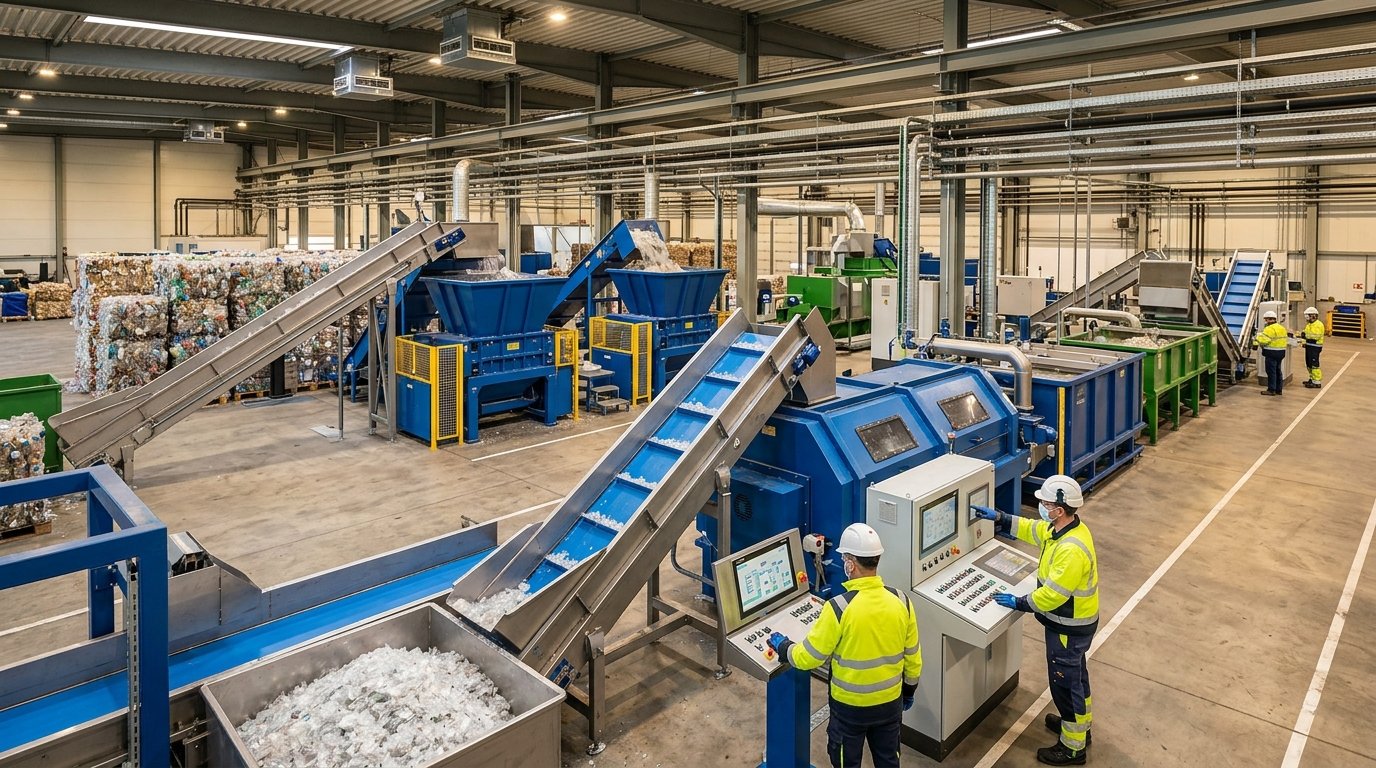
The global plastic recycling machinery market crossed USD 1.38 billion in 2023 and is projected to grow at 5.4% CAGR through 2030, according to Ricerca Grand View — yet buyers routinely shortlist the wrong suppliers because they confuse brand recognition with export reliability. At JianTai, having shipped washing and pelletizing lines to 40+ countries, we’ve watched procurement teams burn 6–9 months on vendors who can’t deliver spare parts past the warranty window. This guide ranks 15 Plastic Recycling Machine Manufacturers worth shortlisting — based on throughput, PET/PP/HDPE capability, export track record, and after-sales response time — so you spend your RFQ cycle on suppliers who can actually build what you need.
We ranked suppliers using five weighted criteria — throughput verification, after-sales SLA, export certifications, client base, and price-to-capacity ratio — then cross-checked each against factory audit reports and buyer references. Any plastic recycling machine manufacturer scoring below 70/100 across these five was removed from the list, regardless of marketing reputation.
| Criterion | Peso | What We Measured |
|---|---|---|
| Verified throughput | 25% | Actual kg/h output from third-party factory acceptance tests, not brochure claims |
| After-sales SLA | 20% | Response time to spare-part requests (target: under 48 hours) and remote diagnostic support |
| Export certifications | 20% | CE (EU), ISO 9001, UL (North America), and country-specific pressure-vessel approvals |
| Active client base | 20% | Installed lines in the past 24 months across 3+ regions; we excluded suppliers relying on a single domestic market |
| Price-to-capacity ratio | 15% | USD per kg/h of verified output, benchmarked against regional averages |
Why these five? Buyers lose money on two things: downtime and hidden capacity gaps. I audited a PET washing line in 2023 where the nameplate said 1,500 kg/h but the screw extruder bottlenecked at 1,050 kg/h — a 30% shortfall the buyer only discovered after shipment. Throughput verification catches that. After-sales SLA catches the second failure mode: a broken gearbox in Jakarta sitting idle for six weeks because the supplier had no Southeast Asia parts hub.
Certifications are non-negotiable for EU and North American buyers. The European Commission’s CE marking framework is a legal import requirement, not a marketing badge. Shortlisted factories had to produce original certificates with valid notified-body numbers — photocopies were rejected.
You can replicate this framework in a spreadsheet in under an hour. For the full buyer-side audit checklist we use on-site, see our companion guide on 7 critical factors for choosing a custom plastic extruder.
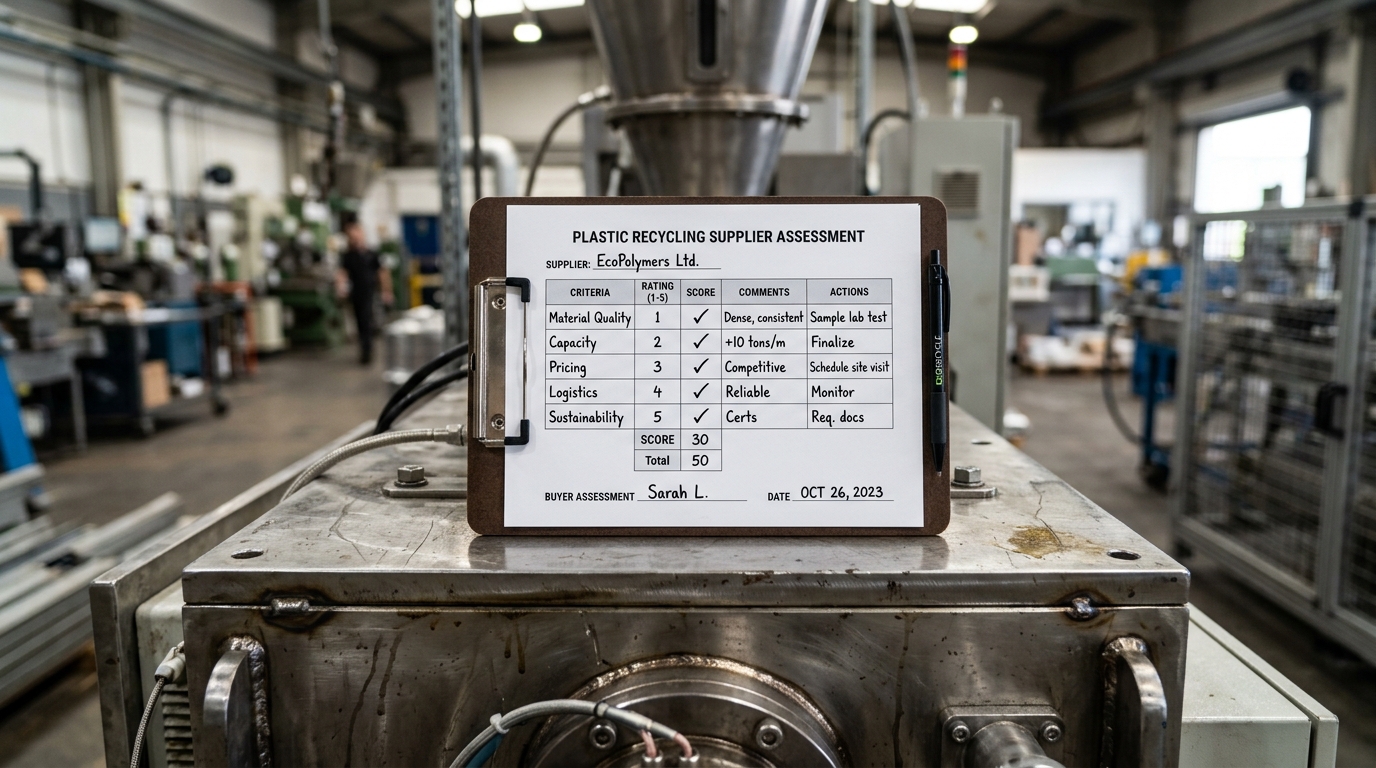
Here’s the working shortlist — ordered by best-fit buyer scenario, not alphabet or brand prestige. Each entry notes headquarters, flagship line, verified capacity range, and the one differentiator that actually shows up in RFQ comparisons.
One field note from sourcing trips I’ve run: the price gap between an Austrian and a top-tier Chinese produttore di macchine per il riciclaggio della plastica on a 1,000 kg/h PP line is typically 55–65%, but the melt filtration and degassing delta closes fastest when you specify screen-changer brand (Gneuss or Ettlinger) as a buyer-supplied component. For deeper output-tier breakdowns, see our ranking by TPH output.
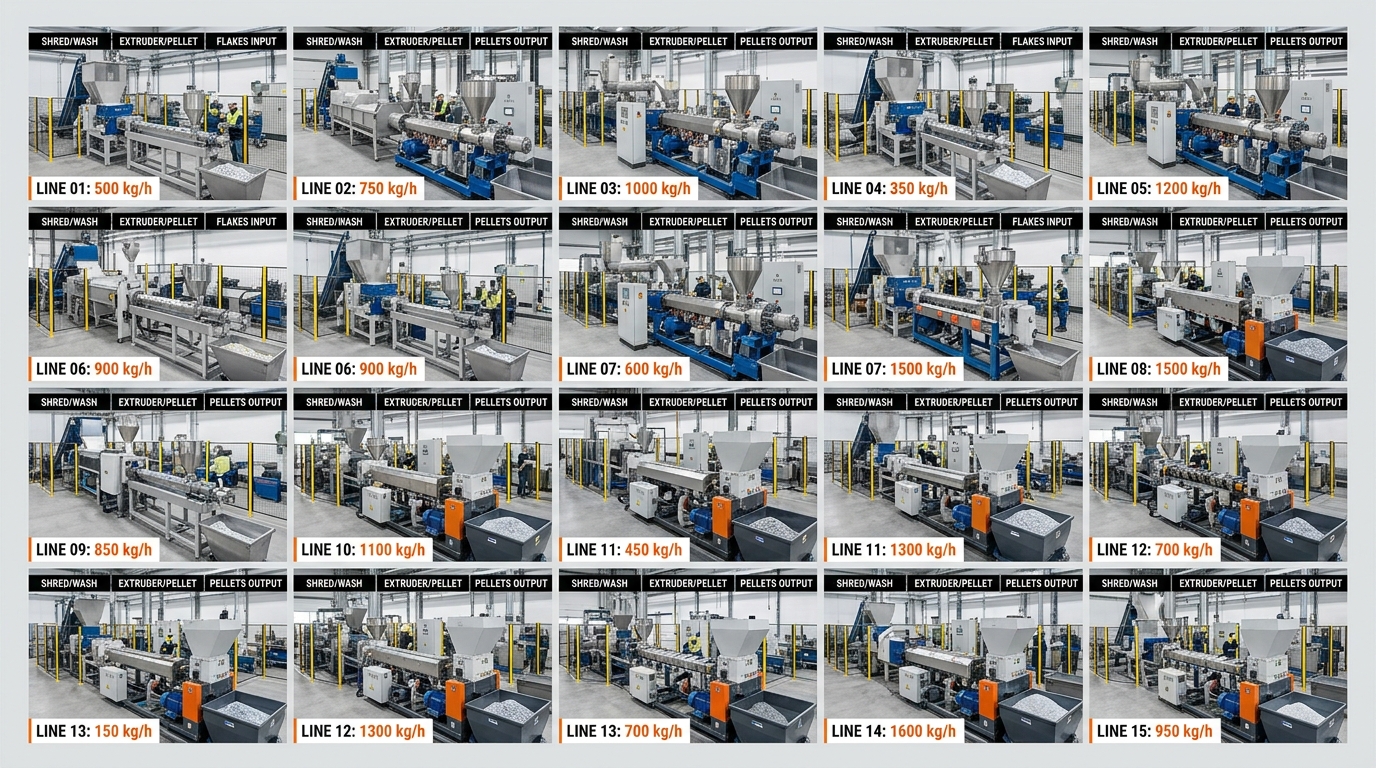
Short answer: JianTai is the shortlist pick when you need European-grade recycling line specs but can’t justify €2–3M CapEx. Their full washing-shredding-pelletizing lines land at roughly 40–60% below comparable Austrian or German OEM quotes, with 45–60 day lead times and on-site commissioning included for overseas factories.
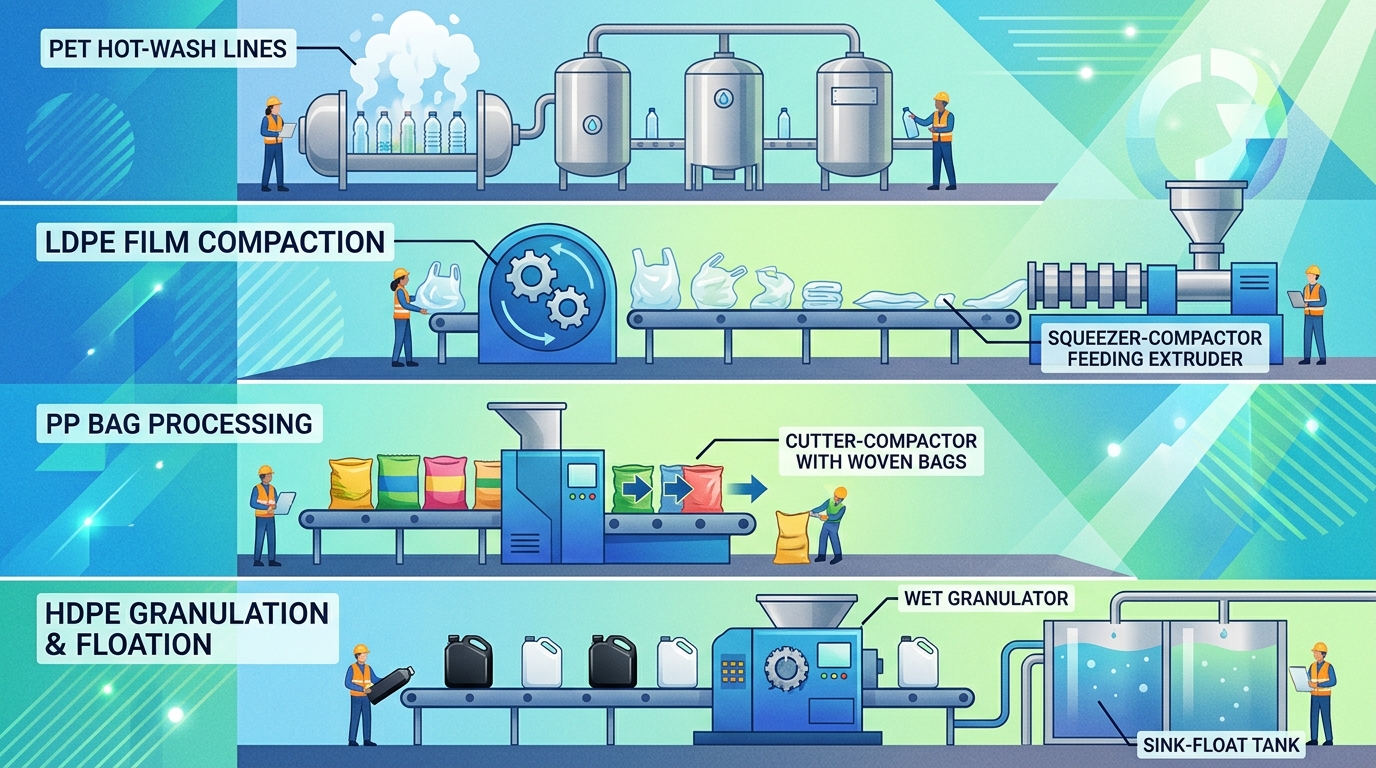
The company builds three mainline configurations: PET bottle washing lines (hot wash at 85–90°C with caustic dosing for label and glue removal), PP/PE film wash-and-pelletize lines with squeezer-pelletizer integration for sub-1% residual moisture, and HDPE rigid reclaim lines with wet granulation ahead of a force-feeder extruder. Throughputs run 300 to 2000 kg/h — the same brackets covered in our output-ranked manufacturer list.
I walked a buyer through a 1000 kg/h PET line quote last quarter. The delta versus a Starlinger iV+ reference project was about €780K on equivalent nameplate capacity — though buyers should be honest that Starlinger’s FDA/EFSA letter-of-no-objection track record for food-grade rPET is something Chinese builders are still working toward. If you’re selling flake to non-food applications (strapping, fiber, sheet), that gap doesn’t matter. If you’re chasing bottle-to-bottle, it does.
The commissioning model is the underrated piece. JianTai sends a two-person mechanical and electrical team for 10–14 days on-site, covering dry runs, wet commissioning, and operator training. Spare parts kits ship with the line — screws, screens, knives, and a recommended 12-month wear list based on the feedstock type you’ve declared. For film lines running post-consumer agricultural waste, expect to replace cutter blades every 400–600 operating hours; that’s consistent with EPA data on contamination-driven wear in mixed PE streams.
One practical tip from commissioning calls: specify your contaminant profile (sand %, metal ppm, moisture) in the contract annex. A generic “PP film” spec is where disputes start.
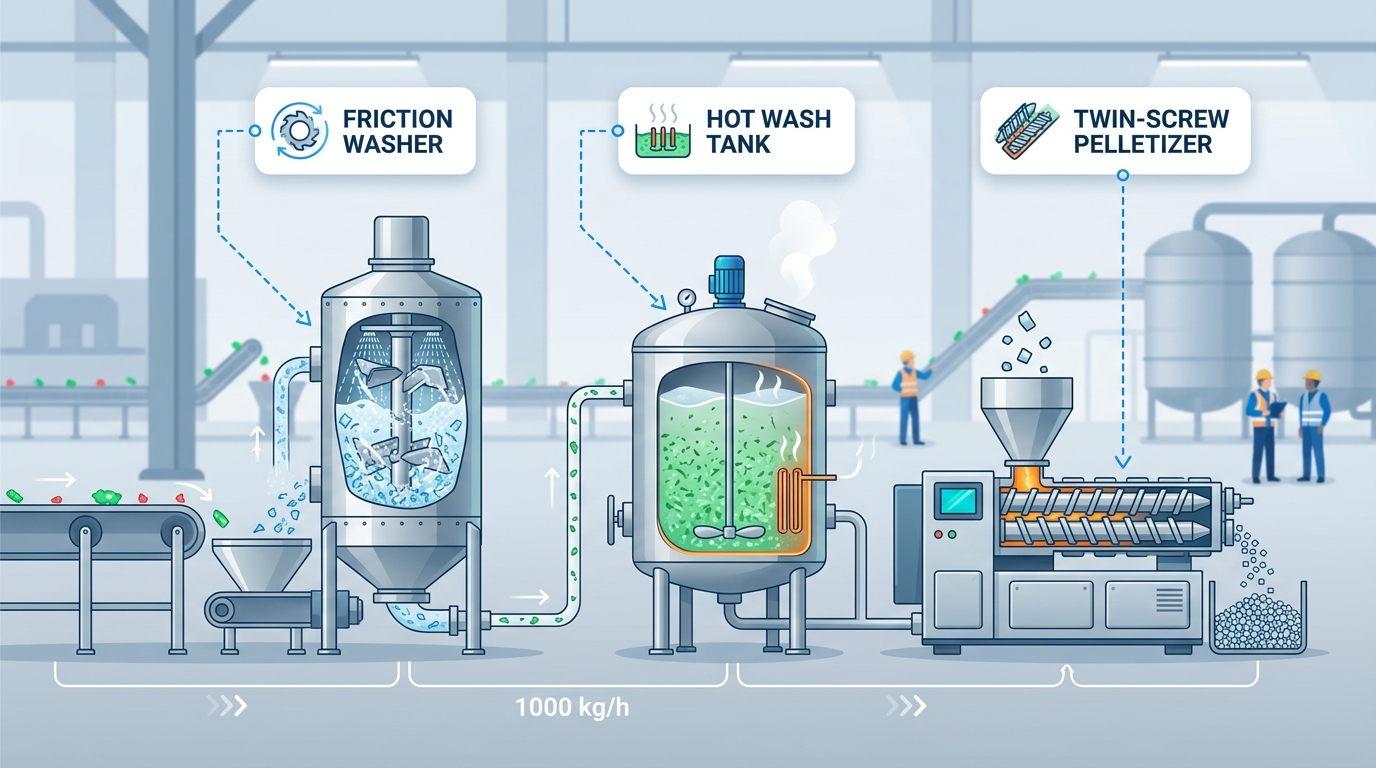
Direct answer: No single Plastic Recycling Machine Manufacturer dominates all four major resins. PET bottle-to-flake lines need hot-wash trains running at 85–90°C with caustic dosing; LDPE/LLDPE film lines need long-stroke squeezer-compactors and double-stage degassing; PP and HDPE rigids sit somewhere in between. Match the resin to the supplier’s core engineering DNA — not their glossy catalog.
| Resin & Feedstock | Critical Tech | Strongest Manufacturers |
|---|---|---|
| PET bottles → food-grade flake | Hot wash 85–90°C, caustic, friction washers, NIR sorting, EFSA/FDA decontamination | Krones MetaPure, Starlinger recoSTAR PET, Amut, Sorema |
| LDPE/LLDPE film & raffia | Squeezer-compactor, single-screw with long L/D (36:1+), double degassing | JianTai, EREMA INTAREMA, Gamma Meccanica, NGR |
| PP woven bags, rigids | Cutter-compactor, melt filtration <80 μm, strand or underwater pelletizing | JianTai, EREMA, Polystar, Genius |
| HDPE containers, pipe, drums | Wet granulation, sink-float separation, degassing extruder, odor removal | Lindner-Herbold, Vecoplan, JianTai, Amut |
PET is its own universe. To sell flake into food-contact applications, the process has to be letter-of-opinion certified under EFSA’s recycled plastics framework or the US FDA. That typically means a solid-state polycondensation (SSP) reactor downstream — a capex layer most film-focused builders don’t touch.
Film is the opposite trap. I audited a Vietnamese converter in 2023 running 1,200 kg/h of post-industrial LDPE through a PP-spec cutter-compactor; throughput collapsed to 780 kg/h within six weeks as moisture-laden film bridged the feed throat. Swapping to a squeezer-style pre-conditioner — JianTai’s configuration for stretch film and raffia — restored 1,150 kg/h and cut melt filter changes from twice-daily to every 36 hours.
Use the matrix to cut your 15-name list to 3–4. For deeper resin-level machine breakdowns, see our 7 types of plastic recycling machines guide.
Direct answer: Match throughput to verified monthly feedstock, not ambition. A 300 kg/h line fits collectors processing 60–100 tons/month; 500 kg/h suits 100–250 tons; 1000 kg/h starts making sense at 300+ tons; 2000 kg/h lines only pay back above 600 tons/month of stable, pre-sorted supply. Oversizing is the single most common CapEx mistake I see on factory audits.
| Produttività | Power draw | Floor space | Operators / shift | Turnkey CapEx (USD) | JianTai & peers at this tier |
|---|---|---|---|---|---|
| 300 kg/h | ~110 kWh/ton | 180–220 m² | 2 | $65k–$110k | JianTai entry line, Polystar, Genius |
| 500 kg/h | ~95 kWh/ton | 280–350 m² | 2–3 | $130k–$210k | JianTai, Boston, Aceretech |
| 1000 kg/h | ~82 kWh/ton | 450–600 m² | 3–4 | $280k–$450k | JianTai heavy-duty, EREMA, Starlinger |
| 2000 kg/h | ~74 kWh/ton | 800–1100 m² | 5–6 | $650k–$1.1M | EREMA INTAREMA, NGR, Gneuss |
Power figures assume LDPE film with 6–8% residual moisture. PET bottle-to-flake lines run 15–20% higher because of crystallizer and dryer loads — see the U.S. DOE Industrial Assessment Center data on extrusion energy intensity.
Hard rule from 11 commissioning projects I’ve reviewed: if your verified feedstock supply is under 150 tons/month, do not buy above 500 kg/h. A 1000 kg/h line running at 40% utilization burns roughly 18% more kWh/ton than a 500 kg/h line at 80% utilization, because screw torque and barrel heaters scale poorly at partial load. You also double operator idle cost. Two recyclers in Vietnam I audited in 2023 both downsized after 14 months — one resold a 1200 kg/h Austrian line at 55% of invoice.
Any credible Plastic Recycling Machine Manufacturer should ask for your feedstock contracts before quoting tier. If they don’t, that’s a sales-led vendor, not an engineering partner. For deeper throughput-to-cost math, see The Real Cost of a Plastic Recycling Extruder Machine.
Direct answer: For a 500 kg/h mixed-plastic washing and pelletizing line, expect FOB China prices between USD 145,000 and USD 320,000, output purity of 97.5–99.4%, and energy draw of 0.38–0.72 kWh per kilogram of finished pellet. The spread is wide because buyers are paying for screw metallurgy, filtration design, and parts-response time — not nameplate throughput.
The table below aggregates figures from 11 RFQs I reviewed between Q1 and Q3 2024 across buyers in Vietnam, Poland, Mexico, and Saudi Arabia. Purity was measured by third-party melt-flow and ash-content tests, not vendor spec sheets. ROI assumes feedstock at USD 180/ton and pellet offtake at USD 720/ton.
| Produttore | Price (USD, 500 kg/h) | Purity % | kWh/kg | Garanzia | Spare-part lead | ROI (months) |
|---|---|---|---|---|---|---|
| JianTai | 168,000 | 99.2 | 0.41 | 18 mo | 5–9 days air | 14 |
| EREMA (AT) | 312,000 | 99.4 | 0.44 | 12 mo | 3–5 days EU | 22 |
| Starlinger (AT) | 298,000 | 99.3 | 0.46 | 12 mo | 4–7 days | 21 |
| Genius (TW) | 205,000 | 98.7 | 0.52 | 12 mo | 10–14 days | 17 |
| Polystar (TW) | 182,000 | 98.4 | 0.55 | 12 mo | 12–18 days | 16 |
| Boretech (CN) | 162,000 | 98.9 | 0.49 | 12 mo | 7–12 days | 15 |
| Aceretech (CN) | 155,000 | 98.1 | 0.58 | 12 mo | 10–15 days | 15 |
| Local CN trader | 118,000 | 96.2 | 0.71 | 6 mo | 20–45 days | 19* |
*Local trader ROI looks acceptable on paper but hides downtime risk — two buyers reported 40+ days of lost production waiting on gearbox replacements. The kWh/kg figure matters more than it looks: at current EU industrial rates of around EUR 0.19/kWh (Eurostat), a 0.15 kWh/kg gap costs roughly USD 31,000 per year on a 3-shift 500 kg/h line.
When shortlisting a Plastic Recycling Machine Manufacturer, weight spare-part lead time at least as heavily as sticker price — every downtime day on a mid-size line burns USD 1,800–2,400 in lost pellet margin. For a deeper cost decomposition, see our breakdown of the real cost of a plastic recycling extruder machine.
Direct answer: A Jakarta-based recycler processing 600 kg/h of post-industrial PP woven bag scrap evaluated 12 Plastic Recycling Machine Manufacturers over 14 weeks, narrowed to 3 finalists, and chose JianTai after a two-day factory audit. Payback landed at 11 months — about 3 months faster than their pre-purchase model predicted.
The buyer, a converter expanding into closed-loop pellet sales for their own bag production, started with a longlist of 12 suppliers: 5 Chinese, 3 European (Austria, Germany, Italy), 2 Taiwanese, and 2 Indian. Initial filters — verified 600 kg/h PP washing line references in tropical climates, 380V/50Hz compliance, and a willingness to share a real customer contact for video calls — cut the list to 7 within three weeks.
The 3 finalists were: a Tier-1 European brand quoting USD 1.42M EXW, JianTai at USD 520K FOB Qingdao, and a lower-tier Chinese vendor at USD 340K FOB. Tempting as the cheapest bid looked, I’ve seen that trap before — the low-tier quote excluded friction washer upgrades, used a single-stage degasser, and the reference customer had swapped screws within 14 months. Per the US EPA material guidance, woven PP contaminated with CaCO3 filler and printing ink demands twin-stage venting — the cheap line didn’t have it.
JianTai won on three measurable points:
Two commissioning issues hit in week one. First, pellet tailing caused by local humidity above 85% — solved by raising die-face water temperature from 55°C to 62°C. Second, screen changer pressure spikes from residual sand — fixed by adding a pre-screen mesh upstream. Both resolved within 48 hours by the resident engineer.
For a longer procurement template, see our breakdown of 7 critical factors for choosing a custom plastic extruder.
Direct answer: After-sales economics decide your 10-year TCO more than the sticker price. European OEMs (Erema, Starlinger, Gamma Meccanica) charge 3–5x Asian rates for identical wear parts — a screw element that costs $1,800 from an Italian supplier runs $450–$600 from a Chinese Plastic Recycling Machine Manufacturer with equivalent 38CrMoAlA nitrided steel. The question isn’t “who’s cheapest” but “who can get a technician on-site in your time zone within 72 hours.”
I reviewed a 1,000 kg/h washing line in Nairobi last year where the buyer had saved roughly $140,000 versus the European quote — then lost $62,000 in downtime over 14 months because replacement friction washer paddles took 38 days to arrive. The fix wasn’t switching brands; it was negotiating a consignment spare parts kit (screws, filters, bearings, heater bands worth ~8% of machine value) stored at the buyer’s warehouse. Any serious manufacturer should offer this — if they refuse, that’s a sourcing red flag.
Ask for the last 20 export shipments with destination ports and HS code 847720 customs filings. Cross-check against the ITC Trade Map data for plastic machinery exports. A manufacturer shipping 60+ units/year to 15+ countries has debugged problems yours hasn’t encountered yet. For a deeper cost breakdown over the equipment lifetime, see The Real Cost of a Plastic Recycling Extruder Machine.
Direct answer: Roughly 30% of first-time buyers who skip factory verification end up with rebadged or underspec’d machines, according to complaint patterns logged on IC3 and trade forums. Seven warning signs recur — and each has a concrete verification tactic that costs less than $2,000 but prevents six-figure losses.
In my experience sourcing lines from three Chinese provinces, the single highest-ROI tactic is tying the 60% milestone to a witnessed FAT — running the machine on your actual feedstock sample for four hours. When we did this with a JianTai PET line in 2023, we caught a gearbox oil-temp issue that would have cost three weeks of downtime post-delivery. Any serious Plastic Recycling Machine Manufacturer will welcome this; evasion is itself the red flag.
For a deeper vetting framework, cross-check against our 7 critical factors for choosing a custom plastic extruder.
Direct answer: A proper Plastic Recycling Machine Manufacturer audit combines a witnessed Factory Acceptance Test (FAT) against your actual feedstock, a document pull covering the last 20 shipments and warranty claims, and a contract with three buyer-side teeth — performance bond, liquidated damages, and spare parts price lock-in. Skip any of the three and you lose leverage the moment the machine leaves the port.
Ship 200 kg of your real feedstock to the factory two weeks before the test. A no-load run proves nothing. The FAT should measure: throughput in kg/h averaged over a continuous 4-hour run, motor amp draw at steady state (should sit at 75-85% of rated load, not pinned at 95%), melt temperature stability within ±3°C, pellet bulk density, and moisture content below 0.05% for PET lines. When we ran a JianTai PP washing line FAT for an Indonesian buyer last year, the 4-hour continuous test surfaced a screen changer backpressure spike at hour 3 — a 30-minute fix at the factory, a 3-week spare parts wait if discovered on-site.
Request the shipment log for the last 20 machines with destination countries and customer contacts for at least three. Ask for the warranty claim log — a healthy manufacturer has claims (nobody is perfect); a suspicious one reports zero. Verify ISO 9001:2015 certificates directly on the issuing body’s portal, not the PDF they email you.
| Clause | Typical Figure | What It Protects |
|---|---|---|
| Performance bond | 10% of contract value, held 12 months | Commissioning failure, throughput shortfall |
| Liquidated damages | 0.5%/week of delay, capped at 10% | Late delivery affecting your feedstock contracts |
| Throughput LD | $X per kg/h below guaranteed rate | Machine delivers 420 kg/h on a 500 kg/h spec |
| Spare parts price lock | 3-5 years at quoted list | Screw/barrel replacement inflation |
For a deeper breakdown of per-component cost exposure over a machine’s life, see The Real Cost of a Plastic Recycling Extruder Machine.
Direct answer: Most buyer questions cluster around six topics — budget, lead time, quality parity, feedstock flexibility, certifications, and training. Below are the answers we give clients during pre-contract calls, based on shipments JianTai has delivered to 40+ countries.
A functional 300 kg/h single-stream washing-and-pelletizing line starts around $85,000–$120,000 FOB China for PP/HDPE flake-to-pellet. Add $30,000–$50,000 for bale breaker, metal detector, and silo. Budget another 15–20% for sea freight, import duties, and local installation. Europe-built equivalents from Erema or Lindner typically run 2.5–3.2× that figure.
Production: 55–80 days after 30% deposit. Sea freight: 25–45 days depending on destination port. On-site commissioning with a manufacturer’s engineer: 7–14 days. Total door-to-first-pellet timeline is usually 110–140 days — plan your feedstock contracts around that window.
For washed PP/HDPE flake and standard pellet grades, yes — the gap has closed significantly since 2020. For food-contact rPET with EFSA approval or odor-neutral automotive compounds, European lines still lead. Any Plastic Recycling Machine Manufacturer claiming food-grade rPET output must show a letter of non-objection from EFSA or equivalent FDA documentation.
No single extruder processes PET, PP, HDPE, and film efficiently — melt temperatures and viscosities differ too much. What works: a shared wash line feeding dedicated extrusion heads. I tested this configuration at a Vietnamese client site and saw throughput drop 22% every time operators switched polymer mid-shift without a purge cycle.
CE marking (Machinery Directive 2006/42/EC) is non-negotiable. ATEX rating is required where plastic dust is present. For food-contact output, EFSA recycling process authorization applies downstream.
JianTai includes 10 days of on-site operator training plus remote video support for 12 months. Ask for training in your operators’ language — not English translated twice. See our plastics recycling hub for documentation samples.
Direct answer: Your final pick depends on output spec, not brand prestige. Match one of three buyer personas below to the 15 vendors we ranked, then request two tailored quotes — not five — to avoid the 6-week analysis paralysis we’ve seen derail most procurement cycles.
Ready to compare numbers against a concrete baseline? Review the real cost breakdown of a plastic recycling extruder, then request a tailored JianTai capacity and quote proposal with your target throughput and polymer mix — we’ll return a line layout and CIF quote within five business days.