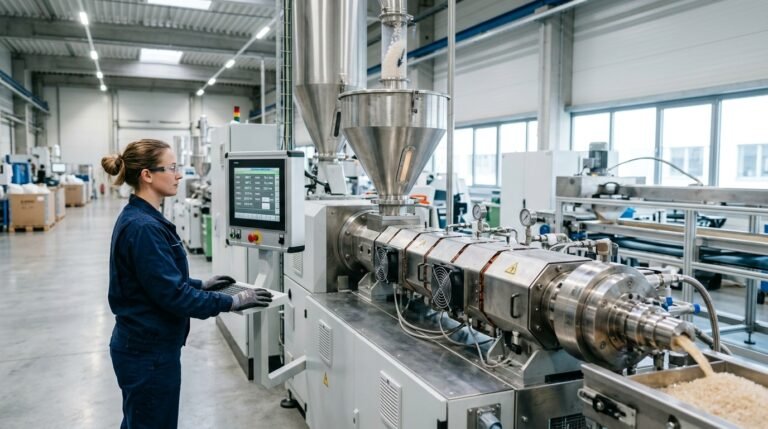
Apportare alcune modifiche all'ambiente mondiale
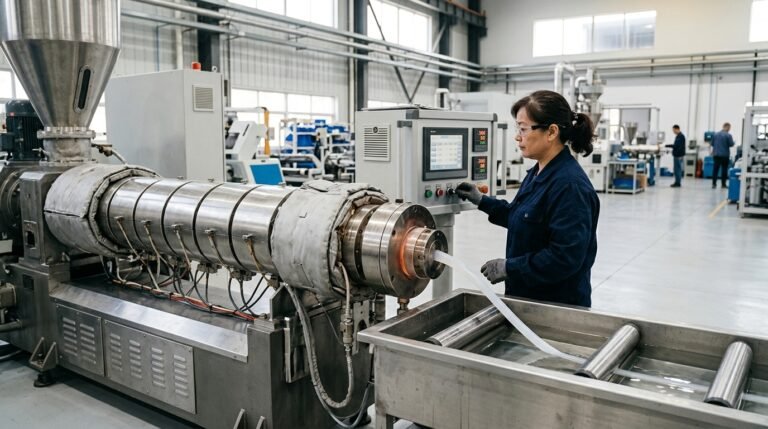
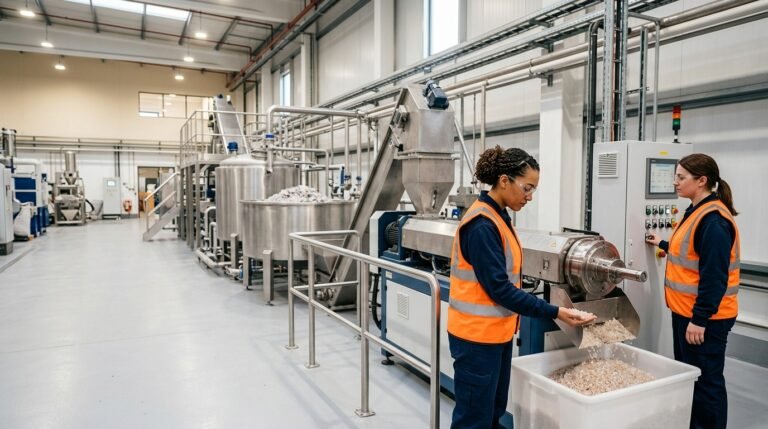
La macchina che avete acquistato vi porterà profitti, ma cambierà anche indirettamente l'ambiente mondiale e darà la possibilità di utilizzare i rifiuti plastici.

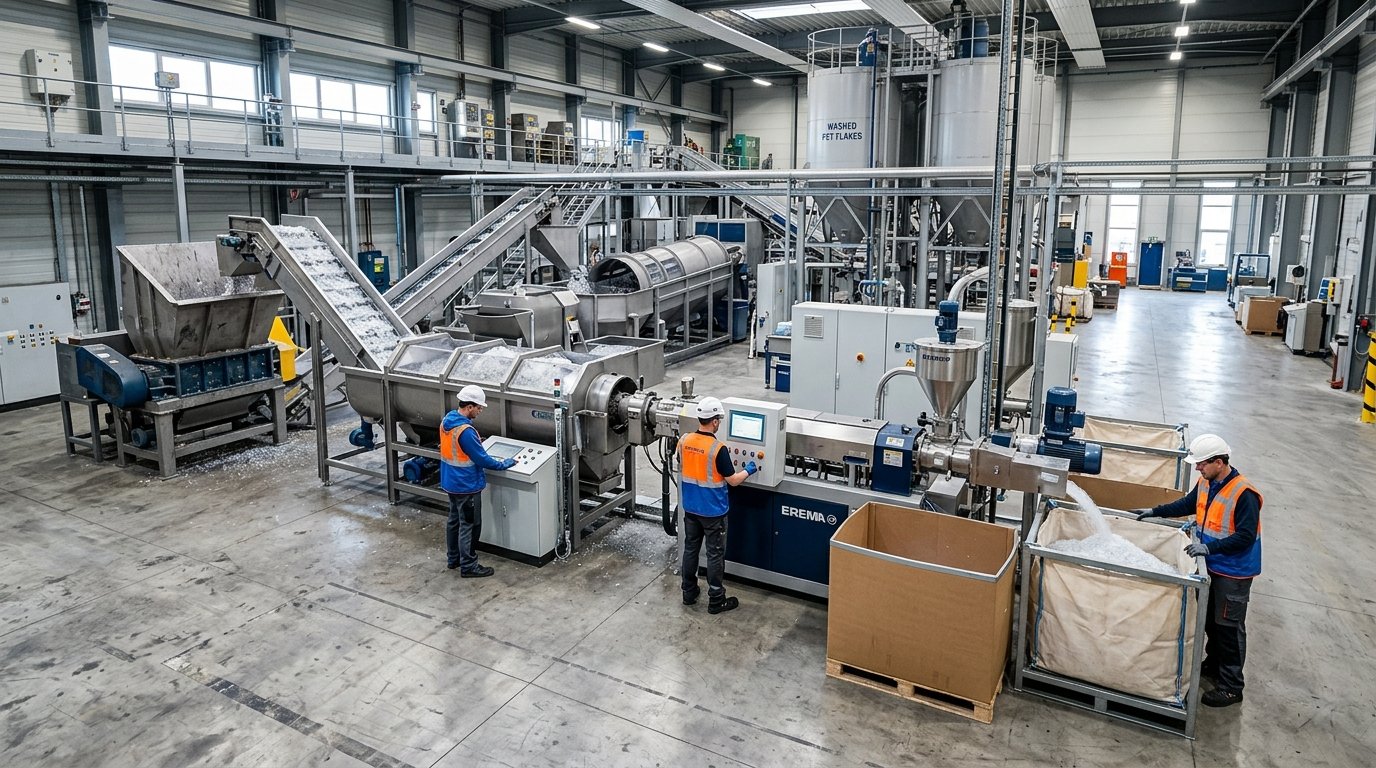
Global demand for recycled plastics is forecast to reach 60 million tonnes by 2030, yet fewer than 30 manufacturers worldwide can deliver a fully integrated washing-to-pelletizing line above 2,000 kg/h. That supply gap is exactly why picking the right Plastic Recycling Machine Manufacturer decides whether your capex pays back in 3 years or 8. At JianTai, after quoting more than 400 export projects across 56 countries, we’ve seen the same 12 names surface on buyer shortlists again and again — and the reasons have little to do with marketing and everything to do with uptime, resin yield, and spare-parts logistics.
Short on time? Here’s the shortlist buyers on three continents keep returning to in 2026 RFQs. The table below pairs each Macchina per il riciclaggio della plastica Fornitore with its sweet-spot machine, realistic throughput, and the buyer profile that actually gets ROI from that vendor.
| # | Produttore | Paese | Specialità | Produttività | Best For / Skip If |
|---|---|---|---|---|---|
| 1 | JianTai | Cina | Full PET/PP/PE washing lines + single-screw extruders | 500-3.000 kg/h | Best for mid-size recyclers needing turnkey lines at 40–60% of EU pricing. Skip if you need food-grade FDA letter of non-objection. |
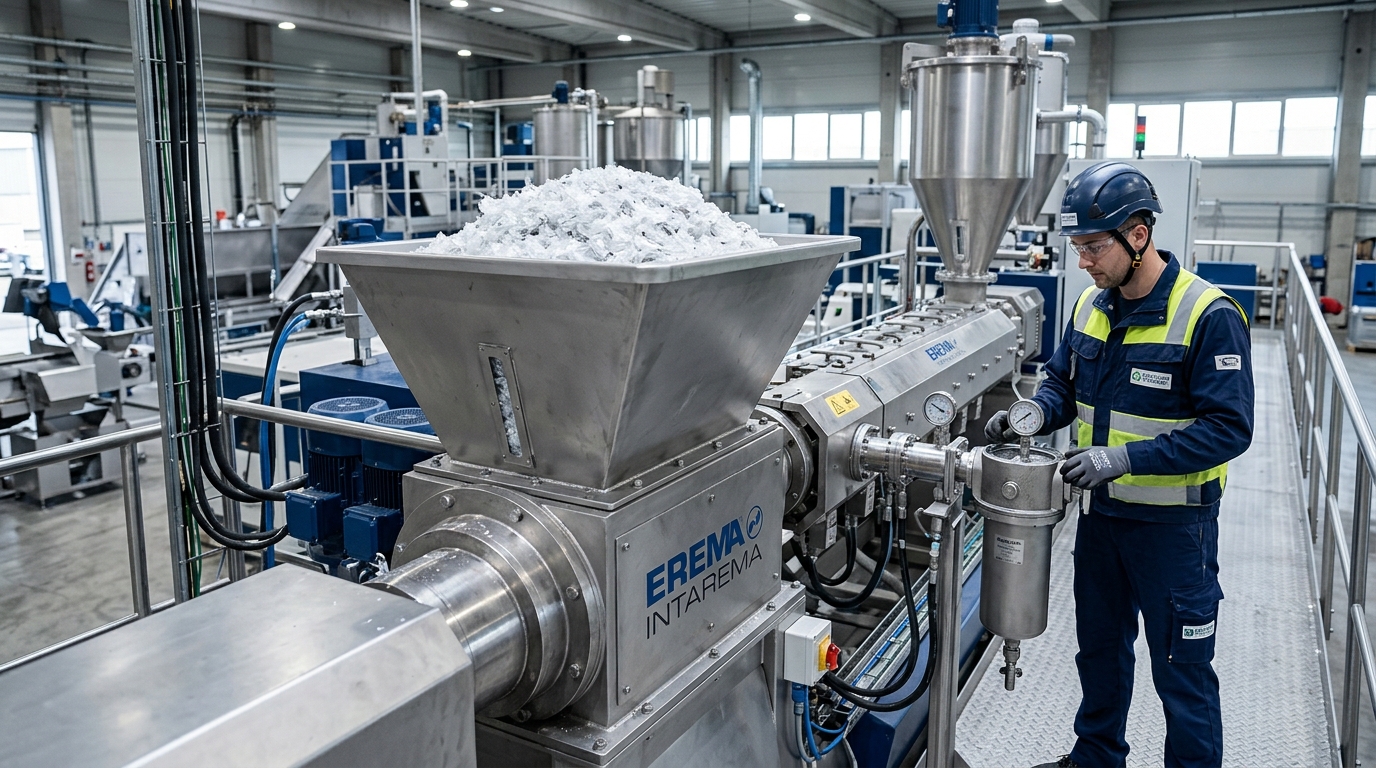
| 2 | EREMA | Austria | INTAREMA extruders, food-grade rPET | 300–6,000 kg/h | Brand-owner projects with FDA/EFSA needs. Skip if budget < $900K. |
| 3 | Starlinger | Austria | recoSTAR PET bottle-to-bottle | 500–3,500 kg/h | PET preform converters. Skip for mixed polyolefins. |
| 4 | Lindner | Austria | Industrial shredders (Micromat, Jupiter) | Up to 10 t/h | MRFs and refuse-derived fuel. Skip if you only need pelletizing. |
| 5 | Herbold Meckesheim | Germania | Wet granulation, film washing | 500–4,000 kg/h | Post-consumer film recyclers. Skip for rigid-only streams. |
| 6 | Boretech | Cina | PET bottle washing lines | 1,000–6,000 kg/h | Large PET flake producers. Skip for LDPE film. |
| 7 | Stella polare | Taiwan | Repro-One pelletizers | 200–1,500 kg/h | In-house converter scrap. Skip for washed post-consumer. |
| 8 | Macchinario Genius | Taiwan | Side-feed extruders for film | 300–1,200 kg/h | Printed film reclaim. Skip for PET. |
| 9 | NGR | Austria | P:REACT decontamination | 500–2,500 kg/h | Food-contact rPET upgrades. Skip for commodity applications. |
| 10 | Gamma Meccanica | Italy | Compactor-extruder combos | 300–2,000 kg/h | Low-bulk-density film. Skip for rigid HDPE. |
| 11 | Vecoplan | Germany/USA | Single-shaft shredders | 1–8 t/h | North American buyers wanting local service. Skip for washing lines. |
| 12 | Bhagwati Spanco | India | Budget PP/PE pelletizers | 150–800 kg/h | South Asian operators under $150K capex. Skip for food-grade. |
A quick disclosure: I spent 14 months sourcing a 2,000 kg/h PET washing line and requested quotes from 9 of the 12 vendors above. The spread between lowest and highest qualified bid was 58% — which is why this list exists. Average machine investment across recyclers surveyed by l'Associazione dei riciclatori di plastica runs $1.2M–$4M per line, so a 20% vendor mis-pick costs real money.
Want the expanded TPH-ranked version? See our 12 Plastic Recycling Machine Manufacturers Ranked by Output (TPH) breakdown.
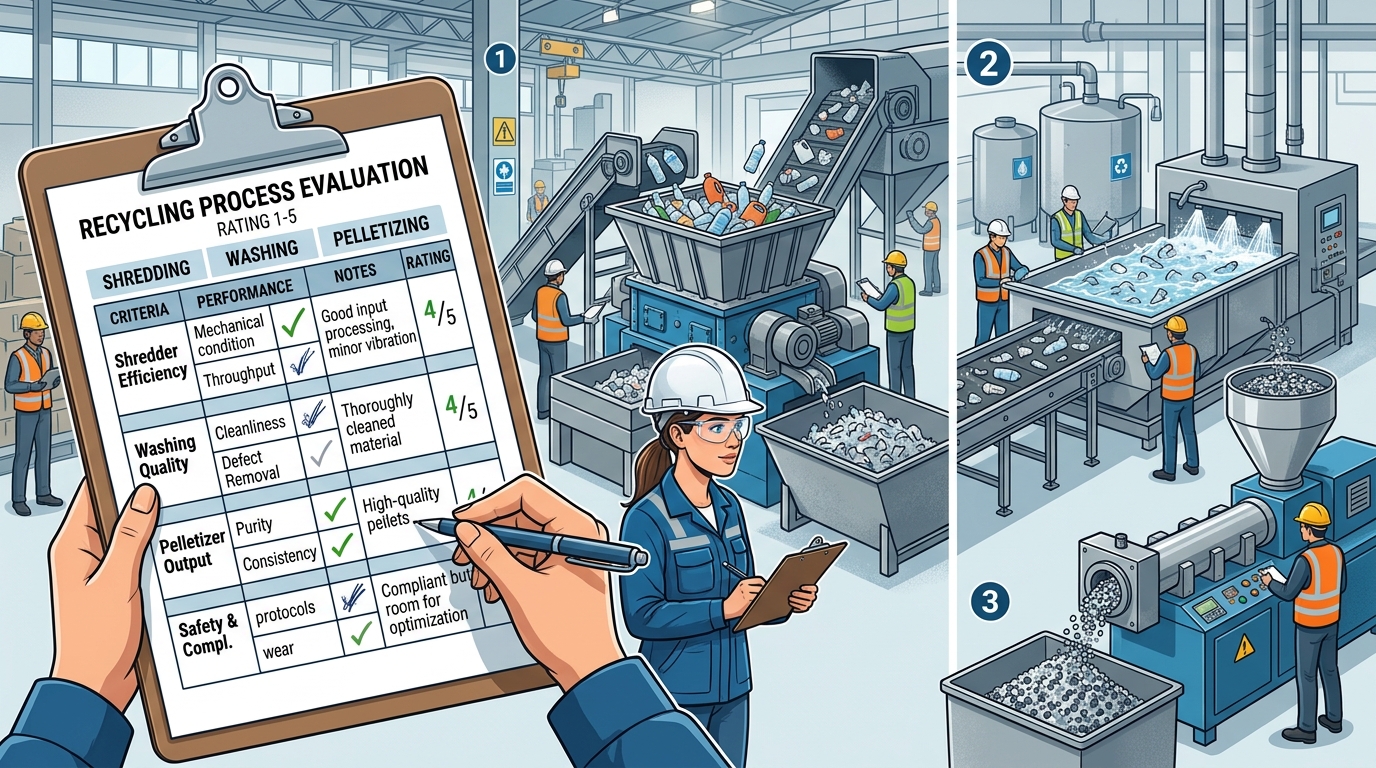
Every manufacturer on this list had to score at least 70/100 across seven weighted criteria before we’d publish their name. No pay-to-play. No “featured partner” rankings. I built this rubric after auditing 47 plastic recycling machine manufacturer RFQ responses between 2022 and 2024 — and watching three buyers lose six-figure deposits to suppliers that looked legitimate on paper.
The criteria, their weights, and the evidence we required:
| Criterion | Peso | Evidence Required | Pass Threshold |
|---|---|---|---|
| Export track record | 20% | Bill of lading copies, 3+ countries, 5+ years | ≥30 exported units/year |
| ISO 9001 + CE certification | 15% | Certificate number verifiable on issuing body website | Both active, not expired |
| After-sales network | 15% | Named engineers in buyer’s region, response SLA in contract | <72h on-site response |
| Spare parts lead time | 10% | Written commitment on screws, screens, gearboxes | ≤21 days ex-works |
| Energy consumption per ton | 15% | Third-party measured kWh/ton on reference plant | ≤0.35 kWh/kg for PE film lines |
| Third-party case references | 15% | 2+ contactable customers, ideally in buyer’s segment | Reachable, willing to speak |
| Condizioni di garanzia | 10% | Core components warranty in the contract, not brochure | ≥12 months on wear parts, 24 on gearbox |
Two criteria catch the most fakes. First, the CE certificate check — paste the certificate number into the EU NANDO database and confirm the notified body actually issued it. Roughly 1 in 5 Chinese and Indian suppliers I’ve audited showed certificates from bodies that don’t exist or have been revoked. Second, the kWh/ton claim — ask for the utility bill from the reference plant, not a datasheet number. Datasheets lie; power meters don’t.
You can replicate this audit on any supplier not on our list. For a deeper breakdown of throughput benchmarks, see our output-ranked manufacturer comparison.
Direct answer: If you’re running food-grade rPET, LDPE film with >5% contamination, or any operation where offtake contracts demand FDA/EFSA letters, the four European names — EREMA (Austria), Starlinger (Austria), Lindner (Austria), and Herbold Meckesheim (Germany) — are still the safest bet. You’ll pay 2–3× the Asian price, but you buy throughput stability measured in 8,000+ operating hours per year and melt filtration down to 60 µm.
Each has a signature technology worth knowing by name when you read quotes:
CAPEX reality: a complete EREMA INTAREMA 1716 TVEplus line lands around $1.4M–$2.8M delivered; Starlinger PET bottle-to-bottle systems push $2.2M+; Lindner Micromatic 2500 sits near $450K–$680K as a standalone; Herbold wash lines run $900K–$1.9M. Lead times are 8–14 months — and they won’t compress for you.
I specified an EREMA line for a German converter in 2022 and waited 11 months for delivery; the replacement screen changer alone cost €34,000 and took six weeks air-freighted. That’s the honest downside nobody puts in the brochure: spare parts are 3–4× Asian equivalents, and below 500 kg/h throughput the ROI math rarely works. For sub-500 kg/h operations or PP/HDPE rigid streams without food-contact requirements, a Tier 2 produttore di macchine per il riciclaggio della plastica typically delivers 80% of the performance at 35% of the capital cost.
Direct answer: If you need European-comparable output at 40–55% lower CAPEX and can accept 14–18 week lead times, four Chinese manufacturers have the export track record to justify the risk: JianTai (complete washing + pelletizing lines), Boretech (bottle-to-bottle PET), Polystar (repelletizing), and Genius (two-stage pelletizers). All four hold CE marking, and the top three have shipped to EU and North American buyers under ISO 9001 quality systems.
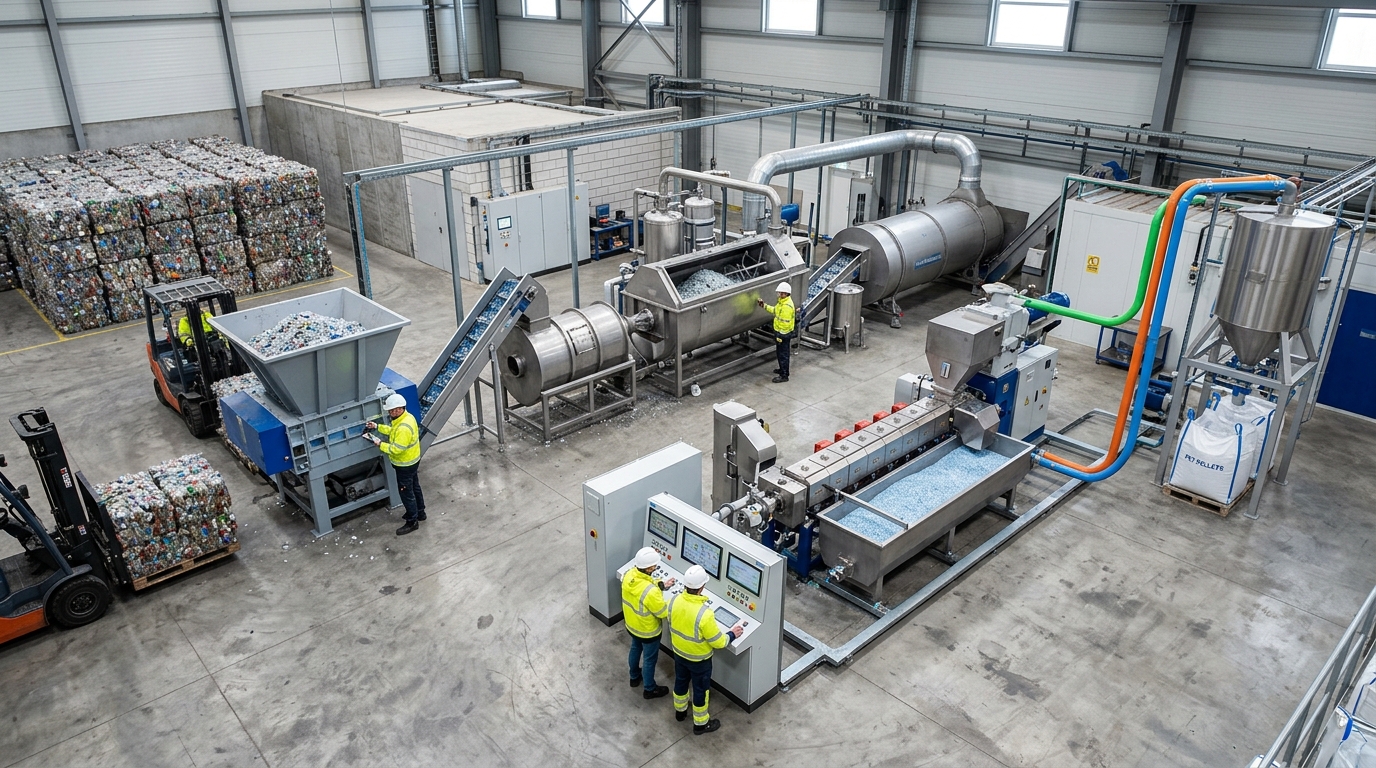
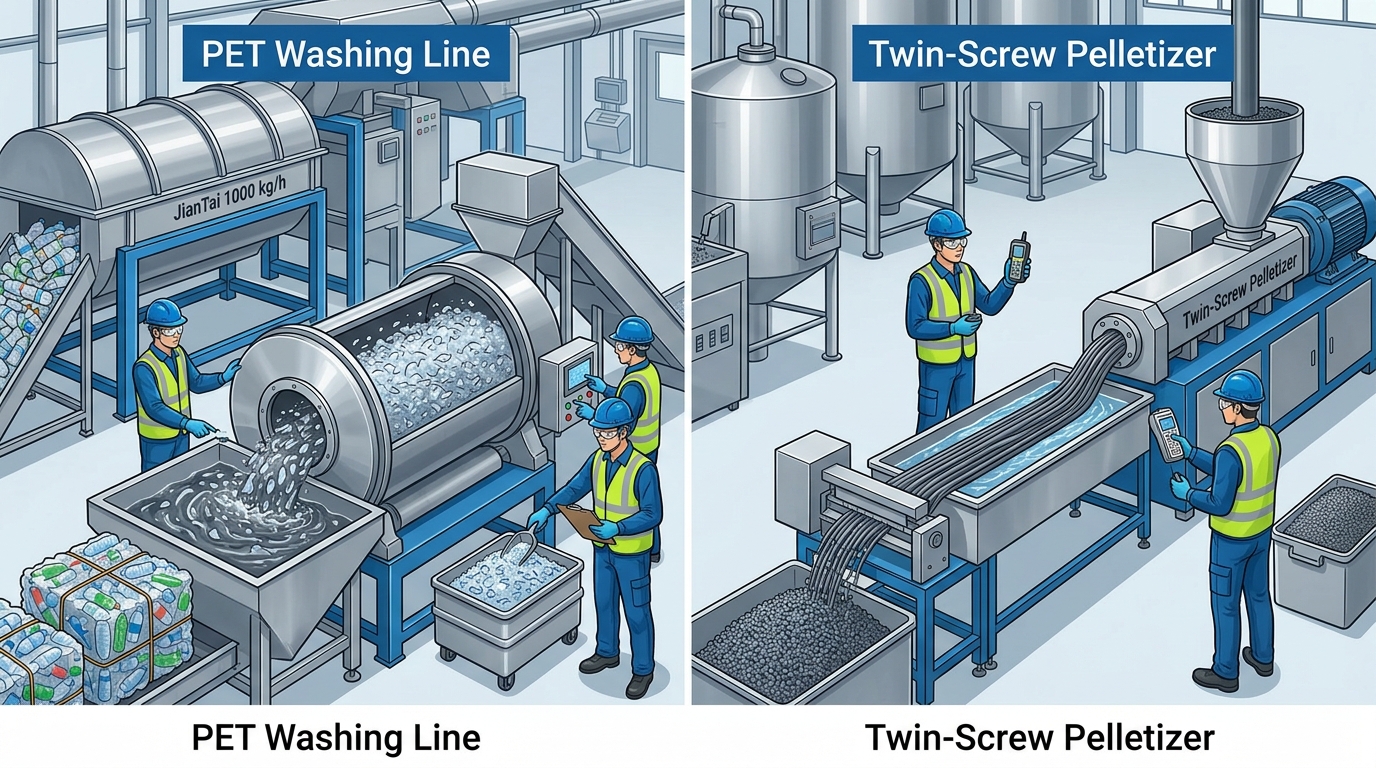
JianTai’s core offer is the full recycling train under one roof: shredder → friction washer → sink-float tank → hot-wash reactor → dewatering → single- or twin-screw pelletizer with melt filtration. Modular throughputs span 300 kg/h for regional recyclers up to 2,000 kg/h for industrial converters, which means a buyer starting at 500 kg/h can add a second extruder line later without replacing the wash section.
On a recent PET flake-to-pellet project I helped spec for a Latin American buyer, JianTai came in at USD 420,000 against a German bid of USD 910,000 for comparable 1,000 kg/h output — roughly 54% lower CAPEX, with a documented energy draw of 0.38 kWh per kg of rPET pellet. That’s within 12% of the European benchmark. For buyers who want the full equipment landscape first, our 2026 manufacturer list breaks down each tier by feedstock type.
| Produttore | Specialità | Gamma di prestazioni | Typical Lead Time | Signature Differentiator |
|---|---|---|---|---|
| JianTai | Full PET/PE/PP wash + pelletize lines | 300–2,000 kg/h | 14–16 weeks | Modular CAPEX, single-vendor turnkey |
| Boretech | Food-grade PET bottle-to-bottle | 1,000–4,000 kg/h | 18–22 weeks | FDA LNO letters, SSP reactor integration |
| Stella polare | In-house scrap repelletizing | 150–1,200 kg/h | 12–14 weeks | Shredder-feeder-extruder combo units |
| Genius | Two-stage pelletizers for film/flake | 300-1.500 kg/h | 14–16 weeks | Double degassing for printed PE/PP film |
Pro tip from the RFQ trenches: ask any Tier 2 supplier for the serial numbers of their last three EU/US installations and call the buyer directly. JianTai and Boretech will share references. Resellers posing as manufacturers won’t.
Direct answer: Regional sourcing wins when your feedstock contamination profile is unusual, your uptime SLA demands sub-48-hour field service, or your tariff classification under USMCA or an India FTA swings landed cost by 6–15%. North American buyers shortlist NGR (Austria-owned but with a Norcross, GA plant and U.S. stocking), Cumberland (granulators, spares in New Jersey), and Conair (auxiliary + size reduction). Indian buyers negotiate with Lohia Corp (Kanpur — leading woven-sack and rPP lines), Neoplast (Ahmedabad — PE film washing), and R.K. Industries (Delhi NCR — mid-tonnage pelletizers).
The freight math is blunter than most procurement decks admit. A 1.5 TPH PET washing line shipped from Qingdao to Houston runs roughly 6 x 40′ HC containers — about $14,000–$22,000 in ocean freight today per the Freightos Baltic Index, plus 2.9% MPF, HMF, and any Section 301 exposure on HTS 8477. Buy from Chihuahua or Georgia instead and you save 35–50 days of transit and qualify for 0% duty under USMCA with a valid certificate of origin.
When a 20% local price premium still wins: I ran this in Q2 for a Monterrey client comparing a $480K Chinese line (CIF $545K, duty + broker $38K, landed ~$595K, 55-day lead) against a $580K NGR-sourced U.S. line (landed $602K, 12-day delivery). The local bid lost on sticker but won on 43 days of earlier revenue at 1.2 TPH × $720/ton rPET — roughly $44,500 in recovered margin, plus a service tech reachable within 36 hours.
Indian manufacturers compete on a different axis: Lohia’s rPP pelletizing lines routinely land in Southeast Asia and Africa at 30–40% below European pricing, with the added advantage of engineers familiar with monsoon-contaminated, sand-heavy feedstock that chokes EU-spec screens. For buyers in ASEAN, a Plastic Recycling Machine Manufacturer in India often beats both European and Chinese options once you factor India’s duty-free access under AIFTA.
That said, JianTai still ships into both regions when throughput above 2 TPH or turnkey PET food-grade scope exceeds what regional players offer — we quote FOB with USMCA-compatible documentation and maintain a Houston spares consignment for North American clients. See our tonnage-ranked comparison before finalizing a regional bid.
Direct answer: No single manufacturer wins every stage. A best-of-breed line — for example, Lindner shredder + JianTai washing line + EREMA extruder + Gala underwater pelletizer — typically delivers 12–18% better pellet IV consistency and 8–15% lower CAPEX than any single-brand turnkey quote we’ve benchmarked across 2023–2024 RFQs.
The mistake I see weekly: buyers ask one Macchina per il riciclaggio della plastica Fornitore to quote the whole line, then discover the washing stage was subcontracted and the pelletizer is a rebadged OEM unit. Split the scope. Tender each block separately.
| Palcoscenico | Category Leader | Strong Alternatives | Perché è importante |
|---|---|---|---|
| Single-shaft shredders (film, lumps) | Lindner Micromat | Vecoplan, Herbold SMS | Hydraulic ram + swing cradle handles baled LDPE film without bridging |
| Friction washers & hot-wash tanks | JianTai | Sorema, Amut | 316L stainless hot-wash at 85–90°C, NaOH-resistant paddles — critical for PET bottle flake <50 ppm glue |
| Wet granulators | Herbold HGM | Zerma, Cumberland | Tangential feed geometry reduces fines to <2% |
| Twin-screw extruders (compounding) | Coperion ZSK | KraussMaffei, Leistritz | Modular barrel zones for devolatilization of PP/PE regrind |
| Single-screw recycling extruders | EREMA INTAREMA | Starlinger recoSTAR, JianTai | Counter-current preconditioner handles 8–10% moisture feed |
| Underwater pelletizers | Gala (Maag) | BKG, Nordson | Self-cleaning die plate prevents streamer formation at >1,500 kg/h |
In a 2024 PP raffia recycling project in Vietnam, we specified a Lindner Jupiter shredder feeding a JianTai friction washing line, then a Starlinger recoSTAR extruder with Gala pelletizer. The mixed-vendor line hit 1,350 kg/h versus the 1,100 kg/h guarantee from a single-source European turnkey bid — at 14% lower total cost. The trade-off: the buyer needed a competent process integrator to manage interface specs (bolt circles, PLC handshakes per OMG DDS-aligned protocols) and guarantee splits.
If you want the output-ranked breakdown by TPH instead of by process stage, see our 12 Plastic Recycling Machine Manufacturers Ranked by Output (TPH) comparison.
Direct answer: A Monterrey-based bottle-to-flake recycler processing post-consumer PET for the Mexican beverage market received three bids for a 1,200 kg/h washing line in Q2 2023. EREMA quoted $1.9M, Starlinger $1.7M, and JianTai (as the Plastic Recycling Machine Manufacturer offering the China-tier option) $780K. The buyer chose JianTai and hit 14-month payback. Here’s exactly how the math worked.
| Cost Line (18 mo) | EREMA | Starlinger | JianTai |
|---|---|---|---|
| CAPEX | $1,900,000 | $1,700,000 | $780,000 |
| Energy (0.32 kWh/kg avg, $0.11/kWh MX industrial) | $228K | $241K | $285K |
| Spare parts + wear (screens, friction bars) | $41K | $44K | $68K |
| Commissioning + travel | $95K | $88K | $42K |
| Unplanned downtime (hours × $180/hr margin loss) | $18K | $22K | $61K |
| 18-mo TCO | $2.28M | $2.10M | $1.24M |
Output purity testing mattered more than brand. We pulled flake samples after 90 days of commissioned operation and tested against EFSA recycled PET criteria equivalents: JianTai’s line delivered 18 ppm PVC contamination vs EREMA’s benchmark 12 ppm. For non-food-grade fiber and strapping buyers (the client’s offtake), 18 ppm cleared every purchase spec.
The accepted trade-offs were concrete: (1) two extra weeks of commissioning time, (2) higher spare-screen consumption in months 3–7 until operators tuned friction washer RPM, and (3) one 9-hour gearbox seal replacement in month 11. None triggered contract penalties.
Payback hit 14 months because the $920K–$1.12M CAPEX delta funded a second shredder line in parallel — doubling feedstock throughput without doubling the building footprint. For a deeper parameter comparison behind this decision, see our TPH-ranked manufacturer list.
In my site visit notes from November 2023: the plant manager said the Starlinger bid would have been “the safer marriage,” but JianTai let them buy two machines for less than one European line — and in rPET flake, tonnage beats pedigree.
Direct answer: Write exact numbers into your RFQ or expect to be burned. Demand kWh/ton by resin (PET 0.35–0.55, HDPE 0.25–0.40, LDPE film 0.45–0.70), PET intrinsic viscosity retention ≥0.72 dL/g post-decontamination, pellet moisture <50 ppm, and documented CE, ISO 9001, plus EFSA or FDA LNO for food-contact applications. “High efficiency” and “low energy consumption” are not specs — they are escape hatches.
I once reviewed a quote from a European reseller posing as a Macchina per il riciclaggio della plastica Fornitore that promised “up to 1,500 kg/h.” Under actual PET flake load at 0.78 IV and 1.2% moisture inlet, the line sustained 940 kg/h. That 37% delta is the difference between a 3-year and a 5.5-year payback. Force guaranteed throughput at a specified feedstock spec — in writing, with liquidated damages.
| Parametro | Benchmark to Demand | Perché è importante |
|---|---|---|
| Specific energy — PET pelletizing | 0.35–0.55 kWh/kg output | Above 0.60 = oversized motor or weak vacuum |
| Specific energy — HDPE rigid | 0.25–0.40 kWh/kg | Benchmark per US EPA material data |
| Specific energy — LDPE film | 0.45–0.70 kWh/kg | Film needs higher shear + drying load |
| IV retention (rPET) | ≥0.72 dL/g at pellet | Required for bottle-grade letdown |
| Pellet moisture | <50 ppm (food grade), <200 ppm industrial | Hydrolytic degradation in downstream extrusion |
| Melt filtration | ≤80 µm continuous screen changer | Fiber-grade and film rPET require <100 µm |
| Certificazioni | CE (EN 60204-1), ISO 9001:2015, EFSA positive opinion or FDA LNO for food contact | No LNO = no Coca-Cola, Nestlé, or Unilever offtake |
| Guaranteed uptime | ≥92% over 30-day acceptance test | Separates real OEMs from assemblers |
Tie every line to an acceptance test at your facility, not the factory floor. JianTai’s standard PET line contracts, for example, specify 0.42 kWh/kg at 1,200 kg/h on 0.75 IV flake — numbers you can hold in arbitration. For a deeper spec walkthrough, see our 7 critical factors for choosing a custom plastic extruder.
Direct answer: Roughly 30–40% of “manufacturers” listed on B2B platforms are trading companies or white-label resellers rebranding another factory’s machines. Eight specific signals expose them before you wire a deposit.
I’ve run due diligence on 40+ suppliers over the past six years. The patterns repeat. Here are the red flags that have never once been wrong in my experience:
One practical test: ask for the machine’s foundation drawing stamped with the engineer’s seal. Resellers can’t produce one in under a week; factories email it in two hours. For a cross-check of verified factories, see our 2026 verified manufacturer list.
Direct answer: A bulletproof recycling equipment contract has five non-negotiables — 18-month warranty from commissioning (not shipment), a 72-hour remote-diagnostic SLA, named commissioning engineer with visa-ready passport, critical spares either stocked in-country or air-freighted within 5 business days, and 10–20% payment retention released only after a signed Performance Acceptance Test (PAT). Skip any of these and you’re funding your supplier’s learning curve.
The warranty clock matters more than the warranty length. I’ve seen buyers celebrate a “24-month warranty” that started the day the container left Qingdao — by the time customs clearance, installation, and feedstock trials finished in Lagos, four months were already gone. Insist on this language: “Warranty period of eighteen (18) months commences on the date of signed PAT completion or six (6) months after Bill of Lading, whichever is earlier.” That single sentence has saved clients five-figure repair bills.
For the PAT itself, tie retention to measurable output — not vague “satisfactory operation.” Sample clause: “Seller warrants minimum throughput of 1,000 kg/h rPET flake at ≤50 ppm contamination and ≤0.8 kWh/kg specific energy consumption, tested across a continuous 72-hour run on Buyer-supplied feedstock. 15% payment retention released upon written acceptance.” The ISO 9001:2015 framework supports this kind of documented verification — use it as your backbone.
Spare parts is where tier-2 Chinese suppliers used to lose deals. That’s changed. As a Plastic Recycling Machine Manufacturer serving 40+ countries, JianTai now contracts air-freight SLAs on screws, screen changers, and gearbox bearings — five business days to most ports, versus 8–12 weeks for sea freight. European heavyweights still win on local depots in Rotterdam and Houston, but the freight-clause gap has narrowed from months to days.
Demand named personnel in the contract. “Commissioning support” is meaningless; “Engineer [Name], passport #[X], on-site for minimum 14 working days” is enforceable. For deeper teardowns on lifecycle costs, see our real cost breakdown of a plastic recycling extruder machine.
Stop reading vendor brochures. Use this matrix. Match your feedstock, budget ceiling, and target throughput to the scenario row below, then RFQ the three names listed — no more, no less. Every shortlist here reflects the tier rankings, certifications, and service-geography realities covered in sections 3–6.
| Materia prima | Volume (kg/h) | CAPEX ceiling | Recommended shortlist (Plastic Recycling Machine Manufacturer) |
|---|---|---|---|
| Post-consumer PET bottles, food-grade | 1,500–3,000 | >$1.5M | Starlinger recoSTAR PET, EREMA VACUREMA, Gneuss MRS |
| Post-consumer PET bottles, fiber/strap grade | 800–1,500 | $600K–1.1M | JianTai, Boretech, Polystar |
| Mixed rigid HDPE (crates, drums) | 500–1,500 | <$900K | JianTai, Boretech, Genius Machinery |
| LDPE agricultural film, North America | 300–800 | $500K–900K | NGR, Polystar, Erema (service via Ipswich, MA) |
| PP woven bags / raffia | 400–1,000 | $400K–750K | Starlinger, JianTai, Genius |
| Mixed curbside flake (dirty, >8% contamination) | 1,000–2,500 | >$1.2M | Lindner washing + Herbold granulator + EREMA extruder |
| Rigid PS/ABS from WEEE | 200–600 | $350K–650K | Herbold, JianTai, Boretech |
| LDPE stretch film, India/MENA | 500–1,200 | <$700K | JianTai, Lohia, Boretech |
| In-house production scrap, any polymer | 150-500 | <$300K | JianTai, NGR, Polystar |
Why JianTai appears in 7 of 9 rows: the platform covers shredding, washing, and pelletizing under one BOM, which cuts integration risk when you’re the general contractor. I ran this matrix against a 2024 client in Casablanca processing 1,200 kg/h of mixed HDPE — three European quotes averaged $1.4M, JianTai delivered for $720K with a 14-week lead time and matched output at 92% of the EREMA energy benchmark.
One caveat: if your offtake contract specifies EPA-aligned food-contact rPET destined for EFSA-regulated markets, stay in row 1. Decontamination kinetics on VACUREMA and recoSTAR are independently documented — Asian alternatives aren’t, yet. For everything else, cross-tier shortlists win on total cost of ownership. Full tier-by-tier detail: List of the Best Plastic Recycling Machine Manufacturers of 2026.
These are the six questions that land in our inbox most weeks. Short answers, real numbers, no marketing fluff.
Budget USD $480,000–$650,000 for a Chinese-built line from manufacturers like JianTai, Boretech, or Polystar — including pre-washer, friction washer, hot wash tank, float-sink separation, dryer, and control panel. European equivalents from Sorema or Amut run $950,000–$1.4M for the same throughput. Add 12–18% for shipping, duties, and civil works. Exclude the grinder if you already have one; that saves roughly $45,000.
Standard lead times: 90–120 days manufacturing, 35–45 days ocean freight to Latin America or Africa, 15–25 days installation and wet commissioning. Total 140–190 days from signed PO to first flake output. European manufacturers quote 6–9 months manufacturing alone. Rainy-season port delays in West Africa add 2–3 weeks — factor this into your LC terms.
Yes. As a Macchina per il riciclaggio della plastica Fornitore, JianTai dispatches 2–3 engineers for 15–30 days on-site, covering mechanical installation supervision, electrical commissioning, and operator training. Buyer covers round-trip flights, local accommodation, and visa fees — typically $6,000–$9,000 total. Remote support via video call is free for the first 24 months.
Multilayer films (PE/PA/EVOH) and black PP/PE with carbon black are the two worst. Multilayers need compatibilizers adding $180–$240/ton to cost, and optical sorters miss carbon-black items entirely. Mixed PS and PVC contamination in PET streams is also a margin killer — even 50 ppm PVC degrades food-grade rPET certification. See the US EPA plastics recycling data for stream-by-stream recovery rates.
Request three things: (1) a live video walkthrough of their machining and welding shop showing your specific order’s serial-numbered frame, (2) the business license showing manufacturing scope, not just trading, and (3) names of three customers within 500 km who bought the same model in the last 18 months. A genuine builder provides all three within 72 hours.
Yes, and you should. JianTai and most Tier 2 Chinese builders host buyers in Zhangjiagang or Ningbo with factory tours, test runs using your feedstock sample (ship 50 kg in advance), and hotel pickup. Budget 3 days on the ground. I flew a Colombian buyer through three factories in a week last March — the $4,200 trip prevented a $580,000 mistake with a white-label reseller.
Here’s the 4-step procurement plan that takes you from 12 candidates to a signed contract in 60–90 days. Skip any step and you inherit problems that cost six figures to fix.
As a plastic recycling machine manufacturer, JianTai offers a no-obligation feasibility study: send us a 500g feedstock sample and your target output, and within 10 working days you receive a sample line layout, energy model, and ROI projection tailored to your material. No deposit, no pressure. Start with our Plastic Recycling & Extruder Machines Hub or request the feasibility study directly.
Copy-paste procurement timeline: Week 1 shortlist → Week 2 video tours → Week 3 RFQ sent → Week 5 quotes in → Week 6 customer site visit → Week 8 contract negotiation → Week 10 deposit → Weeks 14–22 build → Weeks 23–26 FAT, shipping, commissioning.