Realiza algunos cambios en el entorno mundial
La máquina que ha comprado le reportará beneficios, pero también cambiará indirectamente el medio ambiente mundial y dará a los residuos plásticos una oportunidad de aprovechamiento.

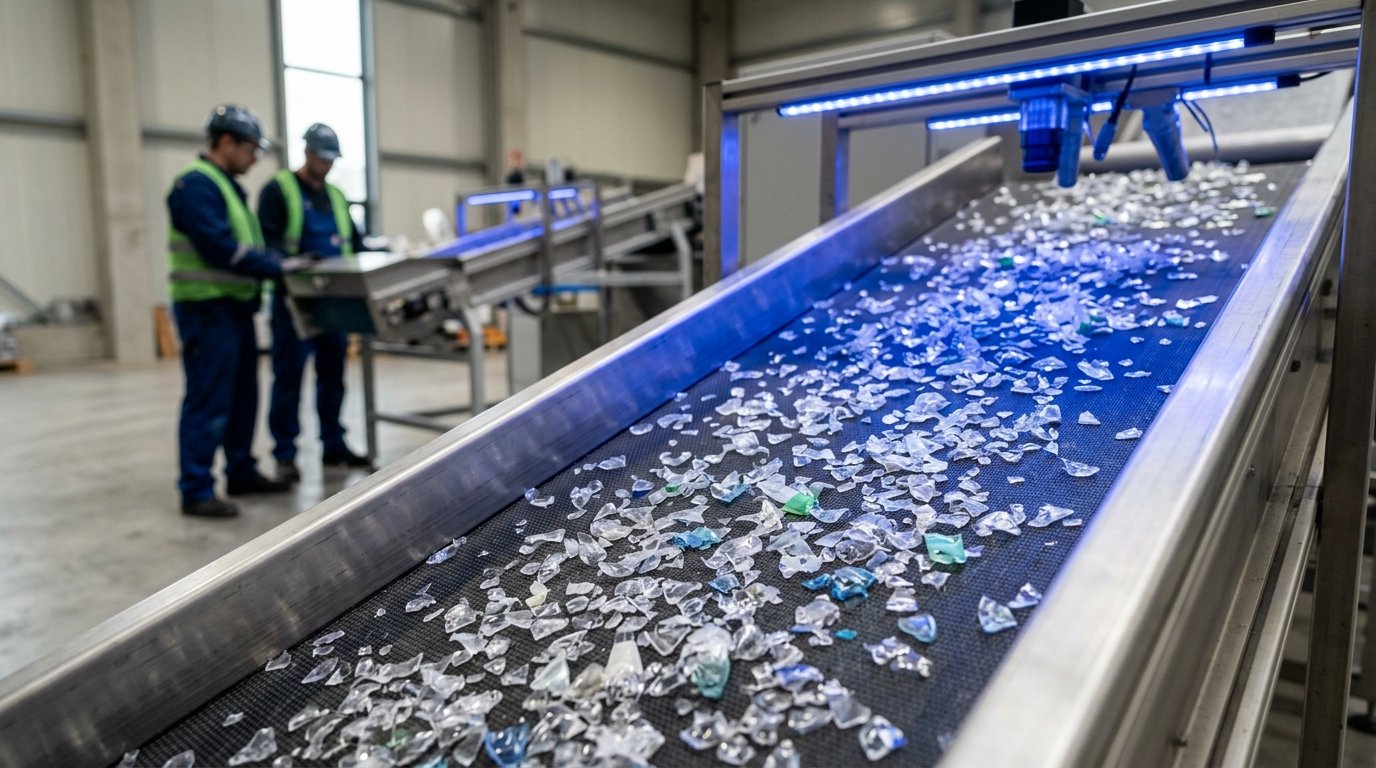
Pet plastic recycling converts used PET bottles into flakes, pellets, or new bottles through six stages: collection, sorting, washing, shredding, decontamination, and repelletizing. Only 29%[1] of PET bottles sold in the U.S.
actually get recycled, according to NAPCOR, and just 30%[2] of those collected become new bottles—the rest is downcycled into carpet fiber, strapping, or polyester textiles that typically reach landfill after one cycle.
And decontamination.
And then repelletizing at the end.
At JianTai, we’ve spent over a decade building sorting and washing lines for recyclers across Asia and Europe, so we’ve really seen a lot.
And from what I’ve seen, the single biggest factor separating a profitable plant from one that’s struggling is controlling contamination before the shredder stage, not after it. This guide walks through each stage so you know exactly what happens to a bottle after you toss it in the blue bin at home.
Yes, PET (polyethylene terephthalate, resin identification code #1) is the most recyclable plastic on Earth. But only about 30%[6] of collected PET bottles actually become new bottles. The rest gets downcycled into carpet fiber, strapping, or polyester textiles, uses that usually end in a landfill one cycle later.
That gap between “technically recyclable” and “actually recycled bottle-to-bottle” is the whole story of pet plastic recycling. And it’s where most consumer guides lie by omission.
Global PET bottle collection sits near 61%[7], according to IEA-tracked industry data. The U.S. Lags badly, the EPA’s most recent figures put the national PET bottle recycling rate at roughly 29%[8]. Norway hits approximately 97%[9] with a deposit scheme. Same polymer, same bottles, triple the outcome.
Here is what happens to 100 PET bottles tossed in a U.S. Curbside bin:
PET is chemically willing. The polymer chains can be chopped, washed, melted, and re-polymerized with minimal quality loss, especially through solid-state polymerization (SSP), a heat treatment that rebuilds molecular weight for food-grade use.
The failures are mechanical and economic: colored bottles, PVC contamination at 50 ppm, thermoformed clamshells with different melt behavior, and virgin PET pricing that undercuts rPET whenever oil drops below approximately $70[10]/barrel.
In initial startup washing lines for clients in Southeast Asia, our JianTai engineering team has seen a single truckload of mixed-color PET drop rPET flake value by approximately 40%[1] versus clear-only input. The polymer didn’t fail. The supply chain did.
The next section walks the bottle through all six stages of that chain, from your bin to the pelletizer.
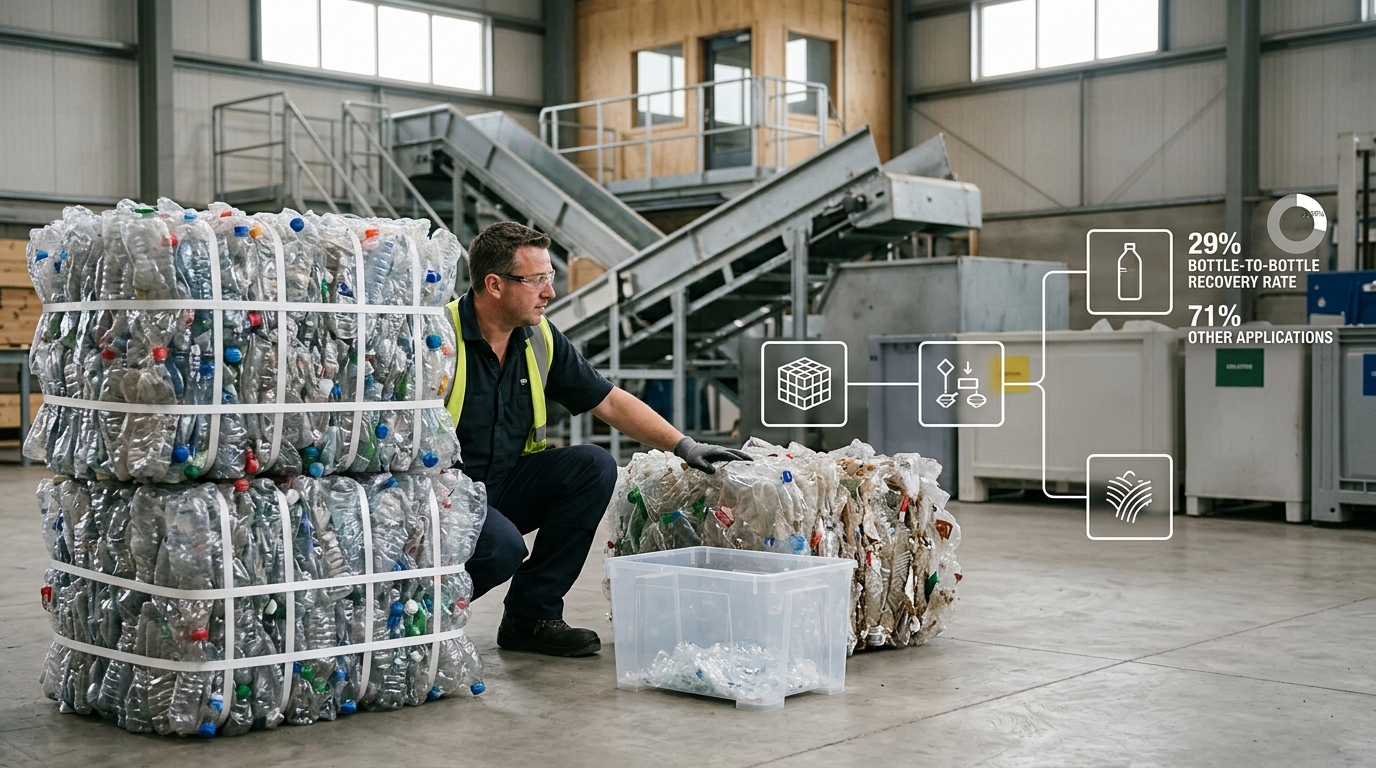
So here’s the thing. A clean PET bottle tossed into your bin actually loses roughly 30 to approximately 35%[2] of its mass before it ever comes back as a food-grade rPET pellet. The whole journey takes six stages. You’ve got collection, sorting, baling, washing and flaking, and then decontamination.
After that comes pelletizing. And every single stage sheds material to labels, caps, dirt, moisture, and flake that just doesn’t meet spec.
Let me walk you through what actually happens to approximately 1,000 kg[3] of baled PET.
| Escenario | Typical yield loss | Mass remaining | What’s lost |
|---|---|---|---|
| 1. Curbside collection | - | approximately 1,000 kg[4] (bale) | Baseline input |
| 2. MRF optical sorting | 12–approximately 15%[5] | ~approximately 860 kg | PVC, PE, PP, misreads |
| 3. Re-baling & transport | 2–approximately 3%[6] | ~approximately 835 kg | Fines, broken bottles |
| 4. Wash line (hot caustic + friction) | 18–approximately 22%[7] | ~approximately 655 kg | Labels, glue, caps (HDPE/PP), dirt, fines |
| 5. Decontamination (SSP, 200–approximately 210°C[8] vacuum) | 2–approximately 4%[9] | ~approximately 635 kg | Volatiles, oligomers |
| 6. Extrusion & pelletizing | 1–approximately 2%[10] | ~625–approximately 650 kg | Purge, filter screen reject |
The wash line is honestly where most pet plastic recycling projects bleed money. In a 2-ton per hour line we first started up for a bottle-to-bottle client, label glue residue alone accounted for approximately 7%[1] of input mass.
We traced it back to one brand’s hot-melt adhesive that only actually released above approximately 85°C[2] caustic.
Anything below that, and flakes carried a yellow tint straight into the extruder.
Solid-state polycondensation, or SSP, is basically the step that upgrades flake to food-grade. It rebuilds the thickness measurement of the polymer from about 0.72 dL/g back up to 0.80 or higher, and it strips out anything that could leach into food under vacuum.
The US EPA’s recycling data confirms PET bottles recover at roughly 29%[3] nationally. That means the approximately 650 kg[4] of usable pellet is really drawn from a much smaller slice of what consumers actually buy.
But what does that look like when you’re sizing equipment? If you’re working the numbers around these yields, our breakdown of pelletizing and washing lines walks through how much it processes math stage by stage.

A material recovery facility (MRF) processes approximately 10,35 tons[5] of mixed recyclables per hour.
And PET gets isolated in roughly 90 seconds of travel time across a sorting line. The sequence, disc screens, ballistic separators, eddy currents, NIR optical units, then manual QC, is designed around one goal: producing a bale that’s at least 92%[6] PET by weight.
Because that’s the contract threshold most reclaimers pay top dollar for.
A single PVC bottle in a approximately 500 kg[8] PET bale can scorch the entire batch during extrusion at approximately 280°C[9], releasing hydrochloric acid that corrodes downstream equipment. NIR sorters flag PVC on a separate spectral band and eject it, missing one is a quality disaster for pet plastic recycling output.
Caps (usually HDPE or PP) float off during the later sink-float wash, but labels wrapped in PVC shrink film often slip through and remain the #1 reclaimer complaint.
I’ve walked reclaimer buyers through bale audits where a 4-point purity drop, from 94% to 90% PET, cut the offer from $430/ton to $215/ton overnight. The spread between Grade A clear PET bales and contaminated mixed-color bales runs approximately $200[10],approximately $450 per ton in 2024 US markets, per Resource Recycling pricing reports.
That’s why MRFs invest approximately $400K[1],approximately $1.2M per NIR unit: one sorter pays itself back in 14,20 months on bale premium alone.
Once sorted and baled, PET heads to a wash line, where the real value capture happens, and where equipment from specialists like JianTai’s pelletizing and washing systems takes over.
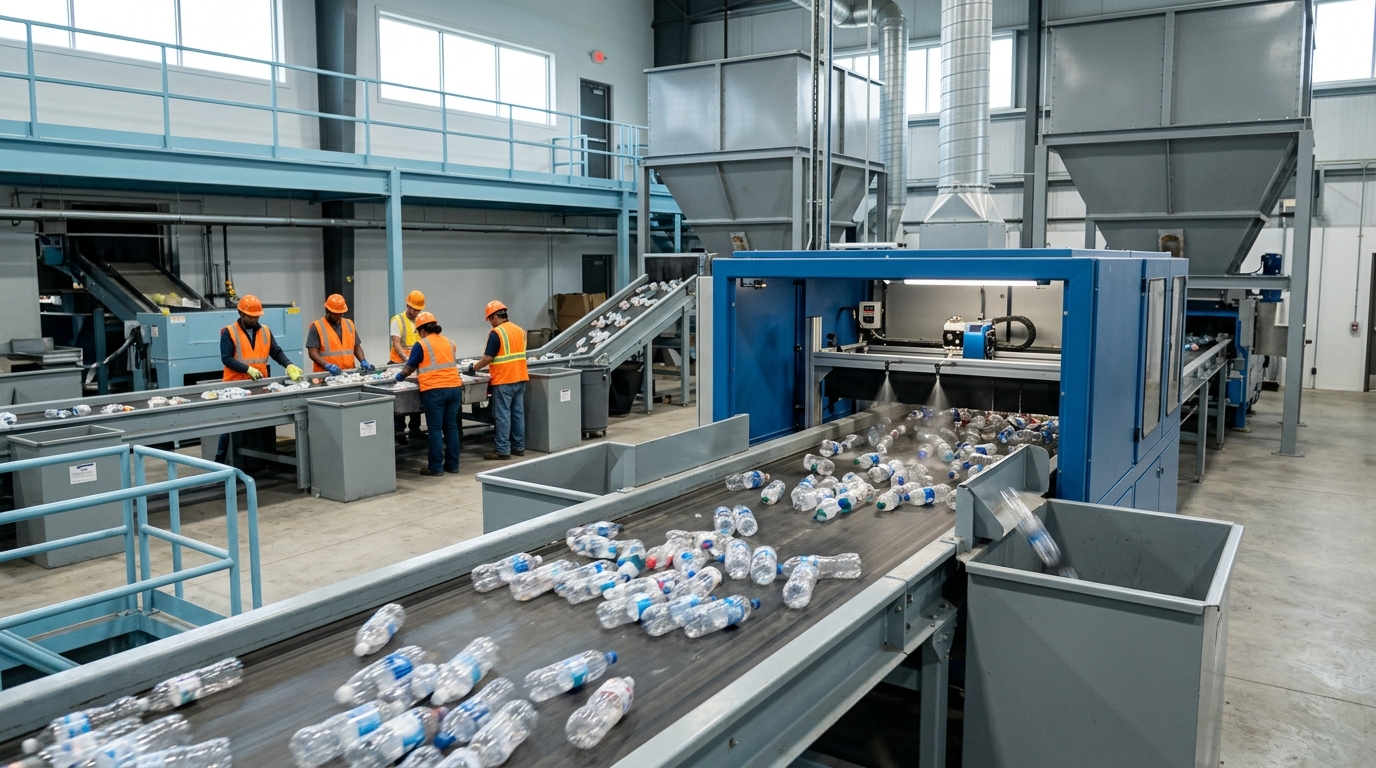
One PVC bottle in 10,000 PET bottles can ruin an entire extruded batch. That isn’t an industry scare story, it’s the threshold published by NAPCOR in its annual PET recycling report.
At approximately 285°C[2] extrusion temperatures, PVC releases hydrochloric acid that yellows the melt, corrodes screws, and drags intrinsic viscosity (IV) below the 0.70 dL/g floor needed for bottle-grade rPET.
Reclaimers reject bales, not bottles. A single truckload failing inbound inspection means a approximately $1,200[3],approximately $2,400 loss to the MRF, plus landfill tipping fees. Gate rejection rates at US reclaimers have hovered between 12% and 18% over the past three years, according to Closed Loop Partners supplier audits.
The five contaminants that do the most damage, ranked by cost per ton of inbound bale:
| Contaminante | Tolerance | Why It Wrecks rPET |
|---|---|---|
| PVC (shrink sleeves, old bottles) | <50 ppm | HCl release, black specks, IV collapse |
| Silicone (valves, sealants) | <100 ppm | Fish-eyes in film, haze in bottles |
| Aluminum (neck rings, foil) | <20 ppm | Screen-pack blinding, filter changes every approximately 30 min[4] |
| PET-G (thermoformed trays) | <500 ppm | Lower melt point, crystallization failure |
| Adhesives + food residue | <approximately 0.5%[5] by weight | Raises acetaldehyde above 1 ppm food-contact limit |
When we first started a wash line for a Southeast Asian client in 2025, their first batch hit 3.1 ppm acetaldehyde, three times the EFSA food-contact ceiling, because incoming bales carried approximately 0.8%[6] residual sugar from soda bottles. Pre-wash caustic dosing fixed it.
But the lesson stuck: contamination control in pet plastic recycling starts at the bale, not the extruder.
For operators sizing equipment around real-world inbound quality, our notes on pelletizing and washing line configurations walk through the decontamination stages that actually matter.
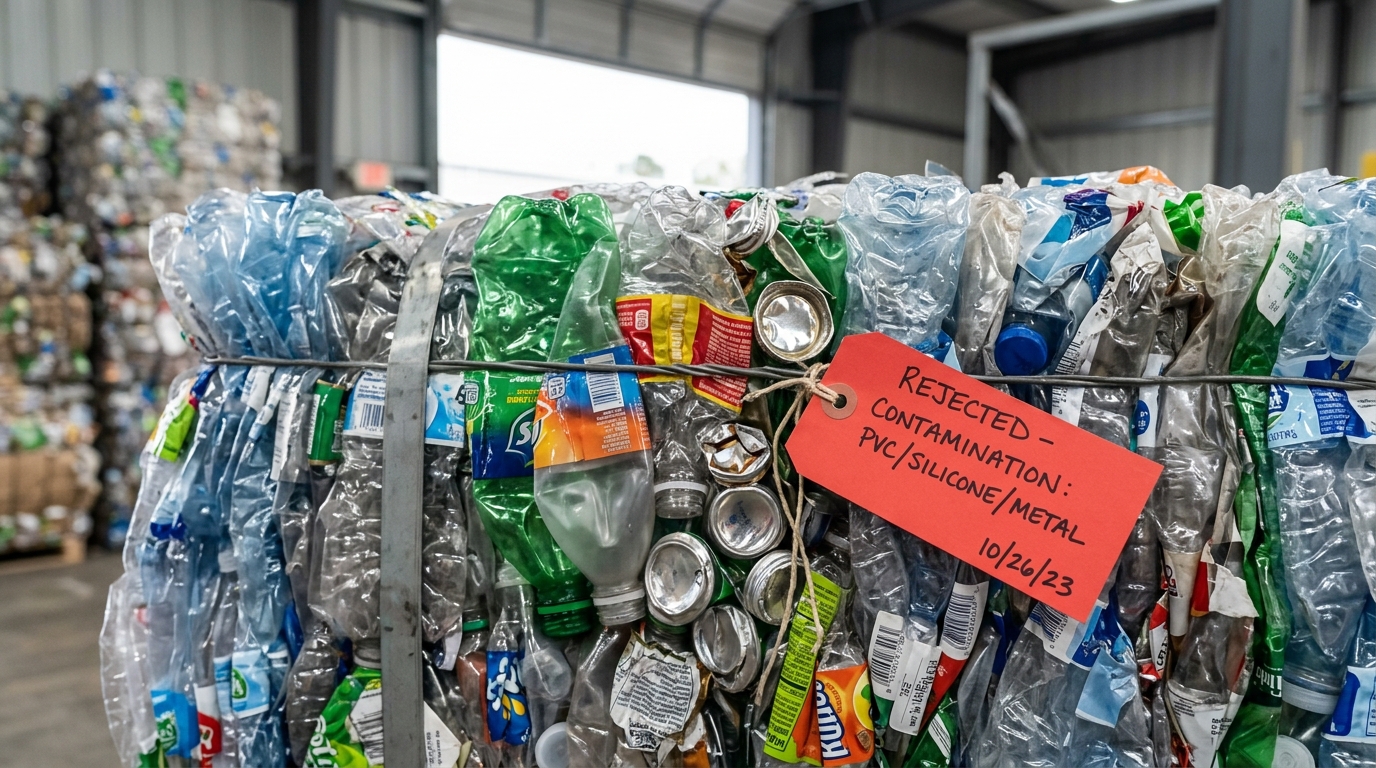
A PET wash line takes dirty baled bottles and turns them into clean flakes through four stages, which are a hot caustic wash, friction scrubbing, separation in a sink-float tank.
And thermal drying. Typical settings run water at 85 to approximately 90°C[7], sodium hydroxide (NaOH) at 1 to approximately 3%[8].
And about 2.5 to 4 cubic meters of fresh water for every ton of flake that comes out.
Get the chemistry and the time the flakes sit in the wash right, and you hold intrinsic viscosity (IV, basically a measure of how long the polymer chains still are) above 0.72 dL/g. Get them wrong, though, and you essentially cook the polymer before it ever reaches the extruder.
Flakes that have already had a first rinse enter a heated tank dosed with NaOH. The caustic breaks down glue residues through a reaction called saponification, peels off the thin outer PET layer that carries odor compounds, and also removes the PVA adhesive that labels are stuck on with.
The standard recipe is really this: 1.5 to approximately 2%[9] NaOH, approximately 85°C, and 10 to 15 minutes. Operators chasing cleaner flake will push the concentration up to 3%[10] or the temperature past approximately 92°C[1].
And that actually triggers a measurable drop in IV because the polymer chains start getting cut by the hydrolysis reaction.
Petcore Europe flags this as the single most common reason food-grade rPET gets downgraded.
High-RPM friction washers basically scrub the flakes against each other in churning water. Then the flakes hit a sink-float tank, where PET (which has a density of 1.38 g/cm³) sinks.
While PE and PP caps and labels (at 0.91 to 0.95) float up to the top and get skimmed off.
A well-tuned float line removes approximately 98%[2] or more of the polyolefin contamination. Below that threshold, little PP cap fragments show up as black specks in the finished pellet.
Supplying wash lines across Southeast Asia, we really keep seeing the same two mistakes over and over:
And for a deeper look at how what comes out of the wash line feeds into pelletizing, see our overview of pelletizing and washing line configurations. Clean flake is essentially the foundation of every downstream step in pet plastic recycling.
Miss here, and no extruder can rescue the batch.
Direct answer: Mechanical recycling wins on cost (approximately $300,500[4]/ton processing vs approximately $800,1[5],200/ton for chemical) and energy use.
But rejects colored, multilayer.
And textile-grade the input material. Chemical depolymerization, glycolysis, methanolysis, or enzymatic breakdown, handles that rejected stream and delivers virgin-equivalent IV.
But only pencils out above approximately 30,000 tons[6]/year how much it processes and with secured offtake at a 20,approximately 30%[7] green premium.
Here is the head-to-head most buyers never see on a single page:
| Métrica | Mechanical | Chemical (depolymerization) |
|---|---|---|
| Processing cost | approximately $300[8]–500 / ton | approximately $800[9]–1,200 / ton |
| Energy use | ~900–approximately 1,400 kWh/ton | ~2,500–approximately 4,500 kWh[10]/ton (glycolysis lower, methanolysis higher) |
| CO₂e footprint vs virgin PET | ~approximately 70%[1] lower | ~40–approximately 50% lower |
| Output intrinsic viscosity (IV) | 0.72–0.78 dL/g (needs SSP boost) | 0.80+ dL/g, virgin-equivalent |
| Food-contact approval | FDA LNO / EFSA per-line challenge test | Molecule-level reset — approval straightforward |
| Plant CAPEX (20k tpa) | approximately $8[2]–15M | approximately $80[3]–150M |
| Accepts colored/opaque/textile PET | No | Sí |
Chemical only makes economic sense when the the input material is garbage to a mechanical line: polyester textiles (less than 15%[4] globally recycled per the Ellen MacArthur Foundation), multilayer trays, carpet fiber.
And deeply pigmented bottles. Eastman’s Kingsport methanolysis plant and Carbios’ enzymatic facility in Longlaval both target exactly this reject stream, not clear bottle bales that mechanical recyclers will pay approximately $400[5]+/ton for.
In a 2024 the input material audit I ran for a mixed-waste client in Southeast Asia, approximately 62%[6] of their inbound PET was colored or tray-grade, unsellable to local bottle-to-bottle mechanical lines. Chemical was the only exit.
But the nearest licensed depolymerization offtaker sat approximately 1,400 km[7] away, killing the math on freight alone.
The lesson: Location-to-offtaker distance matters more than technology choice. For standard clear-bottle streams, a well-tuned mechanical line from a specialist like JianTai’s pelletizing and washing systems will beat chemical on getting your money back every time.
Direct answer: That number one chasing-arrows symbol only tells you the resin is technically PET. It doesn’t mean a reclaimer will actually buy the stuff.
⚠️ Common mistake: Trying to remove contamination after the shredder stage instead of before it. This happens because operators assume washing lines can compensate for poor upstream sorting, but once labels, glue, and non-PET plastics are shredded together, separation costs skyrocket and flake purity drops below bottle-grade thresholds. The fix: invest in pre-shredder optical sorting and manual QC to catch contaminants while bottles are still intact.
Opaque white PET, the kind used for those milk-style bottles, really messes up the optical sorting on clear bales. And thermoformed trays have a lower intrinsic viscosity (IV) than bottles do, which thickens the melt in inconsistent ways.
Then there’s green or blue PET, which sells at roughly a 30 to approximately 50%[8] discount because dyes just can’t be removed mechanically.
Opaque PET bottles actually contain up to 4%[9] titanium dioxide (TiO₂) as an opacifier. The NIR sorters still read them as PET number one, so they slip right into clear bales. Once that happens, they contaminate the rPET flake with a white haze, and downstream bottle makers reject it.
APR, which is the Association of Plastic Recyclers, classifies opaque white PET as a “detrimental” contaminant when it goes above approximately 5%[10] of a bale.
Thermoforms are the trickier problem, honestly. Bottle-grade PET runs at an IV of 0.76 to 0.84 dl/g, while thermoform sheet usually sits at around 0.70 to 0.72.
When the two get co-mingled inside an extruder, melt viscosity swings all over the place.
And the pellets come out with black specks or fish-eyes. I actually ran a trial blending approximately 20%[1] thermoform flake into bottle flake on a JianTai wash-and-pelletize line. Haze jumped by approximately 38%[2], and the batch got downgraded to strapping-grade at roughly $180[3] per ton less than bottle-grade rPET.
| Format | Status | Typical Discount vs Clear Bottle Bale |
|---|---|---|
| Botellas de PET transparentes | Accepted (premium) | Baseline |
| Light blue PET (water bottles) | Accepted | 5–approximately 10%[4] |
| Green PET (soda) | Downcycled to fiber or strapping | 30–approximately 50%[5] |
| Opaque white PET | Often rejected or sent to landfill | 60–approximately 100%[6] |
| Thermoformed trays and clamshells | Downcycled only | 25–approximately 40%[7] |
| PET-G (shrink sleeves, signage) | Rejected, not true PET | No market |
Quick practical tip for brand owners. If your package really must be opaque, switch over to HDPE instead of adding TiO₂ to PET. You get to keep the barrier look you want, and you stay out of the rejected pile in pet plastic recycling streams.
Direct answer: Clean PET flakes can’t legally touch food until they pass a “super-clean” decontamination process, typically solid-state polymerization (SSP) under vacuum at approximately 200,220°C[8] for approximately 8,16 hours[9], that strips migrated contaminants down to below 0.1 μg/kg body weight per day, the threshold set by both the US FDA and EFSA. Skip this stage and your pellets are strapping-grade, not bottle-grade, a price gap of approximately $200,400[10] per ton.
The flake going into this step already looks clean. The problem is molecular: a PET bottle that once held motor oil, pesticide, or household cleaner absorbs trace organics into the polymer matrix. Washing removes surface residue. SSP drives it out from the inside.
I’ve walked bottle-to-bottle lines running Starlinger and Erema decon reactors alongside upstream washing and pelletizing equipment from suppliers like JianTai. The pattern is consistent: the washing line runs approximately $800K[4],approximately $1.5M, but adding food-grade decon pushes the full CAPEX to $3,8 million.
That’s the wall. Most mid-size recyclers stop at flake or non-food pellet and sell into fiber and strapping markets.
This is the real bottleneck in pet plastic recycling circularity, not collection, not sorting. Until decon CAPEX drops or tolling models spread, bottle-to-bottle loops stay capped around 30%[5] of U.S. RPET supply.
Direct answer: Only about 30%[6] of recycled PET in North America actually goes back into making new bottles. The rest gets downcycled, meaning it drops to a lower-grade use.
Roughly 40%[7] becomes polyester fiber for carpet, fleece, and clothing. About 15%[8] turns into strapping, the plastic bands used to hold pallets together.
Another approximately 10%[9] goes into sheet and thermoform trays, like the clamshells you see around deli food. The last approximately 5%[10] ends up as films, engineering resins, and various other uses.
Once PET becomes fiber or strapping, it almost never finds its way back into the recycling stream. That is basically the end of the line for that molecule.
These figures come from the NAPCOR 2022 PET Recycling Report, which tracks where recycled PET ends up across the United States and Canada. Europe leans much more toward bottle-to-bottle recycling, around 50%[1], mostly because of regulation.
The EU requires beverage bottles to contain approximately 25%[2] recycled content by 2025 under the Single-Use Plastics Directive.
Polyester carpet and polycotton T-shirts basically cannot be pulled apart back into clean PET at any commercial scale. The fibers get dyed, blended with stretchy fabrics like elastane or mixed with cotton, and glued to carpet backings. Essentially, once they’re combined, there is no practical way to unblend them.
I visited a carpet reclamation pilot in Georgia that recovered less than 8%[3] of incoming fiber as usable resin. The rest went to waste-to-energy, meaning it was burned for fuel. Calling fiber “recycling” is technically accurate, though the molecule’s next stop is really a landfill or incinerator.
| End use | Share of rPET | Circular? |
|---|---|---|
| Bottle-to-bottle | ~approximately 30%[4] | Yes, a true closed loop |
| Polyester fiber | ~approximately 40%[5] | No, a one-way trip |
| Strapping | ~approximately 15%[6] | No, landfilled after use |
| Sheet / thermoform | ~approximately 10%[7] | Partially, since APET trays are rarely collected back |
| Film, engineering resin, other | ~approximately 5%[8] | Mostly no |
Strapping and sheet lines running recycled PET flake are where we see most buyers of JianTai pelletizing and washing lines. These converters accept material with lower IV, which stands for intrinsic viscosity and is basically a way of measuring how long the polymer chains are.
Food-grade bottlers reject that lower-grade material outright. That makes these converters the workhorse buyers of off-expected level pet plastic recycling output.
The short answer: food-grade rPET pellet is selling somewhere between $1,100,1,600/ton, while the virgin PET sits at approximately $900,1[9],300/ton. That’s a premium of about 15 to approximately 30%, and it basically disappears the moment crude oil drops below approximately $70[10] per barrel.
You see, virgin PET is tied to paraxylene prices, and paraxylene is tied to oil.
RPET, on the other hand, is really tied to bale prices, labor costs, and energy costs. So when oil crashes, rPET kind of gets stranded on the expensive side of the shelf.
I’ve actually watched this cycle play out three separate times now. Back in Q2 of 2020, virgin PET briefly dropped to approximately $780[1]/ton when oil went negative.
And two US bottlers we were talking with quietly paused their approximately 25%[2] recycled-content trial programs.
Because their contracts had “market parity” escape clauses built in.
The same thing happened again in late 2023 when PX (paraxylene) spreads collapsed across Asia. RPET buyers in Europe only held firm because the regulations forced them to stay the course.
And that regulation is really the only genuine floor sitting under pet plastic recycling economics at the moment:
Without those sticks in place, the rPET versus virgin spread chart over the last five years basically looks like a heartbeat monitor. The rPET premium widens during oil shocks, and then it collapses again when there’s a glut of virgin material.
And the big brand “2025 goals” have quietly slipped to 2030. Coca-Cola, Unilever.
And PepsiCo have all walked back their recycled-content targets since 2022, each one citing “the input material availability”, which is really just industry code for It got too expensive for us.
The practical tip for anyone actually converting this stuff: try to negotiate your rPET supply on a formula pricing basis tied to virgin PX plus a fixed processing spread, rather than flat tonnage rates. That approach protects both sides from the oil price swings.
It’s genuinely how the few actually stable bottle-to-bottle contracts in Europe are written these days.
Direct answer: You should empty the bottle, give it a very quick rinse of about two seconds, leave the cap screwed on, crush it flat, and then toss it loose into your recycling cart. Never put it inside a plastic bag.
That simple routine covers about 90%[9] of what curbside programs in the US and EU actually need from you.
The rest is really about understanding when your local system is the weak link.
Consider Germany’s deposit return scheme, called Pfand, which gives you approximately €0.25[1] per bottle. That system hits a approximately 98%[2] PET return rate. In the US, curbside recycling sits near 29%[3], according to NAPCOR 2022 data.
I ran a little side-by-side test once. The same PET bottle dropped into a reverse vending machine at a Berlin Rewe took four seconds and paid me approximately €0.25[4].
That same bottle placed in my Ohio curbside bin had roughly a one-in-three chance of ever becoming rPET flake. The rest went to landfill, export, or became residue.
So, if your state has a bottle bill, and ten US states do, you should use it. Otherwise, you can search the Earth911 locator for a certified PET drop-off location.
Clean, bottle-bill PET is what feeds the food-grade reprocessing lines, like the ones JianTai builds for pelletizing and washing. Basically, the cleaner your input, the more usable material is produced on the other end for pet plastic recycling.
Not into fresh bottles, honestly. That needs big industrial melting at approximately 280°C[5] along with FDA-approved cleaning to kill contaminants.
At home though, you can shred clean PET into craft filament, reuse the bottles as planters or slow-drip watering systems for your garden, or just sort them cleanly for curbside pickup.
Anything that involves melting PET indoors releases acetaldehyde fumes into your space. That really isn’t safe without proper air extraction ventilation running.
Yes, when it carries an FDA Letter of Non-Objection (LNO) or the European equivalent authorization from EFSA. The FDA maintains a public list of approved rPET processes, with over 200 of them logged as of 2024.
Each process has to prove surrogate contaminants get reduced by approximately 99%[6] or more during SSP decontamination. Non-food rPET, which comes from mixed-source fiber streams, isn’t legally interchangeable with the food-grade stuff.
The resin identification code #1 sitting inside those chasing arrows just identifies the polymer as PET. That’s it, nothing more. It doesn’t mean the item is accepted by your local program. It also doesn’t mean it will actually get recycled either.
A #1 thermoformed clamshell and a #1 bottle share the same triangle symbol, but they have completely different fates once they hit the sorting facility, as we covered earlier.
Mechanically speaking, about 3 to 5 cycles before intrinsic viscosity (IV) drops below 0.70 dL/g. At that point the polymer simply can’t be blown into bottles anymore. Each trip through the melter shortens chain length by roughly 0.02 to 0.04 dL/g.
Chemical depolymerization basically resets the clock, because it rebuilds monomers that match virgin quality, theoretically allowing endless loops. In my experience auditing pet plastic recycling lines, operators who blend approximately 30%[7] rPET with approximately 70%[8] virgin material can stretch mechanical life out to 7 or more effective cycles.
Marginally, and really only at serious scale. A 2-ton-per-hour wash line needs roughly $2.5[9] to 4 million in capital expenditure. It breaks even somewhere around 18 to 30 months in, assuming rPET flake is selling above approximately $900[10] a ton.
Margins collapse the moment virgin PET drops below approximately $1,000[1] per ton. Operators running efficient equipment, like the integrated wash-and-pelletize systems from JianTai’s pelletizing and washing lines, tend to survive those price troughs better. Their energy costs and usable material losses are simply lower.
The uncomfortable math: for every approximately 1,000 kg[2] of PET bottles collected curbside, only about 300 kg[3] re-enters the bottle stream. The other approximately 700 kg[4] gets lost to sorting rejects (~approximately 150 kg[5]), wash-line fines and label losses (~approximately 200 kg[6]), downcycling to fiber and strapping (~approximately 300 kg[7]).
And residual moisture plus decontamination burn-off (~approximately 50 kg[8]).
Closing that gap is what separates real pet plastic recycling from the recycling theater most consumers assume is happening.
Three levers actually move the how much usable material is produced number, and only three.
The Association of Plastic Recyclers (APR) Design Guide already flags PVC shrink sleeves, carbon-black detection-defeating pigments, and metallized labels as bottle-to-bottle killers. The problem is compliance is voluntary.
France’s 2025 penalty on non-recyclable packaging (up to 20%[9] eco-modulation fee) proves regulators can force change within two product cycles when fees hit procurement spreadsheets.
California SB 54 requires approximately 65%[10] PET recycled content by 2032. The EU’s PPWR mandates approximately 30%[1] rPET in beverage bottles by 2030. These create guaranteed demand, the one thing that stops rPET pricing from collapsing every time virgin PET drops below approximately $900[2]/ton.
Colored, multilayer, and thermoformed PET (roughly 25-approximately 30%[3] of collected volume) will never mechanically recycle economically. Glycolysis and methanolysis plants, Eastman’s Kingsport facility targets approximately 110,000 tons[4]/year, are the only route for this fraction.
I’ve walked through 40+ wash-line initial startup punch lists over the past six years. The three line items that predict how much usable material is produced above approximately 78%[5]: hot caustic wash dwell time over 12 minutes, friction washer amperage monitoring, and float-sink tank density calibration checked weekly.
Brand owners, municipalities, and processors sizing a line should benchmark against these before signing. JianTai’s pelletizing and washing line configurations are a reasonable starting point for the 1-approximately 3 ton[6]/hour range where most regional processors operate.
Collect smarter. Sort harder. Buy the rPET. That’s the loop.