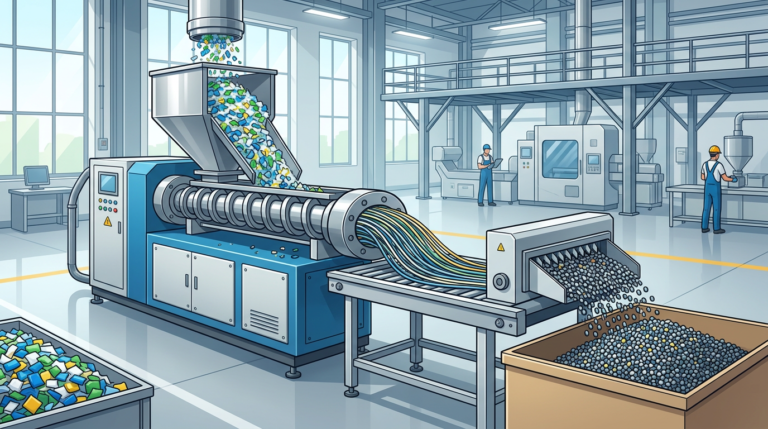
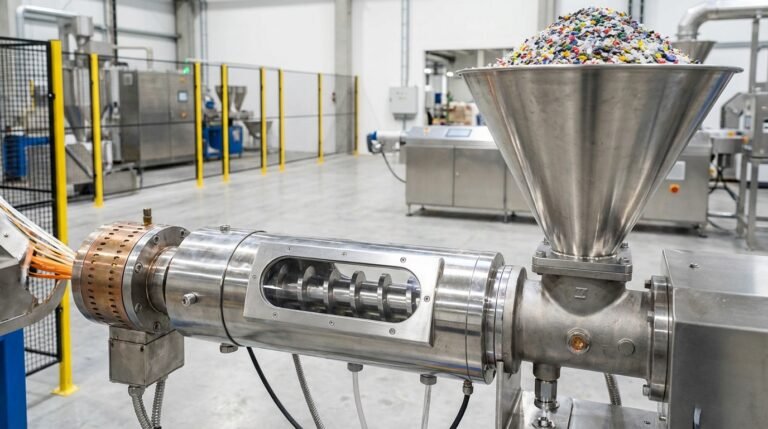
Make some changes to the world environment
The machine you bought will bring you profits, but it will also indirectly change the world environment and give waste plastics a chance to be utilized.

Make some changes to the world environment
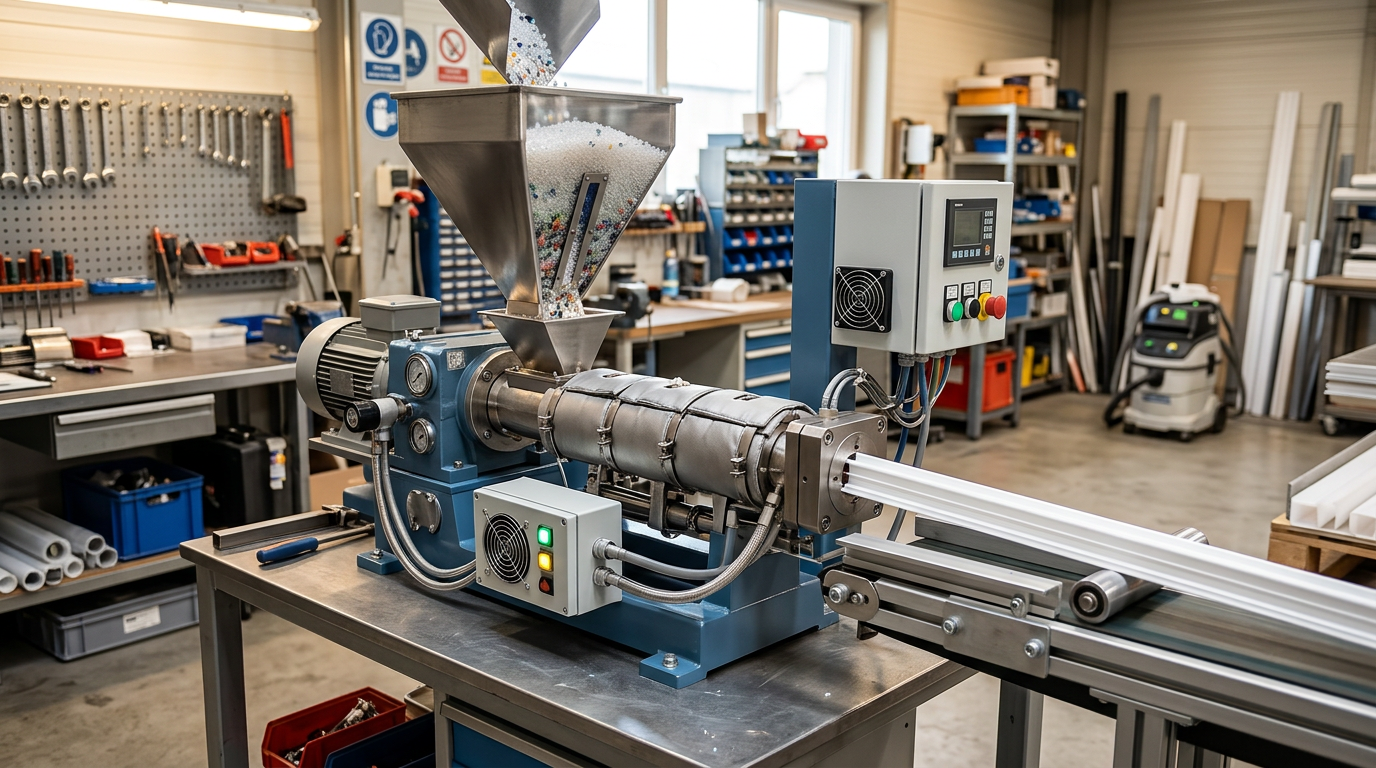
Last spring, a guy named Marco reached out to me from his garage workshop in Phoenix. He had $12,000 saved up, a pile of scrap HDPE he’d been collecting from local businesses, and one question: “Can I actually buy a plastic extruder machine that fits in my two-car garage and turns a profit?” Six months later, he was selling recycled plastic lumber to landscaping companies and clearing $3,500 a month in net profit. The machine that made it happen? A compact single-screw extruder that cost him less than a used Honda Civic. If you’re looking for a plastic extruder machine for small business that’s currently for sale in 2026, you’re in the right place — and the options are better (and more affordable) than most people realize.
The small business extruder market in 2026 looks nothing like it did even three years ago. Back then, if you wanted a plastic extrusion machine, you were mostly stuck choosing between cheap, unreliable benchtop units from no-name sellers on Alibaba or full-scale industrial lines that cost six figures and needed a warehouse. That gap has closed dramatically.
Right now, you can buy a plastic extruder machine for small business in four broad categories:
Most of these ship directly from manufacturers in China — and before you flinch at that, let me be blunt. I’ve toured factories in Zhangjiagang, Guangzhou, and Qingdao. The quality gap between Chinese-made small business extruders and their European counterparts has narrowed to the point where, for 80% of small business applications, the Chinese machines deliver identical results at 30-50% of the cost. The key is knowing which manufacturers to trust. JianTai, for example, has built a reputation specifically around efficient plastic recycling equipment designed for smaller operations — not just scaled-down versions of industrial monsters.
Here’s what matters for buyers right now: lead times are averaging 25-45 days for standard models, most reputable suppliers offer FOB or CIF shipping terms, and an increasing number provide turnkey packages that include installation guidance, spare parts kits, and video-call operator training. The barrier to entry has never been lower.
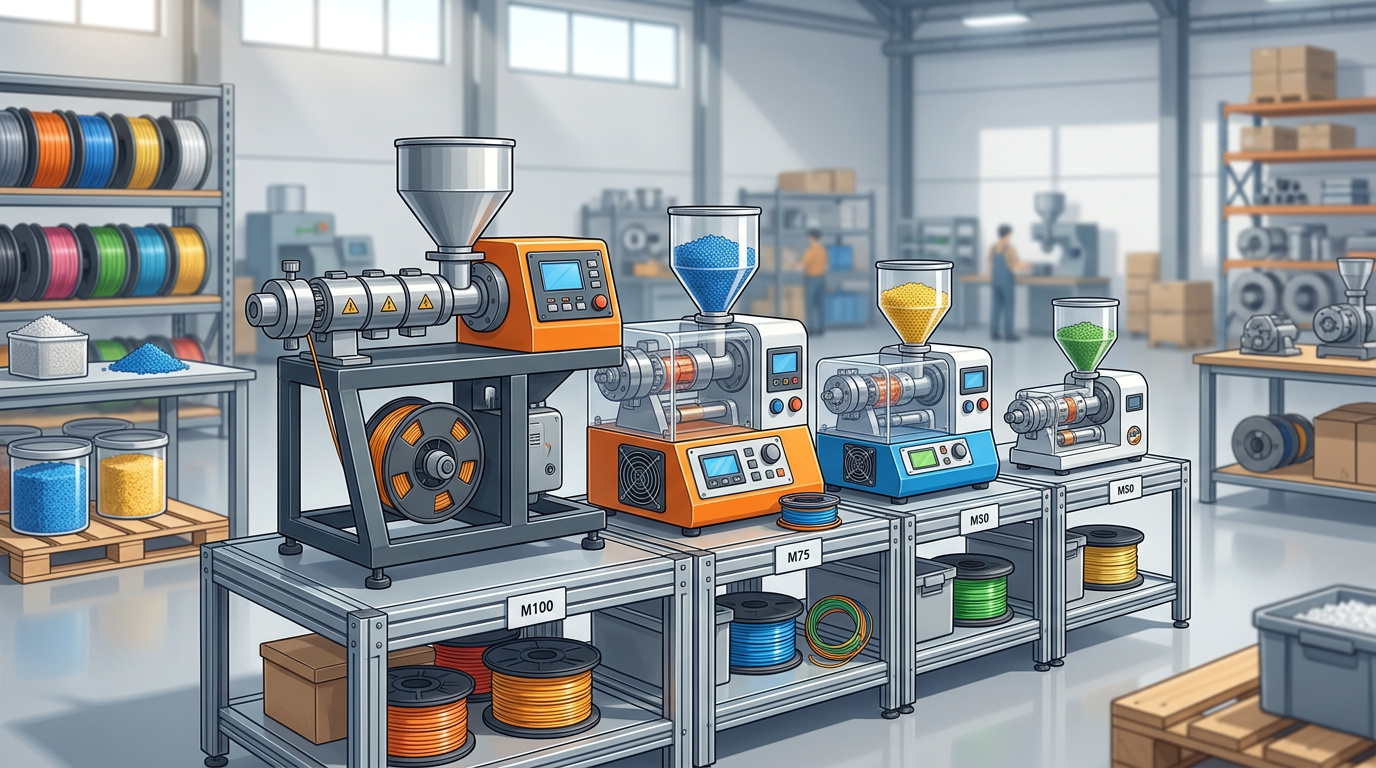
Choosing the right type of extruder is the single most important decision you’ll make — more important than brand, more important than price. I’ve seen small business owners waste $15,000 on a machine that technically works great but is completely wrong for their application. A twin-screw extruder is overkill if you’re just making basic PE pipe. A filament extruder won’t help you if you’re trying to pelletize scrap plastic.
So let’s cut through the noise and match machine types to actual business use cases.
| Extruder Type | Best For | Typical Output | 2026 Price Range | Space Needed |
|---|---|---|---|---|
| Single-Screw | Pipe, profile, sheet, basic recycling | 20-200 kg/hr | $2,800 – $25,000 | 15-40 m² |
| Twin-Screw | Compounding, color masterbatch, recycling blends | 30-300 kg/hr | $8,000 – $50,000+ | 25-60 m² |
| Filament Extruder | 3D printing filament production | 1-15 kg/hr | $1,500 – $15,000 | 2-8 m² |
| Sheet/Profile Line | Flat sheets, custom profiles, edge banding | 15-150 kg/hr | $5,000 – $35,000 | 20-50 m² |
A quick reality check: if your budget is under $5,000, you’re looking at entry-level single-screw machines or filament extruders. That’s not a limitation — it’s actually where most successful small businesses start. You can always upgrade later once cash flow supports it. If you want a deeper dive into the different configurations, this guide to plastic extrusion equipment breaks down the options in more detail.
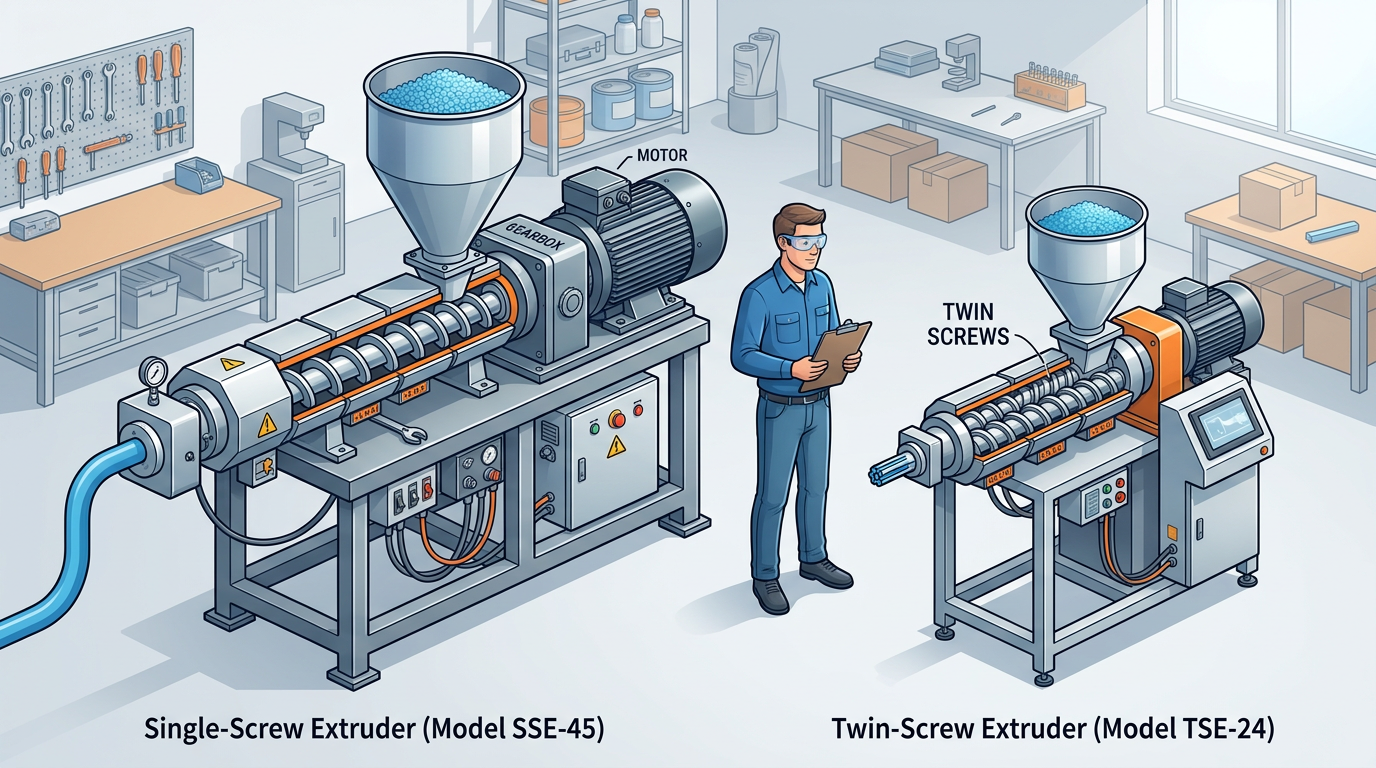
If I had to recommend one machine type to someone starting their first plastic business, it would be a single-screw extruder. Every time. No hesitation.
Why? Because they’re simple. One screw, one barrel, one motor. Fewer things to break, fewer things to calibrate, and a learning curve that most operators can handle within a week of hands-on training. I’ve watched complete beginners — people who’d never touched a manufacturing machine in their lives — produce sellable plastic pipe within three days of unboxing a single-screw unit.
For small businesses, the sweet spot is machines with a screw diameter between 30mm and 65mm. Here’s what that translates to in practical terms:
One thing most sellers won’t tell you: the screw L/D ratio matters as much as the diameter. For general-purpose work with common thermoplastics, look for an L/D ratio of 25:1 to 30:1. Go shorter and you’ll get inconsistent melt quality. Go longer and you’re paying for capacity you probably don’t need yet.
The materials you can process on a basic single-screw unit include HDPE, LDPE, PP, PVC (with proper screw design), ABS, and HIPS. If you’re planning to work with engineering plastics like nylon or polycarbonate, you’ll need upgraded barrel heating zones and a hardened screw — which adds maybe $800-$2,000 to the base price.
Pro tip from the field: When comparing single-screw models, ask the supplier for the specific screw compression ratio. A 3:1 compression ratio works well for most polyolefins. If a seller can’t tell you the compression ratio, that’s a red flag — it means they’re reselling machines they don’t actually understand.
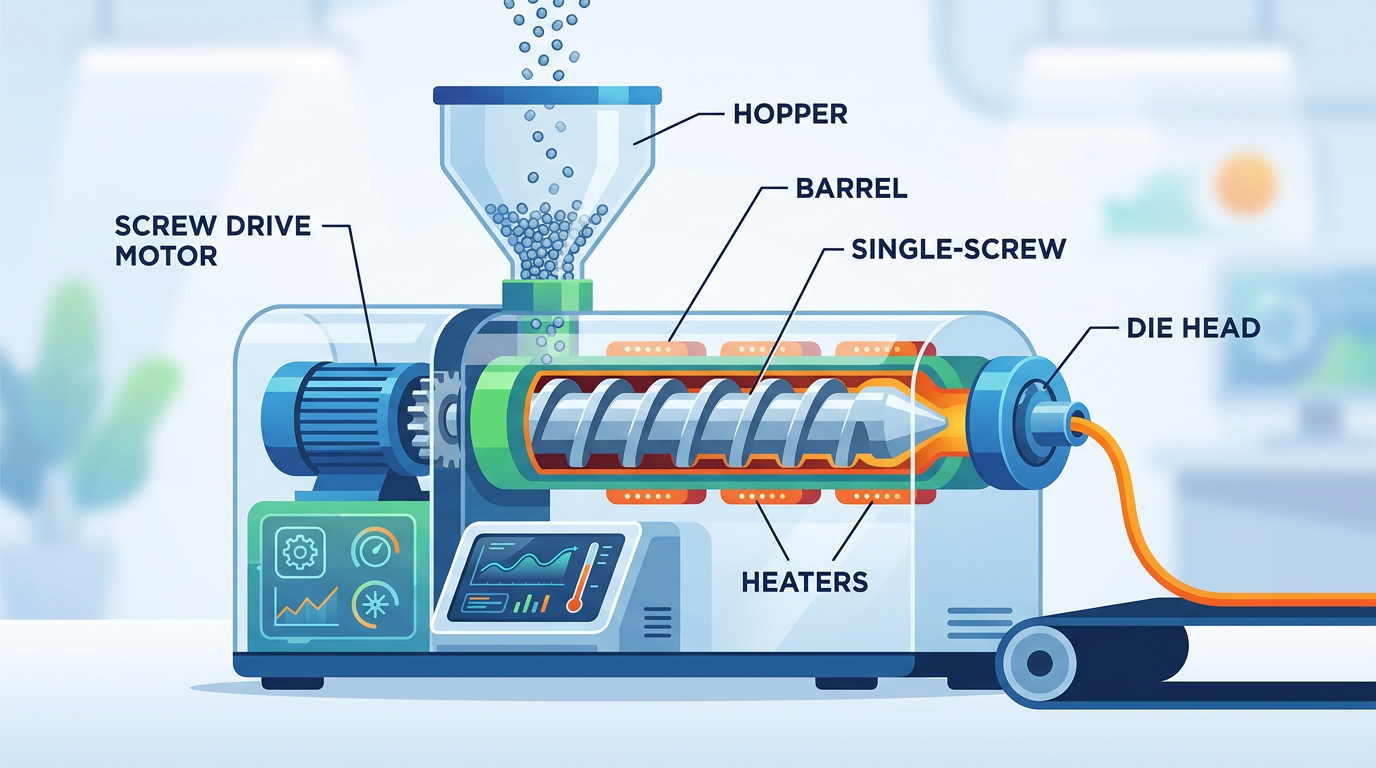
Twin-screw extruders are where things get interesting — and where the profit margins can get seriously fat.
Here’s the deal. A single-screw extruder melts plastic and pushes it through a die. That’s basically it. A twin-screw extruder does that plus mixing, compounding, devolatilizing, and reactive processing. Two intermeshing screws create intense shear and distributive mixing that a single screw simply cannot match.
For small businesses, twin-screw machines open up applications that single-screw units can’t touch:
The entry-level twin-screw extruder for small business is typically a co-rotating model with a 20mm to 35mm screw diameter. Expect to pay $8,000-$18,000 for a quality unit from a reputable Chinese manufacturer. Models in the 50mm-65mm range jump to $20,000-$50,000 but deliver substantially higher throughput.
I want to be honest about something, though. Twin-screw machines are more complex to operate and maintain. The screw elements are modular — you configure them differently depending on what you’re processing — and getting the configuration wrong means bad output quality or, worse, damaging the screws. If you’re a complete beginner with no technical background, I’d suggest either starting with a single-screw machine or budgeting for proper training from your supplier.
For those specifically interested in the recycling angle, JianTai’s plastic pelletizing machines are designed to handle the kind of mixed-stream post-consumer waste that gives generic extruders headaches. Worth looking at if recycling is your primary business model.
This is the category that surprises people. When most folks think “plastic extruder for small business,” they picture a factory floor. But some of the most profitable small-scale extrusion businesses in 2026 are run by one or two people producing specialty 3D printing filament from a spare bedroom or small studio.
The 3D printing filament market is projected to hit $4.2 billion by 2028 according to Grand View Research, and here’s the thing that makes it perfect for small businesses: the big filament manufacturers focus on standard PLA and ABS in common colors. They’re not interested in producing 50-spool runs of glow-in-the-dark PETG or carbon-fiber-filled nylon in custom Pantone colors. But makers, engineers, and specialty print shops will pay $40-$80 per kilogram for exactly those kinds of niche filaments.
The machines you need are surprisingly affordable:
The profit math is compelling. Raw PLA pellets cost roughly $2-4 per kilogram. Finished specialty filament sells for $25-$80 per kilogram depending on the material and niche. Even after accounting for waste, electricity, and packaging, you’re looking at gross margins north of 70%.
One caveat: diameter consistency is everything in filament production. If your filament diameter varies by more than +/- 0.05mm, it’s essentially unsellable for quality-conscious buyers. Cheaper extruders struggle with this. If you’re serious about filament as a business, invest in a machine with a closed-loop diameter measurement system — it’ll pay for itself within the first month by eliminating waste.
Let’s talk money. Because I know that’s what you’re really here for.
I’m going to give you the real 2026 pricing — not the inflated MSRP that nobody actually pays, and not the suspiciously low “starting from” prices that don’t include essential components. These are the actual landed costs I’ve seen small business buyers pay this year, including shipping to North America or Europe:
| Machine Category | Budget Tier | Mid-Range | Premium |
|---|---|---|---|
| Single-Screw (30-45mm) | $2,800 – $5,000 | $5,000 – $12,000 | $12,000 – $25,000 |
| Twin-Screw (20-35mm) | $8,000 – $15,000 | $15,000 – $30,000 | $30,000 – $50,000+ |
| Filament Extruder | $1,500 – $3,500 | $3,500 – $8,000 | $8,000 – $15,000 |
| Sheet/Profile Line | $5,000 – $10,000 | $10,000 – $22,000 | $22,000 – $35,000 |
Important: These prices typically include the extruder, standard die, control panel, and motor. They usually do not include downstream equipment (cooling tanks, pullers, cutters, winders), which can add 20-40% to your total investment. Always ask for a complete line quotation, not just the extruder price.
Now, financing. This is where a lot of small business buyers get stuck, because traditional banks don’t love lending money for manufacturing equipment to startups. Here are the realistic options I’ve seen work in 2026:
My personal take? If you can afford to buy outright — even if it means starting with a cheaper machine — do it. Debt on a business that hasn’t proven its revenue model yet is a recipe for stress. Marco from the story at the top of this article? He started with a $4,200 single-screw extruder, paid cash, and upgraded to a $18,000 unit eight months later using profits from the first machine. That’s the path I recommend.
I’ve tested, toured factories for, or gotten detailed feedback from buyers on dozens of small business extruders over the past three years. Here are the machines I’d actually recommend spending money on in 2026 — and a couple I’d avoid.
This is the machine I point most first-time buyers toward. The 45mm screw handles PE, PP, and ABS at 40-80 kg/hr, which is enough output for most small business applications without being wasteful. The control panel is straightforward — PID temperature controllers, a variable frequency drive for screw speed — and the build quality is genuinely solid. I’ve seen units running 12 hours a day for two years with nothing but routine maintenance. Price: approximately $6,500-$9,000 FOB depending on configuration. For context on the full recycling setup, check out the definitive guide to plastic recycling machines.
If your business model revolves around buying scrap plastic and selling recycled pellets, this is purpose-built for that job. The 65mm screw with a venting zone handles moisture and volatiles from post-consumer waste without needing a separate pre-drying step (saving you time and an extra machine). Output: 80-120 kg/hr. Price: $12,000-$18,000 FOB.
Multiple manufacturers produce nearly identical 30mm single-screw lab extruders in the $2,800-$4,500 range. They’re basic — manual temperature control, simple die designs — but they work. If your total budget is under $5,000, this is where you start. Just make sure the supplier provides at least a 1-year warranty on the motor and barrel.
For 3D printing filament production, the 3devo Composer is the benchmark. Integrated diameter sensor, air-cooling system, and touchscreen interface. It produces remarkably consistent filament at about 1 kg/hr. Price: around $9,500. It’s not cheap, but the filament quality is noticeably better than what sub-$3,000 machines produce.
If you need twin-screw capabilities on a small business budget, the KY-26 (26mm diameter, co-rotating) delivers legitimate compounding performance. Output: 10-30 kg/hr depending on formulation. Price: $12,000-$20,000. The modular screw design lets you reconfigure for different applications, which is valuable if you’re still figuring out your product mix.
Machines I’d skip: I won’t name specific brands, but be very cautious of extruders priced below $2,000 on Alibaba with no factory verification. I’ve personally seen three buyers receive machines with undersized motors (labeled as 7.5kW but actually 5.5kW), substandard barrel steel, and zero after-sales support. The $1,000 you save upfront costs you $5,000 in replacement parts and lost production within six months.
I get asked this constantly: “Why wouldn’t I just buy a used industrial extruder? They’re all over the secondhand market for cheap.”
Fair question. And the answer isn’t what most equipment guides will tell you.
Yes, you can find used industrial extruders — 90mm, 120mm, even 150mm screw diameter monsters — for $10,000-$30,000 on resale sites. On paper, that looks like a bargain. In reality, it’s usually a trap for small businesses. Here’s why.
Power requirements will eat you alive. An industrial 120mm extruder typically needs a 75-150kW motor. That’s 100-200 amps on three-phase 480V power. Most small business locations don’t have that kind of electrical service, and upgrading costs $5,000-$25,000 just for the electrical panel and utility connection. A small business 45mm extruder? It runs on 7.5-15kW. That’s a regular three-phase connection that most commercial spaces already have.
Floor space and ceiling height. Industrial extruders with their downstream equipment can stretch 15-30 meters long and need 4+ meter ceiling clearance. A compact small business line fits in 5-10 meters with standard ceiling height.
Minimum viable run size. Here’s the one nobody talks about. An industrial extruder takes 30-60 minutes to reach operating temperature and stabilize. The startup waste — the material that runs through while you’re dialing in — can be 50-200 kg. If you’re producing 500 kg runs, that waste is acceptable. If you’re doing 50 kg custom runs for different customers, you’re losing 20-40% of your material just in startup and changeover waste. Small business extruders stabilize in 10-20 minutes with 5-15 kg of startup waste.
The ROI math tells the whole story. A $7,000 small business extruder that processes 50 kg/hr and runs 6 hours a day, 5 days a week, produces about 6,500 kg per month. If you’re making recycled pellets with a $0.30/kg margin, that’s roughly $1,950/month in gross profit. Your machine pays for itself in under 4 months. An industrial machine at three times the purchase price, with triple the power bill and ten times the startup waste, takes 12-18 months to break even on small production volumes.
Smaller is smarter when you’re starting out. Period.
After helping dozens of small business owners pick their first extruder, I’ve developed a checklist that separates the machines worth buying from the ones that’ll give you headaches. Print this out. Seriously.
The screw and barrel are the heart of the machine. You want a nitrided steel barrel (38CrMoAlA is the industry standard alloy) and a screw made from the same or comparable material. Cheap machines use plain carbon steel that wears out in 6-12 months of regular use. Ask the supplier for the barrel hardness specification — it should be HV 900+ on the nitrided surface. If they can’t provide this number, walk away.
Look for a machine with a variable frequency drive (VFD), not a fixed-speed motor with a mechanical gearbox. A VFD lets you precisely control screw speed, which directly affects output quality and lets you process different materials without hardware changes. Most quality small business extruders in 2026 come with VFDs standard, but some budget models still use fixed-speed setups. The difference in operational flexibility is enormous.
You need independent PID controllers for each heating zone — minimum 3 zones for a 30mm machine, 4-5 zones for a 45mm+. Machines with a single temperature controller for the entire barrel cannot produce consistent output. Also check whether the machine has both heating and cooling for each zone. Cooling fans on the barrel allow you to quickly adjust temperatures when switching materials or if a zone overheats.
Not all extruders handle all plastics. If you plan to process PVC, the machine needs a specific screw design (lower compression ratio, typically 2:1 to 2.5:1) and corrosion-resistant barrel lining. Running PVC through a standard polyolefin screw will degrade the PVC and corrode your barrel within weeks. For a detailed breakdown of how different extruder parts and functions affect material processing, that guide is worth bookmarking.
Bigger isn’t better. I’ve seen small business owners buy a 150 kg/hr machine when they only need 30 kg/hr because “room to grow.” The problem? Running a large extruder at 20% capacity is inefficient — you waste energy, the melt quality suffers, and you’re paying for capacity that sits idle. Buy for your current needs plus maybe 30-50% headroom. That’s it.
At the small business level, you don’t need a fully automated PLC-controlled line with SCADA monitoring. That’s a $10,000+ premium that won’t pay off unless you’re running 24/7. What you do want: automatic temperature control (PID), a digital screw speed display, and an overload protection system. Nice-to-have: a gravimetric feeder for consistent material dosing, especially if you’re doing compounding work.
This is where cheap machines really burn you. A good supplier offers:
Ask the supplier directly: “If my barrel heater fails in 14 months, how quickly can you ship a replacement and what does it cost?” Their answer tells you everything about whether they’re a real partner or just chasing a one-time sale.
You’ve picked your machine. You’ve wired the payment. Now what?
This is the part of the buying process that catches first-timers off guard, so let me walk you through exactly what to expect — because I’ve seen too many buyers panic when a 2-ton crate shows up on a flatbed truck and they realize they haven’t thought about how to get it off.
For machines shipping from China to North America or Europe, here’s the realistic timeline in 2026:
Total door-to-door: roughly 45-80 days from order confirmation. Plan accordingly. If you need the machine running by a specific date, work backward from that date and add a 2-week buffer for the unexpected.
Shipping cost varies wildly depending on machine size and destination. A compact 30mm extruder might ship for $800-$1,500 to a U.S. port. A complete 65mm extrusion line with downstream equipment could run $3,000-$6,000. Always get a CIF quote (Cost, Insurance, and Freight) so you know the total landed cost before you commit.
Most small business extruders ship in wooden crates on pallets. You’ll need either a forklift (for machines under 1,500 kg) or a small crane/boom truck for heavier units. Don’t try to muscle a 2,000 kg crate off a truck with three guys and a prayer. I’ve seen it attempted. It doesn’t end well.
When the crate arrives, inspect it before signing the delivery receipt. Photograph any visible damage to the crate exterior. Open it within 48 hours and check the machine against the packing list. Report any shipping damage to both the supplier and your freight insurance provider immediately — most policies have a 5-day reporting window.
Small business extruders are significantly easier to install than industrial machines, but you still need to prepare your space:
Reputable suppliers provide operator training — the format varies. JianTai and similar manufacturers typically offer:
My strong recommendation: take the video training seriously. Record the sessions. Create a simple SOP document for your specific machine and materials. The most common cause of early machine problems isn’t defective equipment — it’s operator error during the first two weeks.
Here’s something I wish someone had told me years ago: the price you see listed on a supplier’s website is almost never the price you’ll actually pay. It’s a starting point. Every serious manufacturer expects to customize the quotation based on your specific needs, and the final price can go up or down depending on what you actually require.
To get an accurate, useful quote — and to avoid three rounds of back-and-forth emails — prepare this information before you reach out:
Most suppliers respond to quote requests within 24-48 hours. If you don’t hear back within 3 business days, that’s a signal about their customer service — and it only gets worse after you’ve paid.
When you receive the quote, look for these line items specifically:
If any of those are missing, ask. A supplier who provides a vague, one-line quote without detailed specifications is either disorganized or deliberately obscuring what you’re getting.
In 2026, small business plastic extruder machines range from $1,500 for a basic desktop filament extruder to $50,000+ for a fully equipped twin-screw compounding line. The most popular price bracket for first-time small business buyers is $5,000-$15,000, which gets you a capable single-screw extruder (45-65mm) with standard die and basic downstream equipment. Remember to budget an additional 20-40% for downstream equipment, shipping, installation, and initial raw materials. A realistic total startup investment for a basic extrusion operation is $8,000-$25,000 all-in.
For absolute beginners, I recommend starting with a single-screw extruder in the 30-45mm range. These machines have the simplest operation, the fewest things that can go wrong, and the most forgiving processing window. Specifically, the JianTai SJ-45 is a strong choice — it’s affordable ($6,500-$9,000), handles the most common thermoplastics, and comes with training support. If you’re entering the 3D filament niche, the 3devo Composer 450 is the most beginner-friendly filament extruder on the market, with an intuitive touchscreen interface and built-in diameter monitoring.
The biggest mistake beginners make? Buying a twin-screw machine as their first extruder because someone told them it’s “more versatile.” It is more versatile — and it’s also significantly harder to learn, more expensive to maintain, and less forgiving of operator errors. Master the single-screw first. You can always add a twin-screw later.
Absolutely — and thousands of people are doing exactly that in 2026. A small extruder is the core of a recycling operation, but you’ll need a few additional pieces of equipment to build a complete plastic recycling line:
Total startup cost for a small plastic recycling operation: $10,000-$40,000 depending on scale and automation level. The revenue side? Recycled HDPE pellets sell for $600-$900 per metric ton in 2026 according to Plastics Today, and recycled PET commands $800-$1,200 per ton. If you can source cheap or free scrap plastic (many businesses will pay you to haul it away), the margins are very attractive.
Yes, but the options depend on where you’re buying from. Here’s the breakdown:
One thing to watch out for: some suppliers advertise “0% financing” or “no money down” deals. Read the fine print carefully. These often include inflated machine prices that more than offset the financing benefit, or balloon payments at the end of the term.
Look, I’ve thrown a lot of information at you. So let me boil it down to the decisions that actually matter.
If you’re starting a small plastic business in 2026, here’s the shortest path from “thinking about it” to “making money”:
JianTai has been manufacturing plastic recycling and extrusion equipment for years, with a specific focus on machines sized for small and medium businesses. Their engineering team can help you configure the right extruder for your exact application — whether that’s recycling post-consumer HDPE, producing custom plastic profiles, or building a complete pelletizing line from scratch.
Here’s what to do right now: Head to the JianTai website, use the quote request form, and include the details I outlined in the custom quote section above — your target material, desired output, power supply specs, and budget range. You’ll get a detailed, itemized quotation within 24-48 hours. No pressure, no obligation. Just real numbers you can use to make a smart decision.
Marco from Phoenix didn’t overthink it. He spent two weeks researching, requested three quotes, picked the machine that matched his budget and application, and placed the order. Four months later, he had a profitable business. Your timeline could look the same.
Stop researching. Start extruding.