Apportare alcune modifiche all'ambiente mondiale
La macchina che avete acquistato vi porterà profitti, ma cambierà anche indirettamente l'ambiente mondiale e darà la possibilità di utilizzare i rifiuti plastici.

Apportare alcune modifiche all'ambiente mondiale
The global plastic recycling machinery market hit $1.7 billion in 2023, and projections from Grand View Research suggest it will nearly double by 2030 — yet most buyers still struggle to tell one plastic recycling machinery manufacturer from another. Choosing the right manufacturer determines not just your upfront equipment cost but your throughput consistency, pellet quality, downtime frequency, and long-term ROI across 10–15 years of operation. This guide breaks down the major manufacturers by region, compares machine types and pricing tiers, and walks through the exact evaluation criteria that separate a reliable partner from an expensive headache.
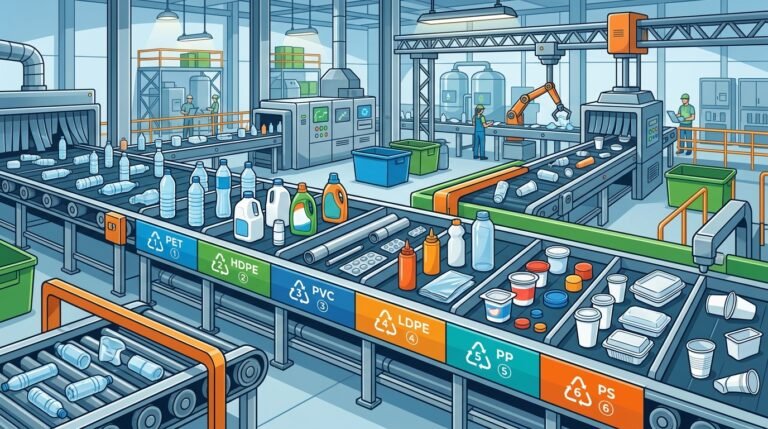
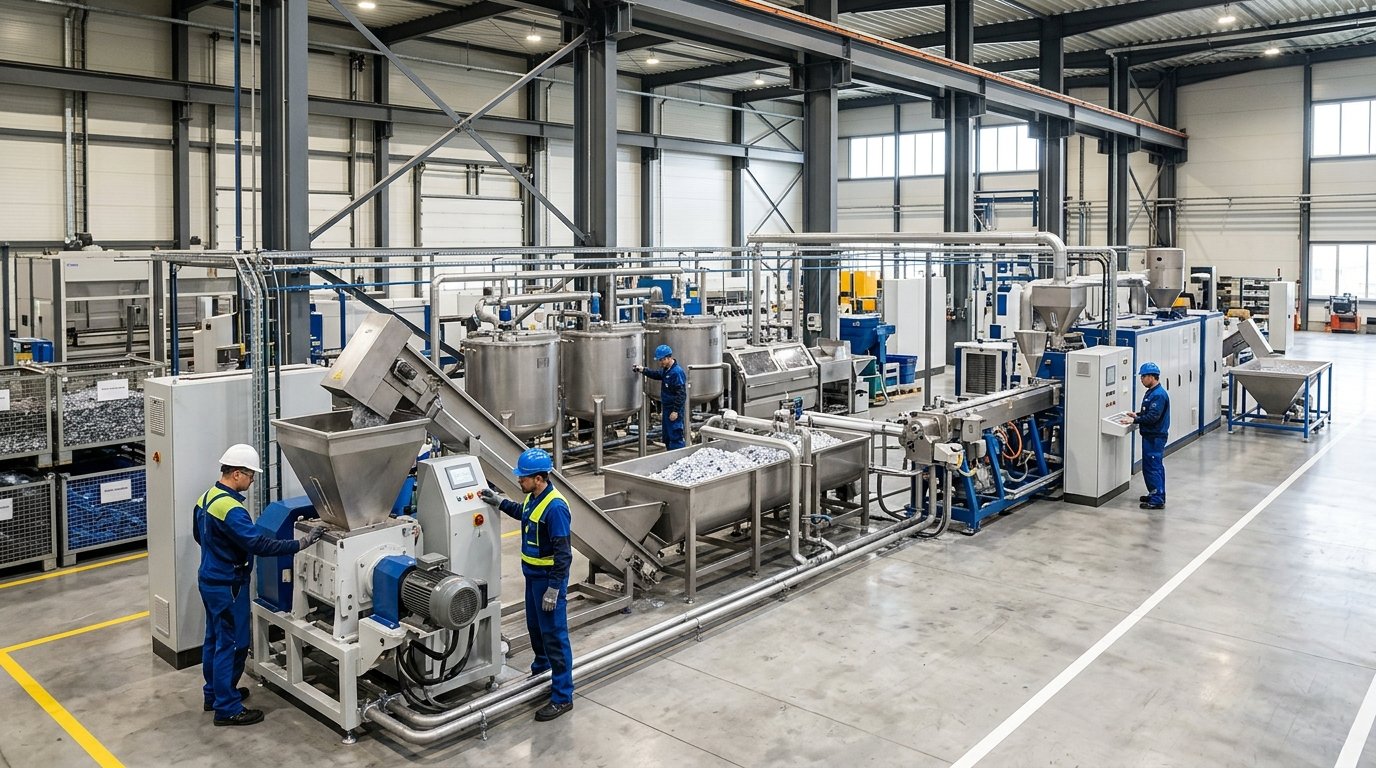
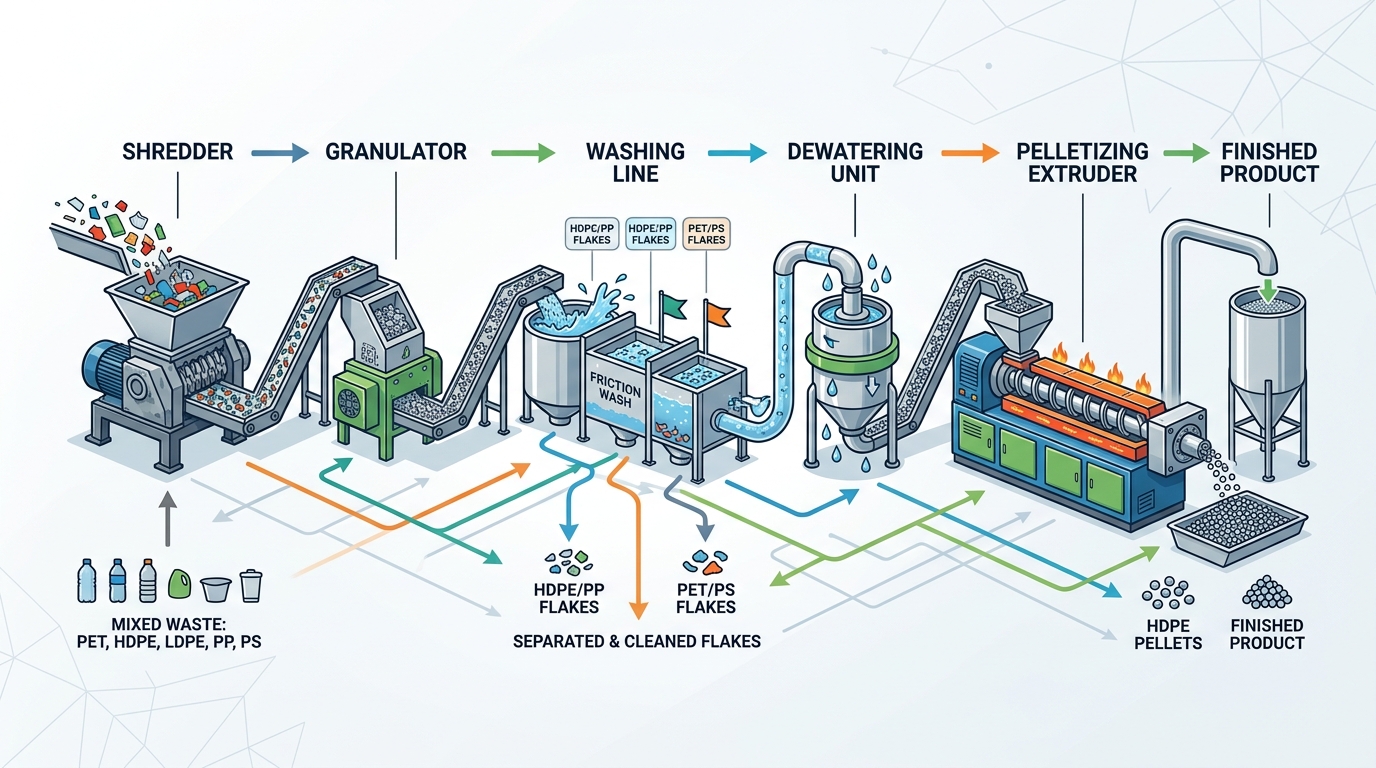
Plastic recycling machinery turns post-consumer and post-industrial waste into reusable raw material. A complete line typically includes shredders that break bulky items into fragments, washing systems that strip away contaminants like labels and adhesives, granulators that size-reduce flakes to a uniform cut, and pelletizers paired with extrusion systems that melt and reshape clean plastic into market-ready pellets. Each stage has to work in sync — a bottleneck at the washing line, for instance, starves the extruder downstream and tanks your hourly throughput.
That interdependence is exactly why the plastic recycling machinery manufacturer you choose matters more than any single spec on a data sheet. A manufacturer that engineers the full process — not just individual machines — can match motor sizing, conveyor speeds, and thermal profiles so the entire system hits its rated capacity. Get this wrong and you’re looking at 15–30% output losses, frequent unplanned downtime, and pellet quality too inconsistent for buyers who demand MFI tolerances within ±0.5 g/10 min.
According to the Grand View Research plastic recycling market report, global demand for recycled resin is projected to grow at a CAGR above 9% through 2030. That growth means more buyers entering the market — and more pressure to source equipment that delivers consistent ROI from day one. If you’re new to how plastic recycling actually works, understanding the machinery chain is the first step toward making a confident purchasing decision.
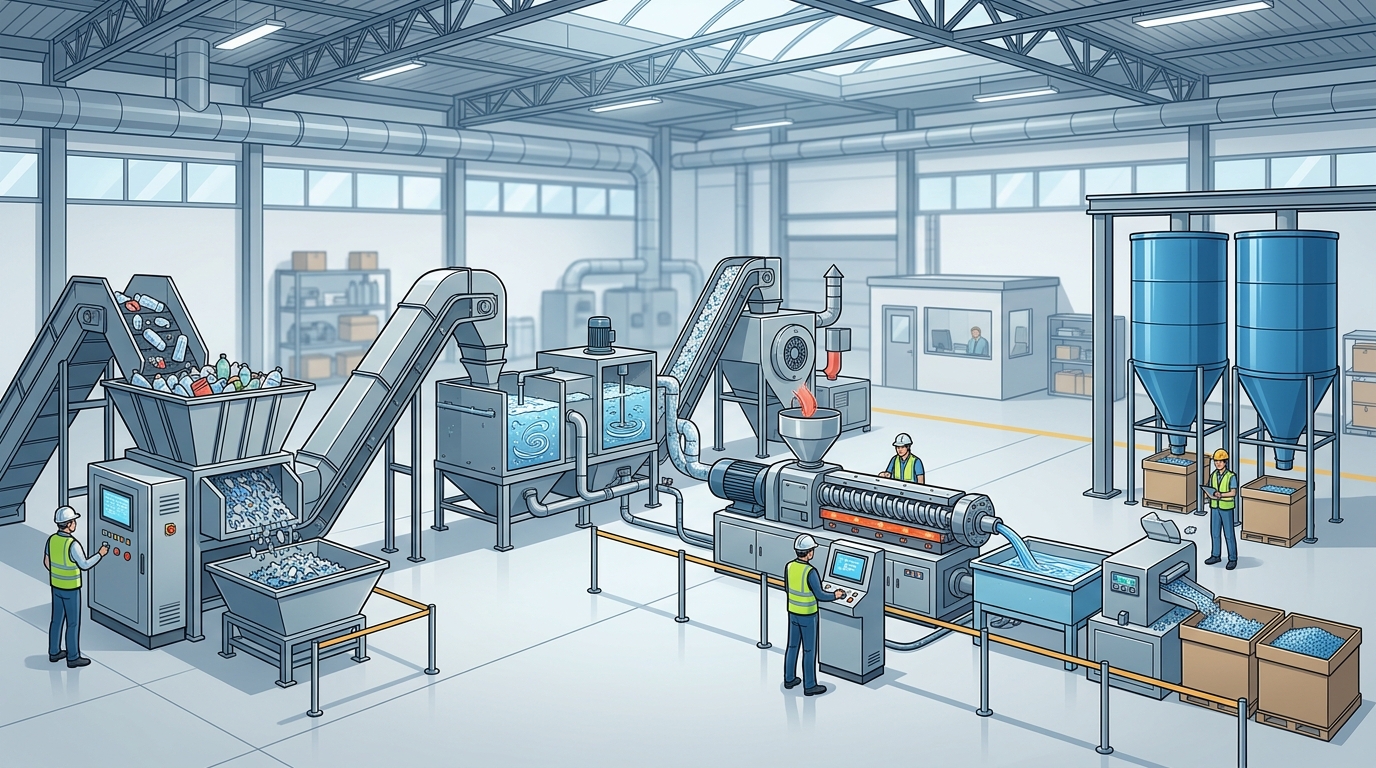
Every recycling line is built from a handful of core machine types, each tackling a different stage of the process. Matching the right equipment to your feedstock — PET bottles, HDPE drums, LDPE film, or PP woven bags — is where most buying decisions start. A reputable plastic recycling machinery manufacturer will typically offer these categories as standalone units or integrated turnkey lines.
Single-shaft shredders excel at bulky rigid plastics like HDPE containers, cutting them into 20–50 mm pieces at throughputs of 500–2,000 kg/hr. Double-shaft models handle mixed, contaminated bales — think agricultural film tangled with dirt. Granulators then reduce those pieces further to uniform 8–12 mm flakes, which is critical for clean downstream washing.
Friction washers strip labels and surface grime from PET and HDPE flakes in seconds. Hot washing tanks, running at 80–95 °C with caustic soda, dissolve glue residue that cold water can’t touch. Centrifugal dewatering machines then bring moisture content below 3%, preparing flakes for extrusion. For a deeper look at how these stages connect, see how plastic recycling actually works.
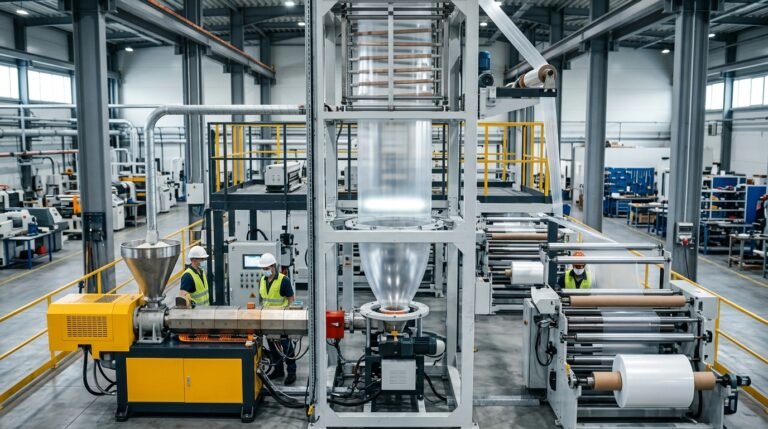
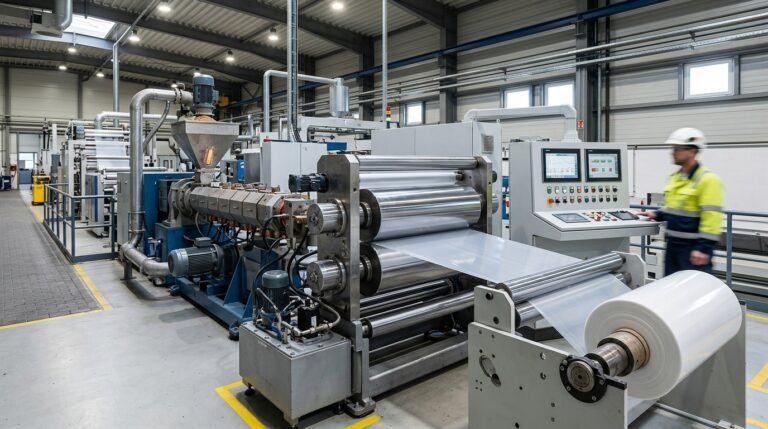
This is where clean flakes become sellable pellets. Single-screw extruders suit straightforward PET and PP reprocessing, while twin-screw systems handle trickier materials like printed LDPE film that off-gases during melting. According to the Association of Plastic Recyclers, pellet quality directly determines resale value — so extruder choice matters more than most buyers realize.
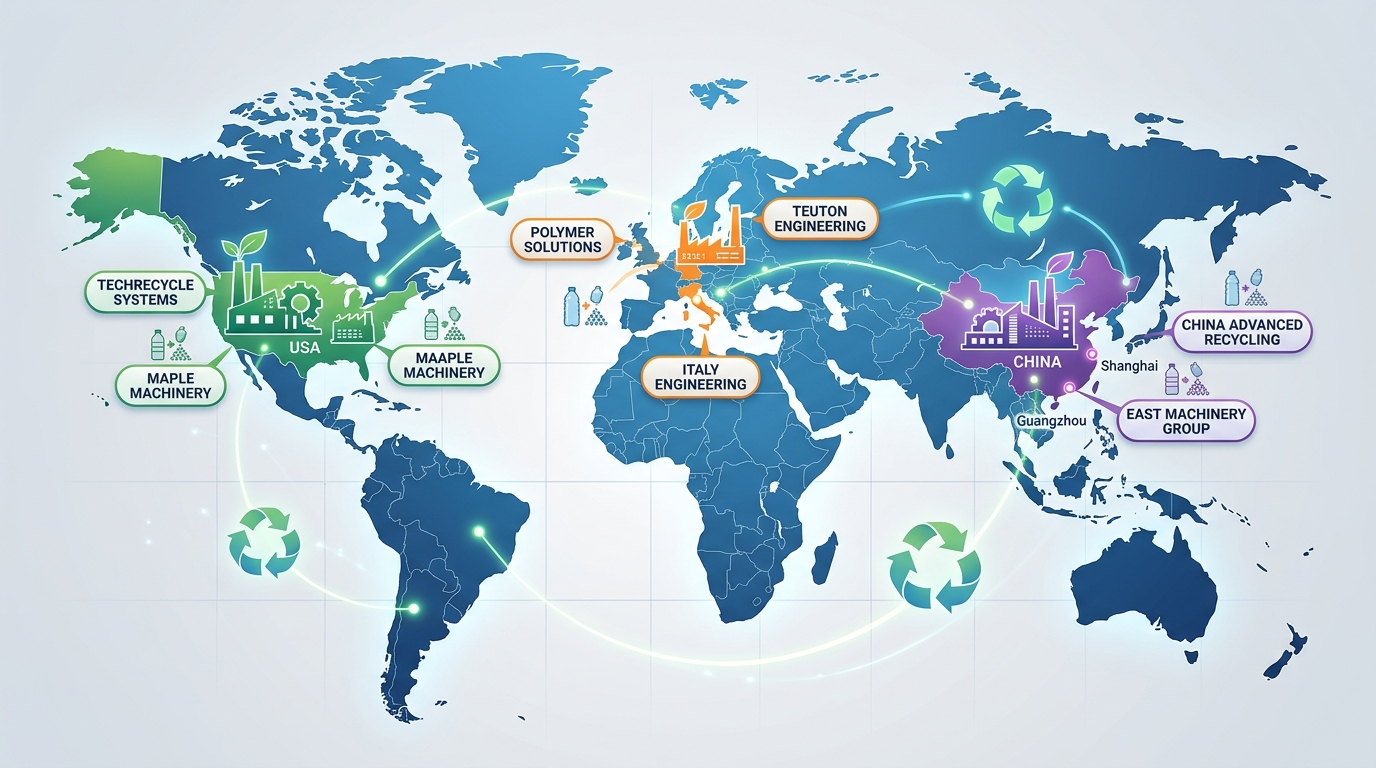
The global market for recycling equipment splits roughly into three manufacturing hubs: China, Europe, and North America. Each region brings a different philosophy to machine design, pricing, and after-sales support, so where your equipment comes from shapes your entire operation.
Cina dominates export volume. Among Chinese suppliers, Macchina JianTai stands out as a plastic recycling machinery manufacturer specializing in complete turnkey lines — washing, crushing, drying, and pelletizing integrated into a single project scope. Their equipment ships to Southeast Asia, Africa, the Middle East, and South America, with pricing that typically ranges from $10,100 to $50,000 depending on configuration. That price-to-capability ratio is hard to match elsewhere.
Europa leans toward premium, high-automation systems. EREMA (Austria) is the benchmark for pelletizing and filtration technology, while Herbold Meckesheim (Germany) excels in washing and size-reduction equipment. Expect European machines to cost 2–4× more than comparable Chinese lines, justified partly by tighter energy-efficiency specs and localized service networks.
Nord America has fewer OEMs but strong system integrators — companies like Van Dyk Recycling Solutions that assemble sorting and processing lines from mixed-origin components. For buyers exploring how the full recycling chain works before committing to a supplier, this overview of plastic recycling processes is a useful starting point.
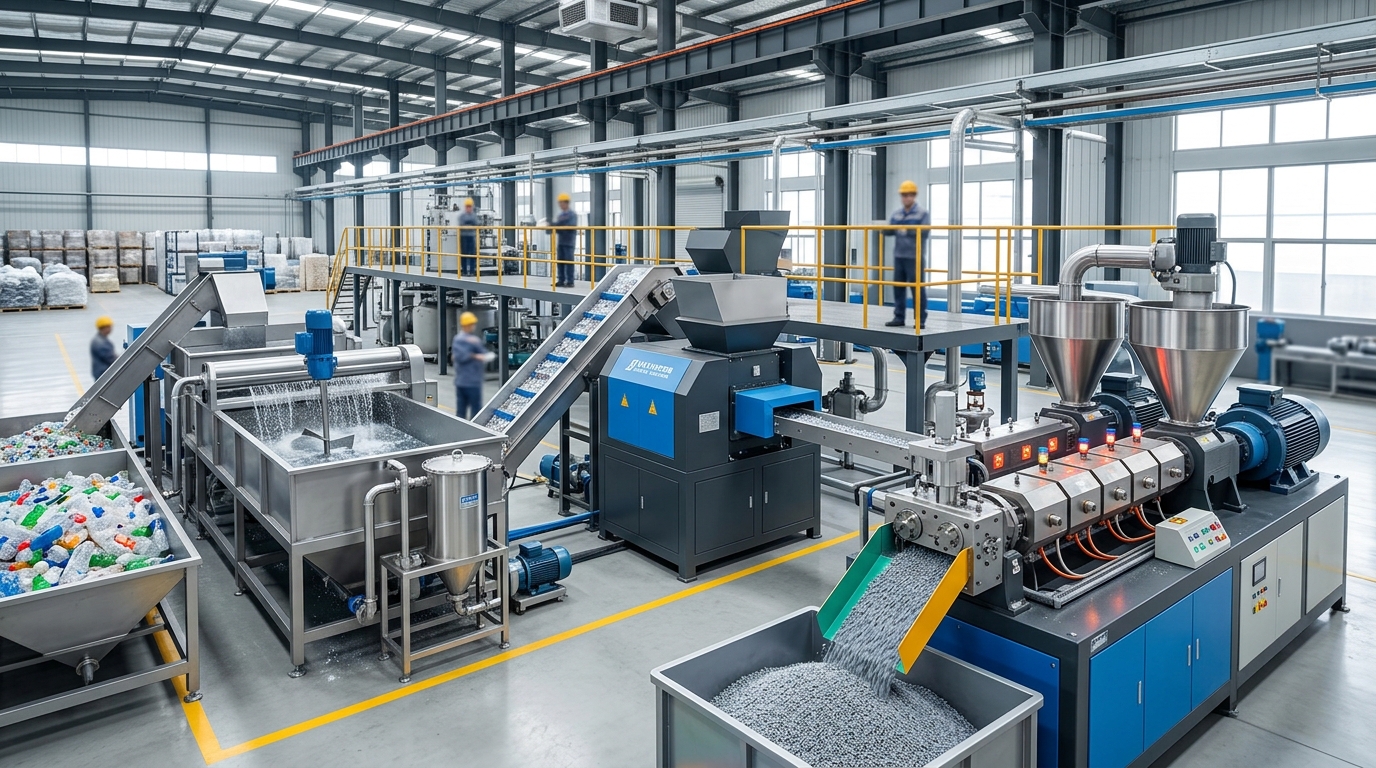
JianTai Machine stands out among Chinese equipment suppliers for one specific reason: they build complete recycling lines, not isolated machines. Their product catalog covers washing systems, crushers, extruders, and pelletizers — all engineered to work as a single integrated workflow. That means fewer compatibility headaches and a single point of contact for technical support. For buyers assembling a full recycling extrusion line, this matters more than most realize.
Their equipment handles PE, PP, PET, PLA, and PS, with published pricing starting around $10,100 and scaling up to $50,000 depending on throughput and configuration. Custom engineering is a core part of the offering — JianTai tailors line layouts to match the specific resin types and contamination levels a buyer deals with locally. That flexibility is hard to find from larger, more rigid plastic recycling machinery manufacturer operations in Europe.
After-sales support is another area where JianTai competes aggressively. They provide remote troubleshooting, spare parts shipping, and on-site installation guidance for international customers. According to their company site, they serve customers worldwide with consistently high review ratings. The pricing gap compared to European equivalents — often 40–60% lower for comparable output capacity — makes them a practical choice for recyclers operating on tighter margins in Southeast Asia, Africa, and Latin America.
Beyond the manufacturers already covered, several other companies deserve a spot on any buyer’s shortlist. Each brings regional advantages that shape pricing, lead times, and after-sales support.
Erema (Austria) dominates the European market with patented INTAREMA® technology for pelletizing post-consumer film. Their systems start around €350,000 for a basic line, climbing past €1.5 million for high-throughput configurations. Premium pricing, but the filtration quality is hard to beat.
Starlinger (Austria) focuses on woven-bag-to-pellet recycling and bottle-grade rPET lines. They’re a go-to plastic recycling machinery manufacturer for food-contact-approved output, with equipment typically in the €400,000–€1.2 million range.
Herbold Meckesheim (Germany) specializes in washing and size-reduction systems — shredders, granulators, friction washers. Expect mid-to-upper European pricing, but their wet-grinding technology handles heavily contaminated bales that cheaper machines choke on.
Polystar (Taiwan) offers compact pelletizing lines priced between $80,000 and $300,000, popular across Southeast Asia and Latin America. Good middle ground between Chinese pricing and European engineering standards. If you’re exploring how a complete recycling extrusion line comes together, Polystar’s integrated cutter-compactor design is a useful reference point.
Cumberland / ACS Group (USA) leads in North American granulator and shredder supply, serving both recyclers and injection molders. Their equipment ranges from $50,000 for standalone granulators to $500,000+ for full-scale industrial systems. Strong domestic service network — a real advantage when downtime costs $2,000–$5,000 per hour. According to Grand View Research, the North American recycling equipment segment is growing at roughly 5.7% CAGR through 2030, which explains why more regional players keep entering this space.
Start with build quality. Check whether the manufacturer uses hardened alloy screws, SKF bearings, and Siemens or ABB electrical components — or cheaper substitutes that wear out within 18 months. A factory visit, even virtual, reveals more than any brochure. Ask to see weld seams, barrel thickness, and how the control cabinet is wired.
Certifications matter, but context matters more. CE marking is mandatory for European markets, while ISO 9001 signals consistent manufacturing processes. A credible plastic recycling machinery manufacturer should hold both and provide documentation without hesitation.
Automation level directly impacts labor costs. PLC touchscreen controls, auto-feeding hoppers, and real-time temperature monitoring can cut operator headcount by 30–50%. Energy efficiency is equally critical — look for machines rated below 0.25 kWh per kilogram of output. Those numbers compound fast at 500 kg/h throughput running two shifts daily.
Spare parts availability separates good suppliers from frustrating ones. Ask about lead times for screws, screens, and blades. Anything beyond 7 days means costly downtime. Technical support responsiveness — 24-hour remote diagnostics, WhatsApp or WeChat access to engineers — should be confirmed before signing. Finally, evaluate willingness to customize: a manufacturer that adjusts line configurations for your specific resin type and throughput requirements is far more valuable than one selling rigid, one-size-fits-all packages.
Capacity ratings on spec sheets almost always reflect ideal conditions—clean, single-resin feedstock running at steady state. Real-world throughput drops fast once you factor in mixed plastics, moisture, or heavy contamination. A line rated at 500 kg/hr on clean HDPE flake might only push 300–350 kg/hr on unwashed post-consumer film. Ask any reputable plastic recycling machinery manufacturer for both peak and realistic output numbers before signing.
Small-scale lines (100–300 kg/hr) typically cost between $10,000 and $50,000, suitable for startups or niche operations. Mid-range systems (500–1,000 kg/hr) land in the $60,000–$180,000 bracket. Full industrial lines exceeding 2 tons/hr can run $250,000 to over $1 million depending on automation level. JianTai Machine, for example, lists complete recycling setups starting around $10,100, scaling up to $50,000 for higher-capacity configurations—competitive pricing that reflects direct-from-factory sourcing. For a deeper look at complete line configurations, see this guide to recycling extrusion line setups.
Match capacity to your actual daily feedstock supply, not your five-year projection. Overspecifying wastes capital and energy. Underspecifying creates bottlenecks that kill margins. According to Grand View Research, the global plastic recycling market is expanding at roughly 9% CAGR, so plan for moderate growth—but buy for today’s tonnage first.
The most expensive mistake? Buying on price alone. A shredder quoted at $18,000 looks attractive until you realize the blade steel is soft enough to dull within weeks, and replacement blades cost $2,400 per set. Any reputable plastic recycling machinery manufacturer will break down total cost of ownership—energy consumption, wear parts, downtime intervals—before you even ask. If they don’t, that’s a red flag.
Skipping a factory audit ranks close behind. Photos and videos can be staged. Visiting the production floor reveals whether CNC machining is actually in-house or subcontracted, and whether quality control exists beyond a sticker on the crate. JianTai Machine, for instance, welcomes on-site inspections and can arrange video walkthroughs for overseas buyers who can’t travel.
Buyers also underestimate installation complexity. A pelletizing line isn’t plug-and-play—it demands proper electrical infrastructure, water cooling loops, and trained operators. Failing to budget 10–15% of the equipment cost for installation and operator training leads to months of underperformance. Before purchasing, confirm whether the manufacturer dispatches engineers and how many training days are included. For a deeper look at complete line setups, see this guide to recycling extrusion line configurations.
Finally, always verify reference projects. Ask for contact details of at least two existing customers processing similar material. A manufacturer that hesitates here probably doesn’t have successful installations to show.
Most manufacturers need 45–90 days for a standard configuration. Fully customized lines—especially those handling mixed-resin inputs or requiring non-standard pelletizing dies—can stretch to 120 days. JianTai Machine typically ships standard systems within 60 days, with custom builds quoted on a case-by-case basis.
The gap has narrowed dramatically. Top-tier Chinese suppliers now use hardened SKD11 blades, Siemens PLCs, and ABB motors—the same components found in European machines. The real difference is price: a comparable washing-and-pelletizing line from a reputable plastic recycling machinery manufacturer in China often costs 30–50% less than a German equivalent. For a deeper look at how the full recycling process works, see this overview of plastic recycling fundamentals.
At minimum: 12-month warranty on core components, remote troubleshooting via video call, and spare-parts availability within 7 business days. Better manufacturers assign a dedicated engineer to your account and offer on-site installation plus operator training. Walk away from any supplier who won’t commit these terms in writing.
Yes—but not all do. Full-line suppliers like JianTai Machine deliver shredders, washers, dryers, extruders, and pelletizers as an integrated system. Single-source procurement simplifies commissioning because every machine is pre-matched for throughput and electrical load. According to Grand View Research, integrated turnkey solutions are driving faster adoption across Southeast Asia and Africa.
For a mid-range line processing 300–500 kg/hr, most operators recover their investment within 14–24 months, assuming consistent feedstock supply and local pellet prices above $600/ton. Margins tighten if you’re buying contaminated bales that require heavy pre-sorting labor.
Here’s a quick-reference checklist to keep your evaluation on track:
Scegliere un plastic recycling machinery manufacturer with full-line capability—like JianTai Machine—eliminates the finger-pointing that happens when a shredder vendor blames the pelletizer vendor for throughput gaps. JianTai engineers handle system integration, electrical coordination, and on-site commissioning as a single package, which cuts startup timelines by weeks. If you’re planning a complete recycling extrusion setup, their team can spec a line matched to your exact feedstock and output targets. Learn more about full recycling extrusion line configurations before reaching out.
Ready to move forward? Contact JianTai Machine to request a detailed quote, book a virtual factory tour, or speak directly with a sales engineer who can scope your project within 48 hours.