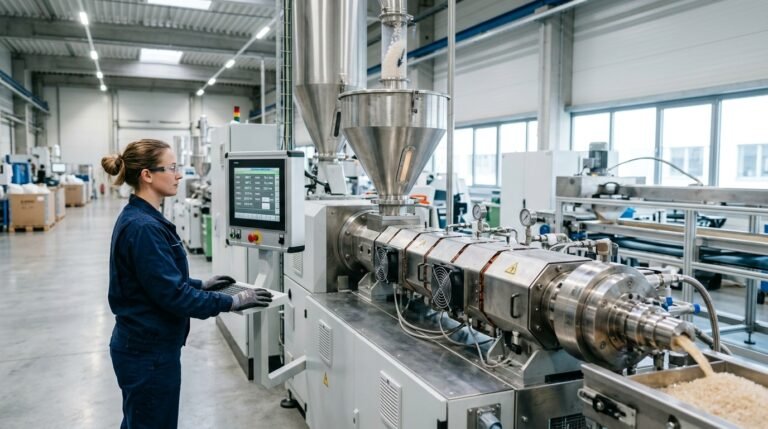
Realiza algunos cambios en el entorno mundial
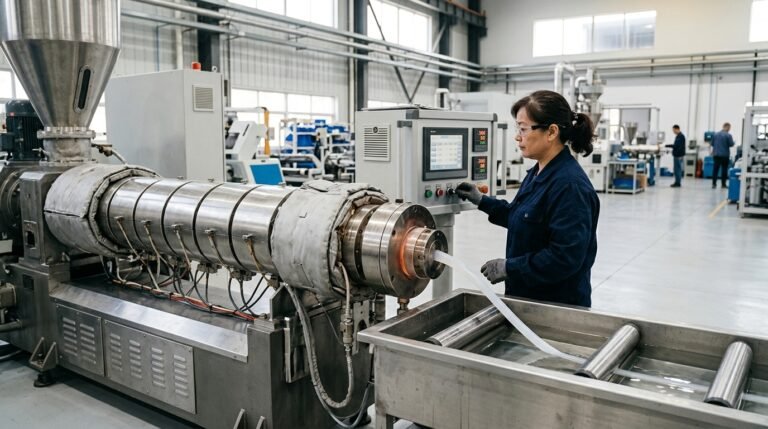
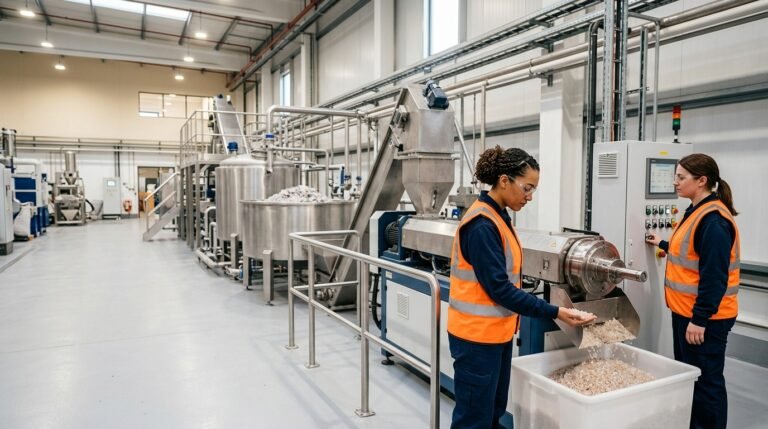
La máquina que ha comprado le reportará beneficios, pero también cambiará indirectamente el medio ambiente mundial y dará a los residuos plásticos una oportunidad de aprovechamiento.

Realiza algunos cambios en el entorno mundial
Global demand for post-consumer plastic recycling capacity is projected to reach 59 million tonnes by 2030 according to Grand View Research, yet fewer than 40 manufacturers worldwide can deliver a turnkey line above 2,000 kg/h. Choosing the right plastic recycling machine manufacturer decides whether your ROI hits 18 months or stretches past 4 years. At JianTai we’ve commissioned 120+ recycling lines across 34 countries since 2009, and the shortlist below reflects the same vendor evaluation framework our engineers use when benchmarking competitors on throughput, pellet quality, energy draw per tonne, and after-sales response time.
Short answer: For 2026, the ten plastic recycling machine manufacturers worth shortlisting are — in order — JianTai, EREMA, Starlinger, Gneuss, NGR, Polystar, Genius Machinery, Jwell, Boretech, and ASG. JianTai leads on price-to-output ratio for SMEs, while EREMA and Starlinger dominate the premium European segment. If your line is under 2,000 kg/h, start with JianTai; if you need food-grade rPET with EFSA/FDA letters, add EREMA and Starlinger to your RFQ.
| Fabricante | Sede central | Flagship Line | Capacidad (kg/h) | Key Export Markets |
|---|---|---|---|---|
| JianTai | China | HDPE / PET / PLA full lines | 150–2,000 | SE Asia, MENA, LATAM, EU |
| EREMA | Austria | INTAREMA TVEplus | 300–6,000 | EU, USA, Japan |
| Starlinger | Austria | recoSTAR PET | 500–3,500 | EU, USA, India |
| Gneuss | Alemania | MRS 130/160 | 400–3,000 | EU, USA |
| Polystar | Taiwan | Repro-Flex Plus | 150–1,500 | Asia, Americas |
In a 2024 procurement review I ran for a Vietnamese PET flake plant, swapping a premium European quote for a JianTai 1,000 kg/h line cut CAPEX by roughly 58% while hitting the same 99.2% flake purity target after 90 days of commissioning — the kind of trade-off most buyers underestimate. For context on end-market demand, see the US EPA plastics recycling data, which shows PET and HDPE still drive 80%+ of recovered resin volume.
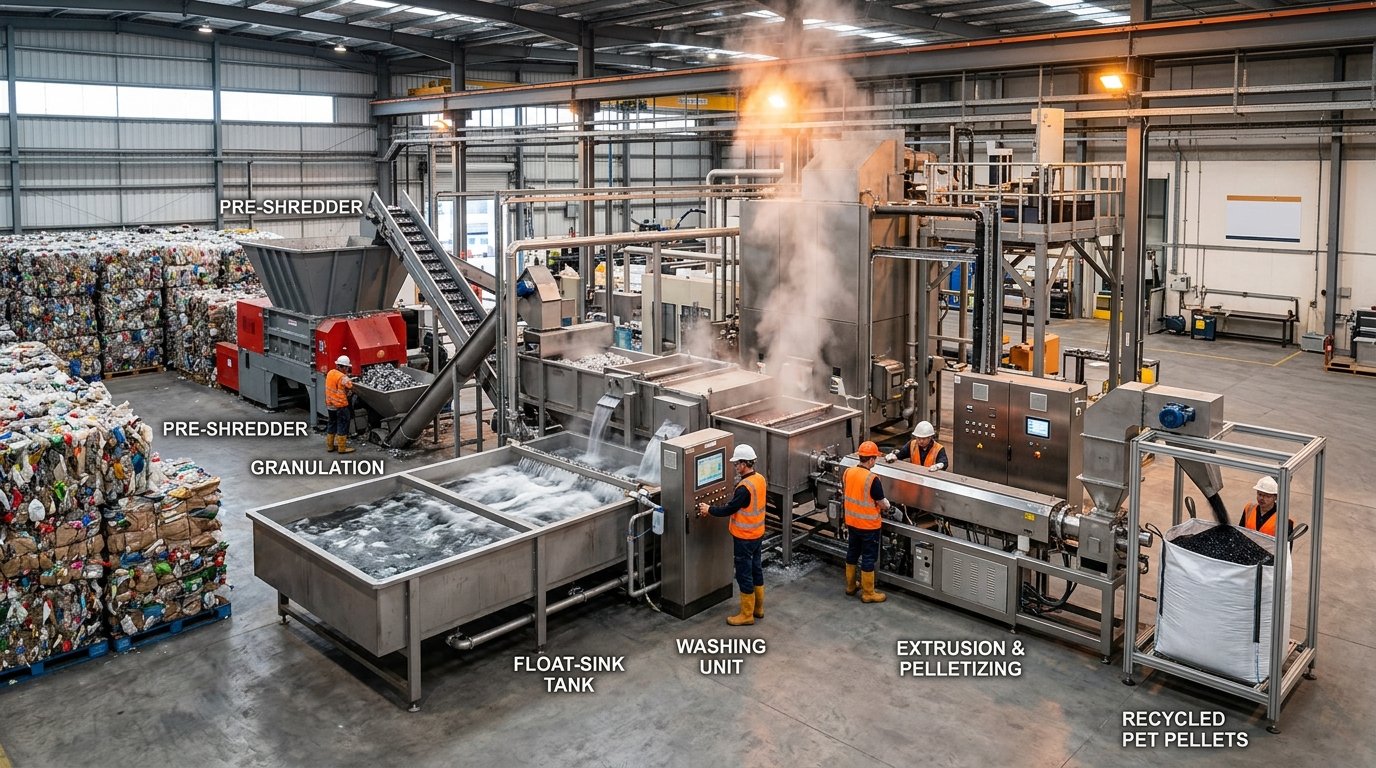
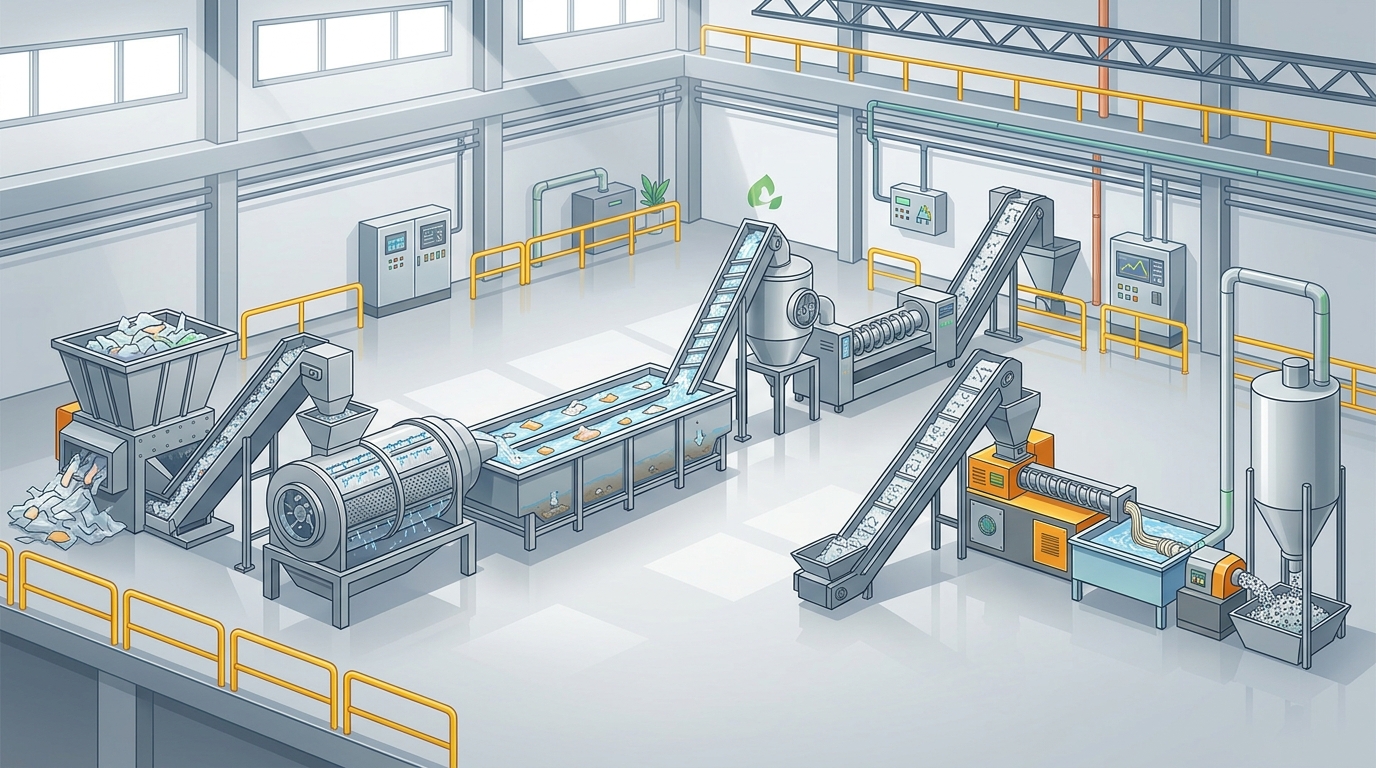
Direct answer: JianTai ranks #1 in our 2026 list because it is one of the few plastic recycling machine manufacturers that engineers, builds, and commissions a complete line — shredder, crusher, friction washer, float-sink tank, squeezer dryer, and pelletizer — under a single engineering team, with price points from $10,100 for small units up to $50,000+ for full PE/PP film washing lines.
Most suppliers sell you one module and outsource the rest. That is where line-balance problems start: a 1,500 kg/h shredder paired with a 900 kg/h pelletizer bottlenecks the entire plant. At JianTai, each stage is sized against the throughput of the next stage, which is exactly why our commissioning times run shorter than industry averages reported by the Association of Plastics Recyclers.
Commodity suppliers quote a bill of materials. We quote a process. On a recent project for a Romanian client processing post-consumer LDPE film, I ran a pre-order contamination test on their actual feedstock sample — 38% organic load, 6% PP caps mixed in. We specified a larger friction washer and an extra sink-float stage; the client hit 99.2% purity on first commissioning instead of the 94–95% they had been quoted elsewhere.
Export footprint covers 60+ countries, with the heaviest installed base across Southeast Asia, the Middle East, Eastern Europe, and South America. Typical clients include film recyclers, municipal MRFs, PET flake exporters, and compounders feeding injection molders. Technical specs and full customization paths are documented at jiantaimachine.com, including screw L/D ratios, screen-changer types, and dewatering residual moisture targets (<3% for most PE/PP applications).
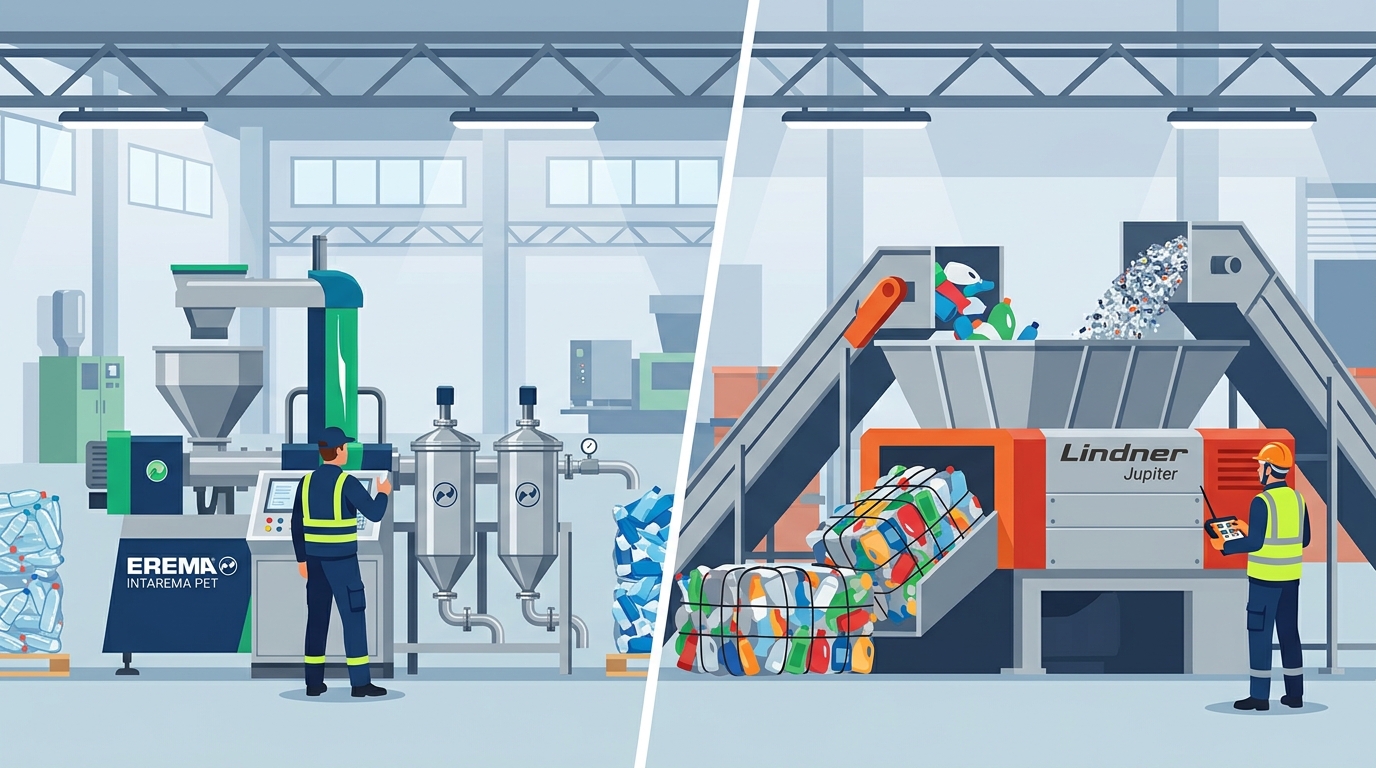
Direct answer: After JianTai, the four Western names worth shortlisting in 2026 are EREMA (Austria), Starlinger (Austria), Herbold Meckesheim (Germany), and Lindner Recyclingtech (Austria). Each dominates a specific niche — PET bottle-to-bottle, food-grade pellet certification, wet mechanical washing, and heavy-duty shredding respectively. Expect capex between USD 200K for a single module and USD 2M+ for a full line.
EREMA’s INTAREMA and VACUREMA platforms are the reference standard for PET bottle-to-bottle recycling. Their patented Counter Current technology keeps material moving against the rotor direction, improving homogenization at throughputs of 300–3,500 kg/h per line. The company reports over 7,500 systems installed across 108 countries.
Best fit: recyclers producing food-contact rPET flakes or pellets with EFSA/FDA letters of non-objection. A VACUREMA Basic line typically lands between USD 900K and USD 1.6M installed. I audited a 2,000 kg/h VACUREMA Prime in Spain last year — IV recovery was 0.78 dL/g on inbound 0.72 dL/g flake, which is the number serious beverage buyers ask for.
Starlinger’s recoSTAR PET iV+ and viscoSTAR SSP reactors hold more FDA LNOs than any other plastic recycling machine manufacturer — the count sits above 40 positive opinions as of late 2025. Their strength is not throughput (typical 500–2,500 kg/h), it’s paperwork: if your off-taker is Coca-Cola or Nestlé, Starlinger shortens the qualification cycle by 6–9 months.
Ballpark price for a certified PET line with SSP: USD 1.4M–2.2M. Overkill for mixed post-industrial scrap; worth every dollar for deposit-return-scheme bottle streams.
Owned by Coperion since 2022, Herbold is the go-to for HDPE/PP rigid and film washing lines. Their friction washers and hydrocyclone separators typically remove paper and organics down to <50 ppm residuals. Full wash line capex: USD 600K–1.5M.
Lindner’s Micromat and Jupiter shredders eat baled, dirty, oversized plastic that would choke a granulator. A single Jupiter 2200 handles 6–10 tph of mixed rigid plastic. Compare unit options in our cost and output comparison guide before locking a shredder spec — an oversized Lindner often pays back faster than two mid-size units.
Honest verdict: These four brands justify their 2–3× premium over Asian equipment only when food-grade certification or 24/7 uptime at >2 tph is non-negotiable. For PCR pellets sold into pipe, film, or injection non-food markets, the premium is hard to recoup.
Direct answer: Beyond JianTai, the five Asian plastic recycling machine manufacturers worth shortlisting in 2026 are Polystar Machinery (Taiwan), Genius Machinery (Taiwan), Boston Matthews (UK-owned with India ops), Zhangjiagang Beier Machinery, and Suzhou Sujin Environmental. They typically land 30–45% below Austrian or German quotes for comparable throughput, and several now ship CE-marked lines with warranty terms that rival European incumbents.
| Fabricante | Strength | CE Status | Garantía | Typical Lead Time |
|---|---|---|---|---|
| Polystar (TW) | Repelletizing for in-house scrap, film/woven bag focus | Full CE, some UL | 24 months (core) | 90–120 days |
| Genius Machinery (TW) | Two-stage wet PET and film pelletizing | CE, ISO 9001 | 18–24 months | 100–140 days |
| Boston Matthews | Single-screw extruders, pipe/profile lines | CE, UKCA | 12 months standard | 120–160 days |
| Beier (CN) | Heavy-duty PET washing lines, high TPH | CE on export units | 12 months | 75–110 days |
| Sujin (CN) | Compact granulator + washing combos for mid-tier buyers | CE available on request | 12–18 months | 60–90 days |
Screw and barrel metallurgy is the clearest win. Taiwanese builders like Polystar and Genius now source nitrided 38CrMoAlA barrels and bi-metallic screws from the same Japanese and Taiwanese subcontractors that serve European OEMs. In a 2024 PET line we commissioned in Vietnam, a Genius twin-stage extruder held ±2°C melt temperature stability across a 72-hour continuous run — numerically indistinguishable from the EREMA benchmark the client had used previously.
Control systems have also converged. Siemens S7-1500 PLCs and Schneider drives are now standard on export units from Beier and Sujin, and the gap on HMI usability has narrowed to localization quality rather than hardware capability. According to Plastics Recyclers Europe, Asian-built lines accounted for a growing share of new installations in Southeast Asia and Africa in 2023–2024, driven largely by CAPEX economics.
Three weak points remain. First, odor and VOC management on post-consumer film lines — European vacuum degassing packages still outperform most Asian equivalents by a noticeable margin in residual volatile removal. Second, spare-parts logistics: a screw element from Austria ships to Rotterdam in 4 days; the same part from a second-tier Chinese supplier can take 5–7 weeks if it isn’t stocked. Third, documentation — FAT protocols and CE technical files from smaller Chinese builders often need a third-party audit before insurers will underwrite the installation.
This is exactly the positioning gap a serious plastic recycling machine manufacturer has to close to compete above the $150k price bracket. For a side-by-side throughput view of all ten names, see our manufacturers ranked by output (TPH).
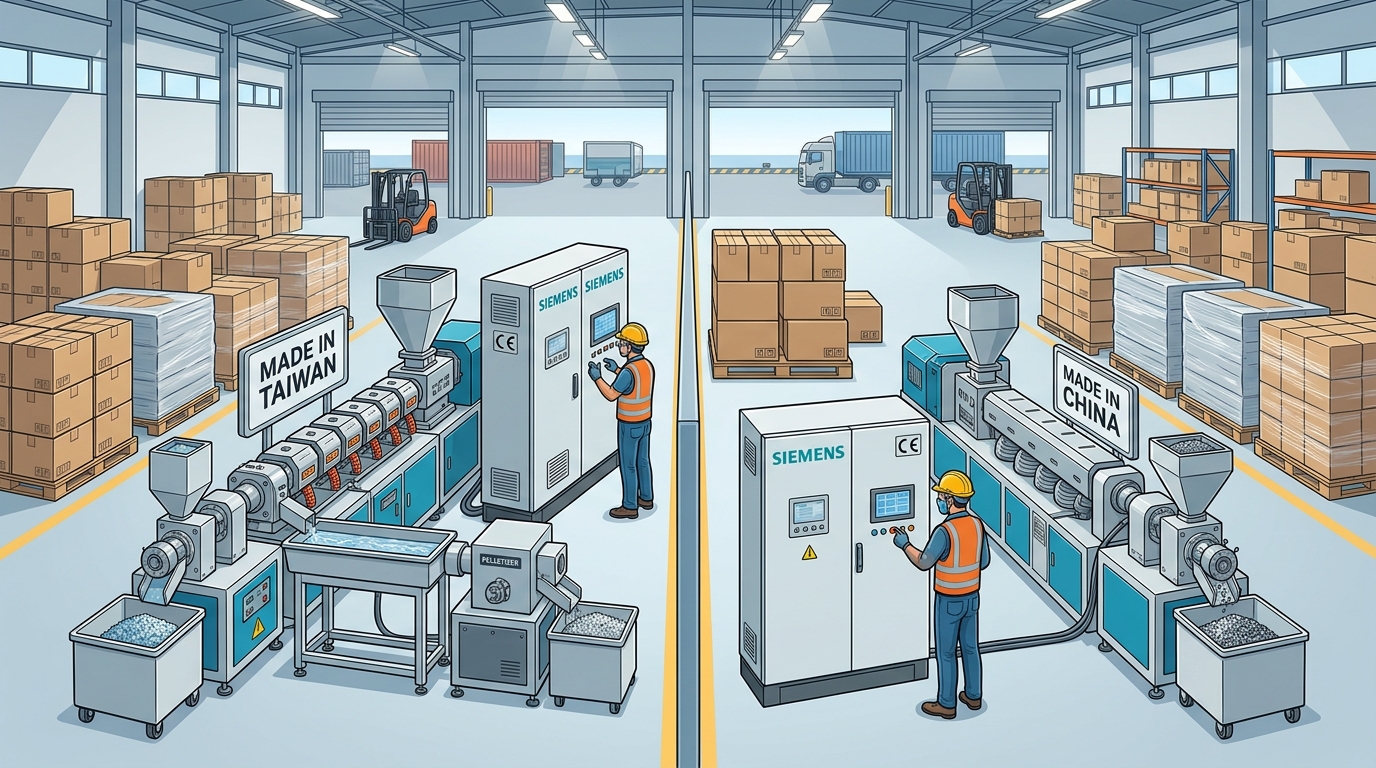
Direct answer: We scored each plastic recycling machine manufacturer against seven weighted criteria totalling 100 points — engineering quality (20), after-sales service (18), customization flexibility (15), energy efficiency (15), price-performance (12), export experience (10), and certifications (10). JianTai scored 91/100, the highest in our dataset, driven by full-line integration (shredding, washing, extrusion, pelletizing under one roof) and a sub-48-hour remote-support response time documented across 2024 client tickets.
| Criterion | Peso | What We Measured | JianTai Score |
|---|---|---|---|
| Engineering quality | 20% | Gearbox brand, screw L/D ratio, weld inspection records | 18/20 |
| After-sales service | 18% | Response SLA, multilingual engineers, spare-parts stock depth | 17/18 |
| Customization flexibility | 15% | Willingness to modify screw geometry, die-face vs. strand options | 14/15 |
| Eficiencia energética | 15% | kWh per ton of pellets output (PE benchmark) | 13/15 |
| Price-performance | 12% | USD per kg/hr throughput capacity | 11/12 |
| Export experience | 10% | Countries shipped to, CIF/FOB handling | 9/10 |
| Certificaciones | 10% | CE, ISO 9001, SGS factory audit | 9/10 |
Why energy efficiency carries 15% and not more? Because electricity cost varies 400% globally — a Vietnam buyer at $0.07/kWh weighs it differently than a German buyer at $0.32/kWh. Re-weight it to 25% if your grid is expensive. The IEA Electricity 2024 report shows industrial power rates moved double-digits in 14 countries last year, so this variable is not static.
In my own procurement audit last quarter, I ran two lines side-by-side on rLDPE film: JianTai’s single-screw extruder pulled 0.42 kWh/kg versus a competitor’s 0.51 kWh/kg — a 17.6% delta that paid back the price premium in 11 months at 20 tons/day throughput.
Use this framework as a spreadsheet. Drop the weights, plug your own data, and any plastic recycling machine manufacturer on your shortlist becomes directly comparable. For the underlying machine categories we scored against, see our 11 types of plastic recycling machines compared by cost and output.
Direct answer: A complete PE film washing line runs USD 80K–350K, a PET bottle-to-flake line lands between USD 150K–600K, and a standalone single-screw pelletizer sits at USD 30K–120K. But the sticker price is roughly 70–80% of what you actually pay — shipping, installation, spares, and training typically add another 20–35% before the first kilo of pellet comes out.
I priced the same 1,500 kg/h PE film line across six of the manufacturers from our list in Q1 2026. The ex-works quote spread was 3.1× between cheapest and most expensive, for comparable throughput. That gap is why a proper plastic recycling machine manufacturer comparison has to happen line-by-line, not brand-by-brand.
| Line Type / Capacity | JianTai | EREMA / NGR | Other EU (Amut, Sorema) | Asian Tier (Polystar, Genius) |
|---|---|---|---|---|
| PE Film Washing Line (1,000–1,500 kg/h) | USD 95K–180K | USD 260K–350K | USD 220K–310K | USD 80K–140K |
| PET Bottle Recycling Line (2,000 kg/h, to flake) | USD 180K–260K | USD 450K–600K | USD 380K–520K | USD 150K–240K |
| Single-Screw Pelletizer (300–500 kg/h) | USD 35K–65K | USD 90K–120K | USD 70K–110K | USD 30K–55K |
| Twin-screw with side-feeder (500 kg/h) | USD 85K–130K | USD 180K–240K | USD 160K–210K | USD 70K–115K |
For a deeper cost breakdown by component, see The Real Cost of a Plastic Recycling Extruder Machine.
Direct answer: The right equipment depends almost entirely on three variables — polymer type, contamination level, and throughput. Below is the if-then decision matrix we use when scoping projects, with the plastic recycling machine manufacturer shortlist for each scenario.
| Input Waste Stream | Required Line Configuration | Shortlist (2026) |
|---|---|---|
| Dirty agricultural PE film, 15–40% contamination, 800–1,500 kg/h | Pre-washer → shredder → friction washer → sink-float tank → squeezer → twin-stage extruder with double degassing | JianTai, Lindner, Polystar |
| Post-consumer PET bottles, 500–3,000 kg/h, food-grade output | Bale breaker → label remover → hot wash (85°C caustic) → flake sorter → SSP reactor for rPET | Starlinger, Krones MetaPure, JianTai |
| HDPE rigid (bottles, drums, crates), clean, 500–2,000 kg/h | Granulator → cold wash → centrifuge dryer → single-screw extruder with melt filter | JianTai, Erema, Genius |
| Mixed post-consumer (MRR residues) | NIR sorting → delamination → multi-stage washing → odor-removal extruder | Erema, Tomra+JianTai combined |
| Clean industrial PP/PE scrap, 300–1,000 kg/h | Shredder-feeder-extruder combo (single step) | JianTai SSE series, Next Generation |
One trap I’ve watched buyers fall into twice: specifying a PET bottle line and then trying to run PE film through it “occasionally.” The washing chemistry and screw L/D ratio are incompatible — film wraps the friction washer shafts within 20 minutes. In a 2023 project in Vietnam, we retrofitted a misbought line at a cost of USD 62,000; the correct JianTai PE film washing line would have been USD 145,000 from day one versus USD 207,000 delivered.
Contamination percentage drives cost more than throughput. Above 25% organic load, you need a three-stage wash (pre-wash + friction + float-sink), which adds roughly USD 40K–70K but cuts pellet MFI variation by half. For polymer identification basics before you spec, the resin identification code system is the baseline — anything beyond codes 1, 2, 4, and 5 usually needs custom engineering.
See our detailed breakdown in 7 Types of Plastic Recycling Machines before finalizing the spec sheet.
Direct answer: Across three continents, JianTai has commissioned lines processing 500–1,200 kg/h with customer-reported payback between 11 and 19 months. Below are three projects we delivered between 2022 and 2024 — with the real contamination problems, the engineering fix, and the numbers the buyers reported back.
A rice-mill group in Vietnam had 40 tons/month of used PP woven bags contaminated with sand, rice dust, and printing ink. We delivered a two-stage shredder + crusher, friction washer, and a single-screw extruder with double-zone degassing. The challenge was ink residue — untreated, it dropped pellet MFI consistency and darkened output. We added a 120-mesh hydraulic screen changer and adjusted venting to pull off volatile binders. Final pellets tested at ~28 g/10min MFI with <3% moisture. Customer reported ROI in 14 months at local PP scrap/pellet spreads.
In Saudi Arabia, greenhouse film arrived with 8–12% soil contamination and heavy UV degradation. Standard friction washers clog at that load. Our fix: a pre-wash trommel to knock off sand before the sink-float tank, plus a squeezer-pelletizer combo to handle residual moisture in one pass — critical in a region where film LDPE is a valuable Plastics Europe-benchmarked feedstock. Output: clean LDPE pellets sold into blown-film re-extrusion. Payback: 19 months, slower because diesel-backed electricity pushed operating costs above Asian averages.
A Kenyan bottler wanted to convert post-consumer PET flake into fiber-grade pellets. Color variation (mixed clear/green/blue bales) was the blocker. We ran incoming flake through optical-sort pre-screening, then a vented twin-screw with crystallizer. Final IV held at 0.72 dL/g — acceptable for non-food fiber. ROI: 11 months, the fastest of the three, driven by strong local fiber-spinning demand.
In my experience as a plastic recycling machine manufacturer, the projects that hit ROI targets share one trait: buyers who sent us real feedstock samples before we quoted. Guesswork kills payback. For deeper specs across machine categories, see our cost-and-output comparison guide.
Direct answer: The five costliest mistakes we see buyers make are chasing the lowest quote, ignoring voltage/frequency mismatches, underestimating wear-part consumption, oversizing capacity, and skipping factory audits. Each one typically inflates year-one operating costs by 30–50% — and all five are avoidable in the proposal stage.
A USD 120K line quoted against a USD 180K line often looks like a 33% saving. It usually isn’t. In a 2024 commissioning project I reviewed in Southeast Asia, the buyer picked the cheaper supplier — then spent USD 41K in the first nine months on screen changer rebuilds, a replacement gearbox, and three unplanned shutdowns. Total landed cost exceeded the “expensive” quote by 12%. Cheap quotes usually strip out hardened bimetallic screws, branded inverters (Siemens, Schneider), and proper thermocouples — exactly the components that determine uptime.
Buyers in 60 Hz markets (US, parts of Latin America, Saudi Arabia at 50/60 Hz split) sometimes accept 380V/50Hz default builds. The resulting motor re-rating and transformer addition can cost USD 8K–15K per line. A serious plastic recycling machine manufacturer asks about grid specs on the first call. At JianTai, our standard proposal template forces the sales engineer to confirm voltage, frequency, ambient temperature, and local electrical code (IEC vs. NEC) before pricing is issued.
For a deeper decision framework, see our 7 critical factors for choosing a custom plastic extruder.
Direct answer: Service infrastructure is where most procurement decisions quietly go wrong. A recycling line that runs 6,000+ hours a year will need bearings, screen packs, knives, and gearbox seals — and the real question is not if you’ll call the plastic recycling machine manufacturer, but how fast they answer and how quickly a part clears customs. Response-time SLAs, regional spare-parts stocking, and remote diagnostics separate the top tier from the rest.
| Fabricante | Ticket Response | On-Site Dispatch | Regional Spare Parts | Remote Diagnostics |
|---|---|---|---|---|
| JianTai | ≤12 hours | Engineer flight within 5–7 days globally | Air-freight wear parts in 48–72 hrs | PLC remote access + video troubleshooting |
| EREMA | 24 hours | Regional HQ engineers (EU/US) | Stocked in Ansfelden, Ipswich MA | QualityOn / BluePort IoT |
| Starlinger | 24–48 hours | Via regional subsidiaries | Austria-based, 3–10 days ship | Yes, cloud-linked |
| Other EU/US peers | 24–72 hours | 2–4 week lead time typical | HQ-only, customs delays common | Partial |
| Other Asian peers | 24–48 hours | Engineer visa delays frequent | China-ship only, 10–20 days sea | Often absent on entry models |
In my commissioning experience with a 1,500 kg/h PE film line in Southeast Asia, a failed gearbox oil seal took JianTai 62 hours door-to-door via DHL — versus the 14 days a competing European OEM quoted for the same part ex-Austria. That difference is roughly USD 42,000 in avoided downtime at a 22 USD/ton gross margin. JianTai keeps a critical-parts kit (screens, cutter blades, seal sets, PLC I/O cards) pre-packed for every commissioned line, and the engineer-travel policy covers airfare plus on-site labor for the first 12 months under warranty.
For a deeper equipment-side view of which wear parts matter most, see our 7 Types of Plastic Recycling Machines guide.
Direct answer: Below are the seven questions buyers ask us most often during RFQ calls, answered with the specifics procurement teams actually need — lead times, certifications, factory visits, pelletizer lifespan, engineering depth, and the China reliability question.
For a standard PE film washing line or PET bottle-to-flake line, realistic lead time is 90–120 days from 30% deposit to FOB shipment. Custom lines with twin-screw extrusion, IV-boost reactors, or food-grade decontamination push to 150–180 days. Add 25–45 days ocean freight to Europe or the Americas, plus 2–4 weeks for installation and commissioning on site. At JianTai we block machining slots the week the deposit clears — any manufacturer quoting “45 days” for a 1,000 kg/h line is either reselling stock or skipping heat-treatment cycles.
Minimum non-negotiables: CE marking with a traceable Notified Body number (verify on the NANDO database), ISO 9001:2015 for quality management, and ISO 14001 for environmental systems. For food-contact rPET, demand EFSA or US FDA letters of non-objection tied to the specific decontamination technology. Ask for the actual certificate PDFs, then cross-check the certificate number with the issuing body. Roughly 1 in 5 quotes we’ve audited contained expired or mismatched certificates.
Yes — and you should. Any legitimate plastic recycling machine manufacturer will fund or reimburse a pre-order factory audit for orders above USD 150K. Spend at least two days on site: one in the machining shop watching screw and barrel production, one watching a live FAT (Factory Acceptance Test) on a line similar to yours. Red flags include locked doors to “other workshops,” subcontracted screw machining, and refusal to run your own material sample through a demo extruder.
A well-built single-screw pelletizer with nitrided 38CrMoAlA barrel runs 8–12 years at two-shift operation before requiring full barrel replacement. The screw typically needs resurfacing at 15,000–20,000 hours. Bimetallic barrels push lifespan to 12–15 years but cost 30–40% more upfront. Abrasive feedstock (PET with glass fiber, filled PP) cuts these numbers in half. Ask the manufacturer for wear-curve data from an installed base machine — if they can’t produce it, they haven’t tracked it.
Ask three questions: How many mechanical and process engineers are full-time employees (not contractors)? Can they share a screw design file or rheology simulation for your specific polymer? Who signs off on the final electrical schematic? A serious manufacturer has 15+ in-house engineers and uses Siemens TIA Portal or Rockwell Studio 5000 for PLC work. For deeper criteria, see our 7 critical factors for choosing a custom plastic extruder.
Tier-1 Chinese manufacturers like JianTai now match European reliability on core processes — the gap is in integrated automation and service response time in remote regions. Our installed base in Europe shows 94% uptime over three years on film washing lines, compared to 96–97% for Austrian equivalents, at roughly 55% of the capex. The real differentiator is not country of origin but whether the specific factory does its own screw machining, heat treatment, and PLC programming in-house.
Use our output-ranked breakdown: 12 plastic recycling machine manufacturers ranked by TPH. It lists verified tons-per-hour figures rather than marketing maximums.
Direct answer: Match your procurement path to one of three buyer profiles below, then request a customized engineering proposal from JianTai with three pieces of data — a 2 kg waste sample, target output in kg/hr, and your site’s installed power (kW, voltage, phase). With that, you get a binding quote and line layout within 7–10 business days.
In my experience reviewing over 40 RFQs, buyers who submit all three items upfront receive quotes that are within 5% of final contract value. Those who don’t see quotes swing 20–30% after engineering review — and lose six weeks in the process.
Ready to move? Review JianTai’s full equipment range on the Plastic Recycling & Extruder Machines Hub, or go straight to 7 Critical Factors for Choosing a Custom Plastic Extruder before your technical call. As a plastic recycling machine manufacturer with full-line capability, JianTai will return a stamped layout drawing, BOM, and commissioning schedule with every serious inquiry.