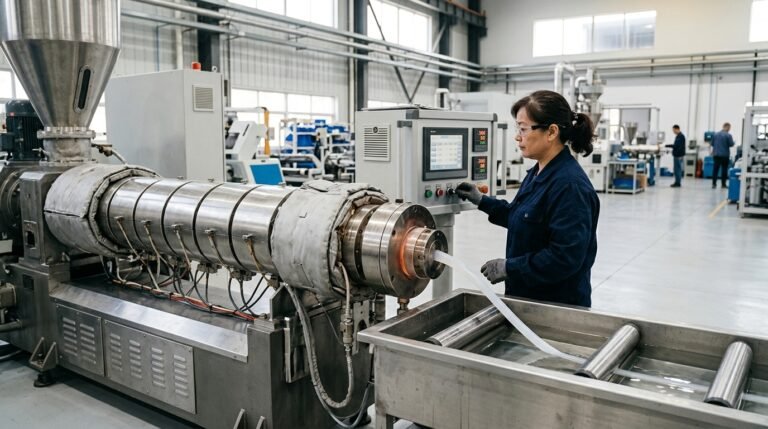
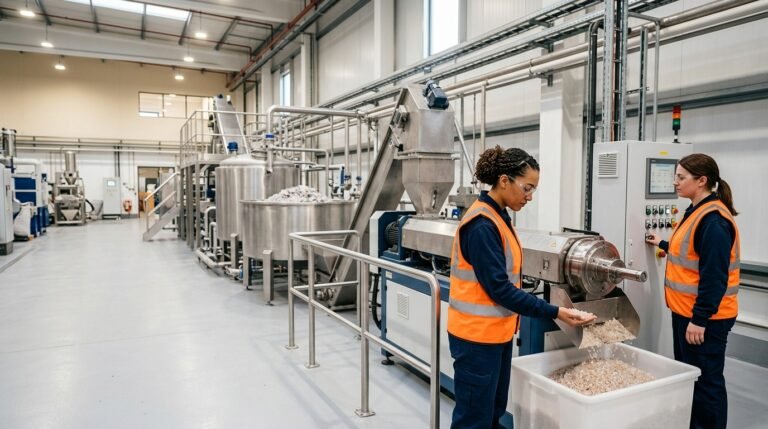
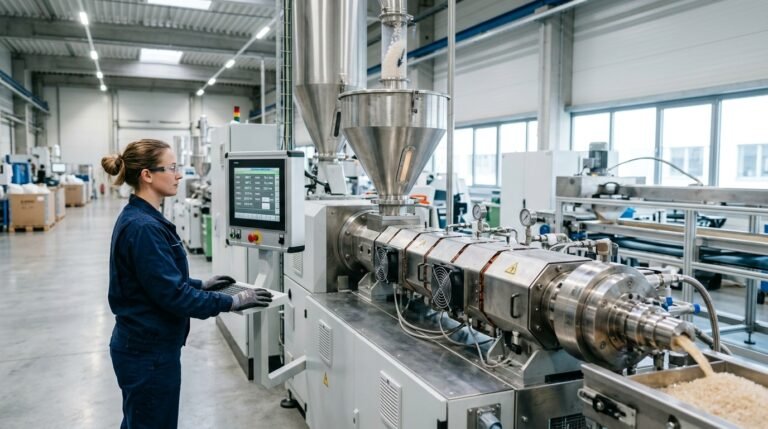
Realiza algunos cambios en el entorno mundial
La máquina que ha comprado le reportará beneficios, pero también cambiará indirectamente el medio ambiente mundial y dará a los residuos plásticos una oportunidad de aprovechamiento.

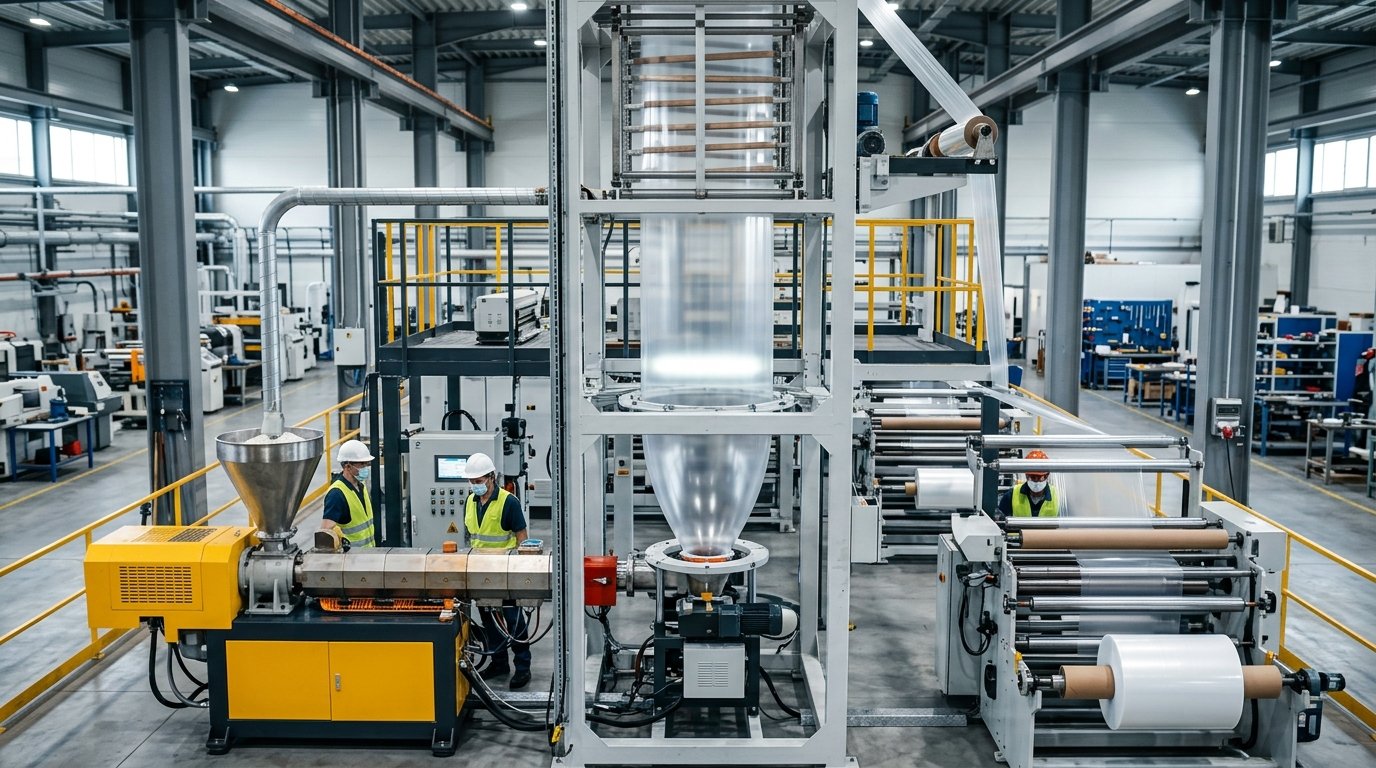
Plastic film extruder machines fall into three distinct capacity tiers — small-scale (under 100 kg/hr), mid-range (100–300 kg/hr), and high-capacity (300+ kg/hr) — and picking the wrong tier is the single most expensive mistake a film producer can make. This guide breaks down the leading machines in each category by throughput, energy efficiency, material compatibility, and real-world ROI so you can match the right extruder to your actual production demands, not just your ambitions.
The film extrusion industry segments machines almost exclusively by hourly output measured in kilograms. This isn’t arbitrary — it directly correlates with screw diameter, motor power, die size, and the cooling infrastructure required to keep up. Understanding where each tier starts and stops saves you from over-investing or, worse, buying a machine that bottlenecks your entire operation within 18 months.
Here is a quick-reference comparison across the three primary capacity tiers:
| Capacity Tier | Output Range | Typical Screw Diameter | Target Buyer | Approx. Investment (USD) |
|---|---|---|---|---|
| Small-Scale | 20–100 kg/hr | 35–55 mm | Startups, niche producers, R&D labs | $30,000–$120,000 |
| Gama media | 100–300 kg/hr | 55–75 mm | Mid-sized converters, regional suppliers | $120,000–$450,000 |
| High-Capacity | 300–1,500+ kg/hr | 75–120 mm | Industrial packaging plants, multinational producers | $450,000–$3,000,000+ |
A common misconception: bigger always equals better. That is flat-out wrong for most buyers. A startup running 8-hour shifts producing agricultural mulch film does not need a 500 kg/hr line designed for 24/7 stretch wrap production. The maintenance overhead alone would eat their margins alive.
The capacity rating also assumes optimal conditions — correct melt temperature, consistent raw material quality, and a well-maintained screw and barrel. Real-world output typically runs 10–15% below the rated maximum, which is something manufacturers rarely emphasize in their brochures. Factor that gap into your calculations before signing a purchase order.
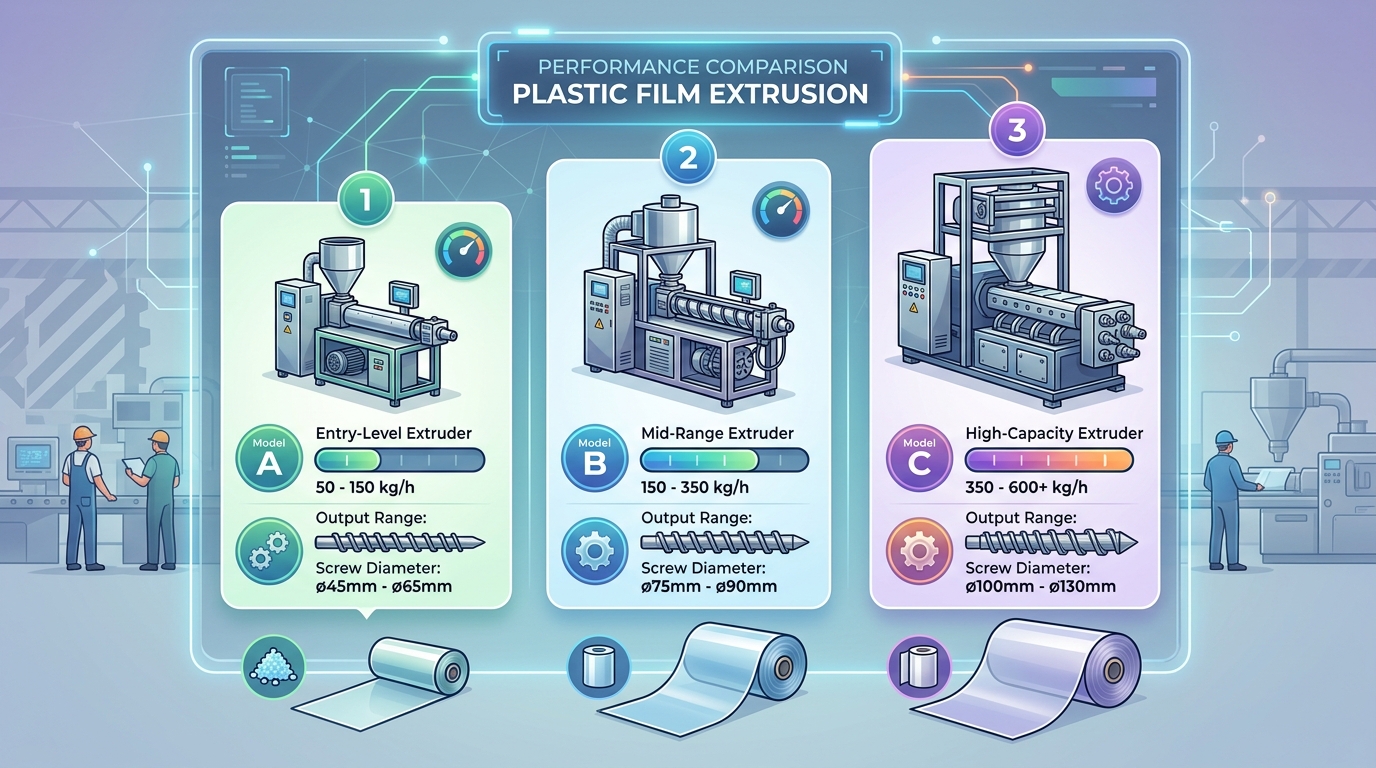
Raw output numbers grab attention, but they tell maybe 40% of the story. The specifications that actually determine whether a plastic film extruder machine will perform profitably over a 10–15 year lifespan go much deeper.
Screw diameter sets your throughput ceiling. But the L/D ratio — the length-to-diameter ratio of the screw — controls melt homogeneity and mixing quality. Most modern film extruders run L/D ratios between 28:1 and 33:1. A higher ratio gives better mixing, which matters enormously when you are processing blends or recycled content. Drop below 26:1 and you will see inconsistent film gauge, especially with LLDPE.
Single-layer dies are straightforward and cheap. But the market is moving decisively toward multi-layer co-extrusion — 3-layer at minimum, with 5-layer and 7-layer becoming standard for barrier films. Each additional layer adds complexity and cost, but also adds margin to your finished product. A 3-layer machine processing the same resin volume as a monolayer unit can produce film worth 25–40% more per kilogram because of the enhanced properties.
This is where many buyers get caught off guard. The extruder itself might handle 250 kg/hr, but if your air ring or IBC (Internal Bubble Cooling) system cannot remove heat fast enough, your actual output drops. High-performance dual-lip air rings and IBC systems can boost effective throughput by 20–30% compared to basic single-lip designs. If you are learning about the broader proceso de extrusión de plásticos, understanding cooling dynamics is essential.
Gravimetric blending, automatic gauge control, and recipe management systems add $30,000–$100,000 to the price tag. Worth it? Almost always, if you are running more than one shift. Automatic gauge control alone typically reduces material waste by 3–5%, which on a mid-range machine processing 200 kg/hr pays for itself within the first year of operation.
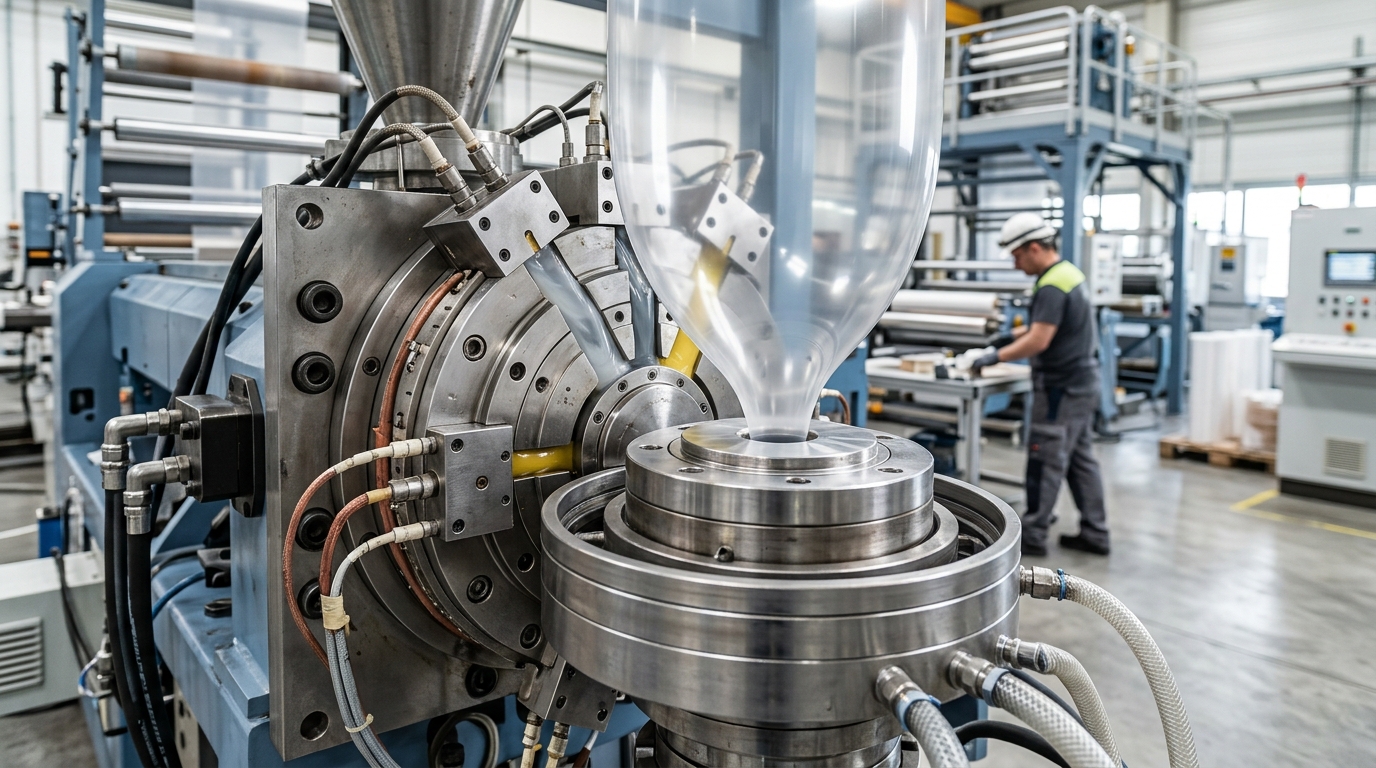
When your production requirements exceed 300 kg/hr and you are running 24/7, you are in territory dominated by European engineering powerhouses. The machines at this level are not just bigger — they are fundamentally different in design philosophy, built for maximum uptime and minimal operator intervention.
The VAREX II is arguably the benchmark for high-output blown film. Output ranges from 400 to over 1,500 kg/hr depending on configuration. The TURBOCLEAN die head enables layer sequence changes in under 30 minutes — a feature that saves massive amounts of scrap during product changeovers. Where this machine truly excels: stretch film, heavy-duty sack film, and multi-layer barrier packaging. The downside? Entry price starts around $1.5 million for a basic 3-layer configuration and climbs steeply from there.
Reifenhauser has pushed hard into 9-layer and 11-layer technology, which sounds excessive until you realize that ultra-thin barrier layers can replace expensive EVOH with cheaper alternatives when you have enough layer flexibility. Their Evolution Ultra line handles 350–800 kg/hr and integrates their patented ULTRA FLAT haul-off system, which produces some of the flattest film in the industry. For food packaging converters chasing the tightest specifications, this is the machine to evaluate.
Alpine (now part of the Hosokawa group) built their reputation on the X-die, which distributes melt more uniformly than conventional spiral mandrel dies. The HX series targets 300–600 kg/hr for 5-layer and 7-layer structures. Particularly strong for collation shrink film and lamination-grade film where optical clarity matters. Their cooling technology — the VENTURI X air ring — is among the most efficient available.
At this tier, the machine itself is only part of the investment. You will need reinforced concrete foundations, dedicated electrical infrastructure (often 400–600 kW connected load), and a team of trained operators. According to data from Plastics Today, industrial-scale film plants typically require 12–18 months from order placement to full production readiness.
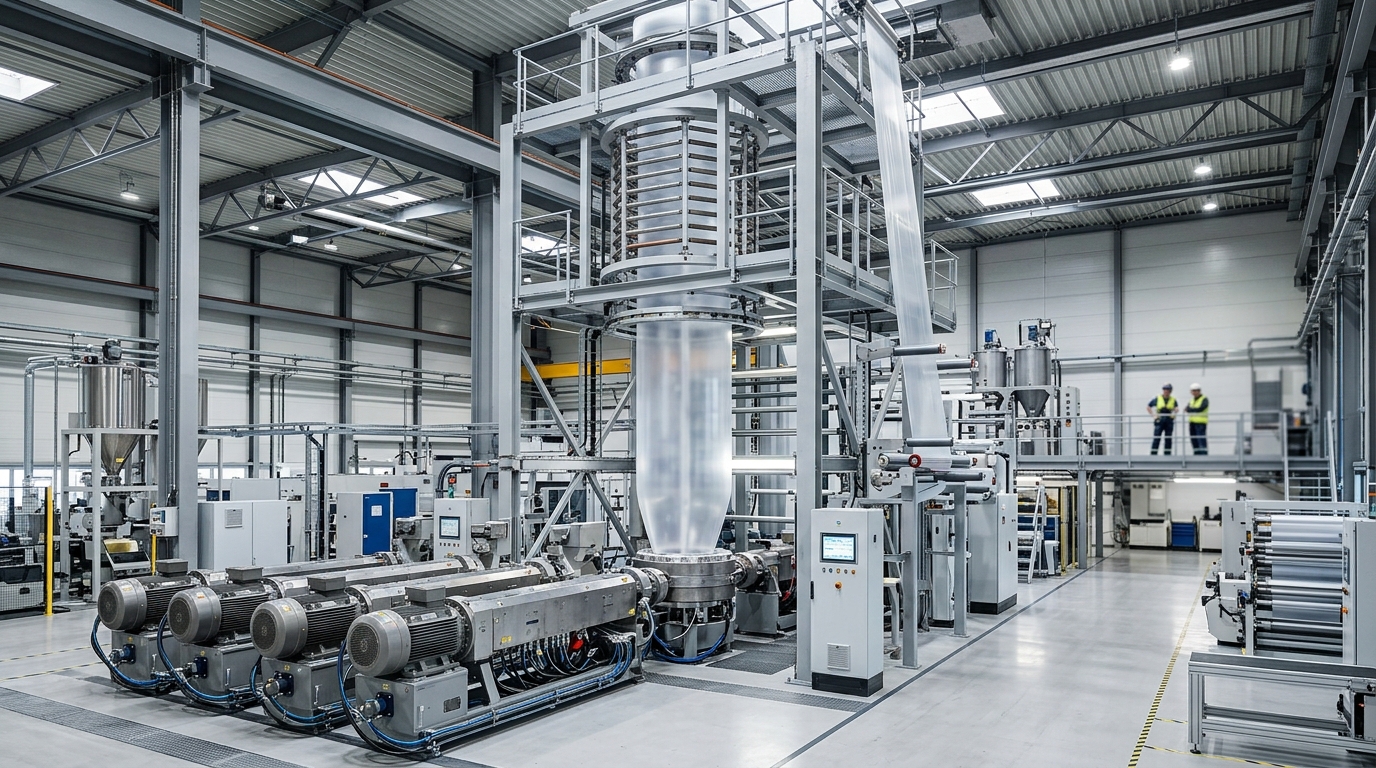
The 100–300 kg/hr segment is where most purchasing decisions happen, and where the competitive landscape gets genuinely interesting. These machines balance serious production capability with enough flexibility to handle frequent product changes — a critical requirement for converters serving multiple customers.
Italian manufacturer Macchi has carved out a strong position in the mid-range with the Coexflex line. Output ranges from 150–350 kg/hr in 3-layer and 5-layer configurations. What sets Macchi apart is their POD (Production on Demand) system, which allows operators to switch between product recipes with minimal transition waste. If you are producing agricultural film on Monday and food packaging on Wednesday, this flexibility has real dollar value.
Another Italian contender, Bandera targets the 120–280 kg/hr range with their SmartFlex platform. Their edge is in energy efficiency — Bandera claims 15–20% lower specific energy consumption compared to previous-generation machines, largely through optimized barrel heating zones and high-efficiency AC motors. For operations where electricity costs represent a significant portion of conversion costs, this matters.
Taiwanese manufacturer Kung Hsing offers compelling value in the 100–250 kg/hr range at price points 30–40% below European equivalents. The KS-FE series includes 3-layer co-extrusion capability and IBC as standard. Film quality is solid for general-purpose applications — think courier bags, garment bags, and general packaging. Where they fall short compared to European machines: ultra-tight gauge tolerance and optical properties for premium food packaging.
For mid-range buyers, the decision often comes down to a trade-off between European precision engineering and Asian cost efficiency. Both approaches work. The right choice depends on your end-market requirements. If your customers demand film that meets strict food-contact specifications, the European machines typically deliver tighter process control. For industrial and commercial packaging, the cost savings from Asian manufacturers can significantly improve your payback timeline. If you are exploring a complete production setup, consider reviewing a full plastic recycling extrusion line configuration to understand how the extruder fits into the broader workflow.
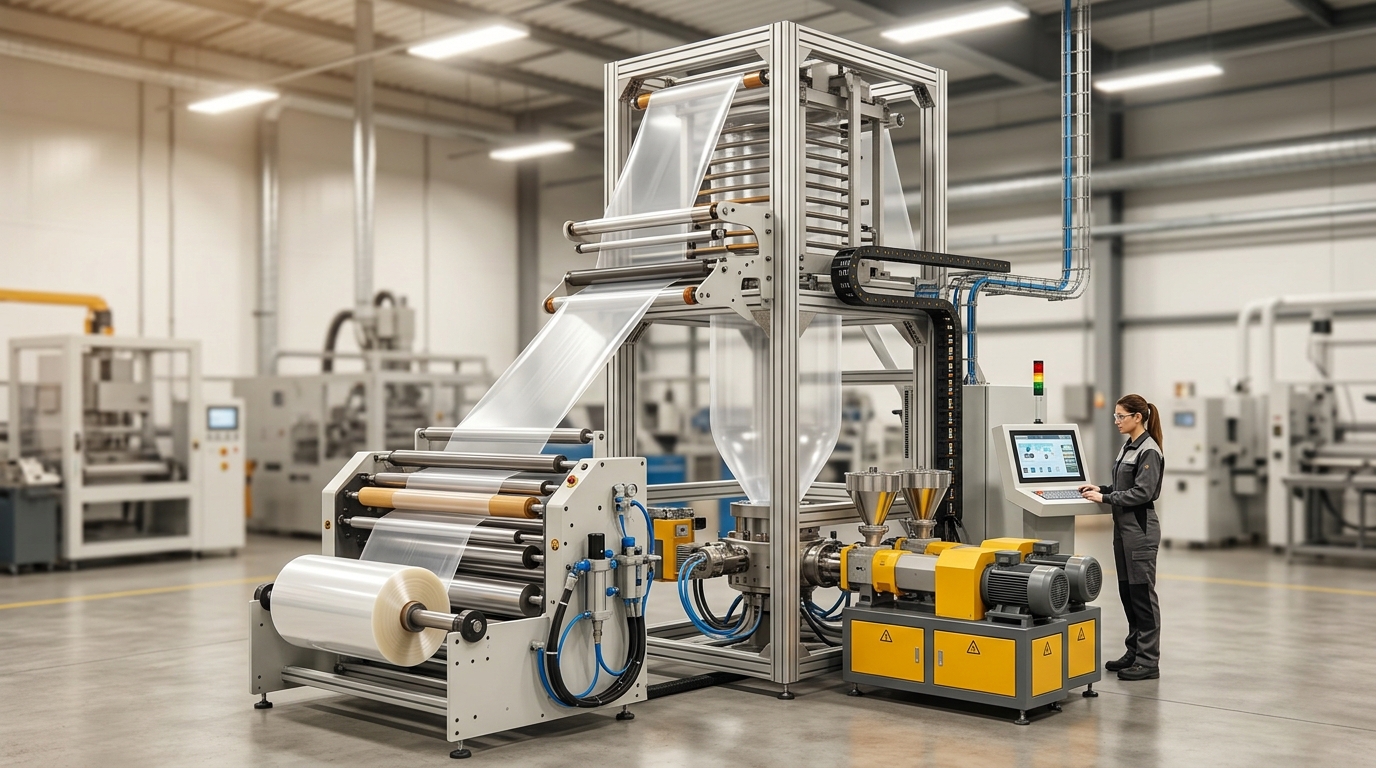
Starting a film production business does not require a million-dollar investment. Machines under 100 kg/hr have improved dramatically in the last decade, and several manufacturers now offer compact lines that produce commercially viable film quality in a fraction of the floor space.
Polystar, based in Taiwan, has become a go-to brand for entry-level and recycling-integrated film extrusion. Their machines in the 30–100 kg/hr range are particularly popular for operations that want to process recycled pellets into film. Build quality is reliable, spare parts are readily available, and their technical support network covers most major markets. A basic single-layer blown film line from Polystar starts around $40,000–$60,000.
Another Taiwanese manufacturer, Ye I focuses on compact 2-layer and 3-layer lines in the 50–120 kg/hr range. Their machines are well-suited for producing shopping bags, trash bags, and agricultural mulch film. The footprint is small enough to fit in a standard warehouse bay — roughly 8m x 4m for the base machine plus winder. For anyone considering a Máquina extrusora de plástico para pequeñas empresas, Ye I represents a solid middle ground between price and capability.
Indian manufacturer SS Machinery offers some of the most affordable entry points in the market, with basic monolayer blown film machines starting under $25,000. Output typically ranges from 20–60 kg/hr. These machines serve a specific purpose: low-volume production for local markets where film specifications are less demanding. Do not expect the tight tolerances or automation features of higher-priced alternatives, but for straightforward LDPE bag production, they get the job done.
One honest assessment about compact machines: they work well for getting started, but most growing businesses outgrow them within 3–5 years. If your business plan projects significant growth, buying a slightly larger machine upfront — even if you only run it at 60% capacity initially — often costs less than upgrading the entire line later.
Energy is the second-largest operating cost in film extrusion after raw materials, typically accounting for 8–15% of total conversion cost. The difference between an efficient machine and a wasteful one can mean $50,000–$200,000 per year in electricity costs, depending on your output volume and local energy rates.
Here is how specific energy consumption (SEC) compares across tiers:
| Capacity Tier | Typical SEC (kWh/kg) | Best-in-Class SEC | Annual Energy Cost (est.)* |
|---|---|---|---|
| Small-Scale (50 kg/hr) | 0.45–0.65 | 0.38 | $18,000–$26,000 |
| Mid-Range (200 kg/hr) | 0.35–0.50 | 0.28 | $48,000–$68,000 |
| High-Capacity (500 kg/hr) | 0.25–0.40 | 0.20 | $85,000–$136,000 |
*Based on $0.10/kWh, single-shift (2,000 hrs/year) for small-scale, double-shift for mid-range, and 24/7 for high-capacity.
Three technologies drive the biggest efficiency gains:
A data point that surprises many buyers: high-capacity machines are significantly more energy-efficient per kilogram than small machines. The physics of extrusion favors scale — larger screws have better surface-area-to-volume ratios, and larger motors operate closer to their optimal efficiency point. This is one reason why, per the European Plastics News, consolidation toward larger production units continues to accelerate across the industry.
When comparing machines, always ask manufacturers for SEC data measured under standardized conditions (specific resin type, specific film thickness, specific output rate). A machine that claims 0.30 kWh/kg running thick LDPE film at 80% capacity will consume far more when you push it to maximum output on thinner LLDPE blends.
Not every plastic film extruder machine handles every resin well. Screw geometry, barrel temperature profiles, and die design all need to match the rheological properties of your target material. Get this wrong and you will fight quality problems endlessly.
These are the bread-and-butter resins for blown film. LDPE is the most forgiving — almost any extruder handles it reasonably well. LLDPE demands better mixing (higher L/D ratio, barrier screw design) because of its narrower processing window. HDPE blown film requires specialized die designs with higher pressure capability and precise temperature control. Most machines rated for LLDPE will handle LDPE without issues, but the reverse is not always true.
PP blown film is a growing segment, especially for packaging that needs higher temperature resistance. However, PP has a much narrower bubble stability window compared to PE. You need a machine with very precise air ring control and often a stalk-type bubble configuration. Machines designed primarily for PE can struggle with PP unless they have been specifically configured for it.
This is where things get tricky. PLA is notoriously difficult to blow into film — it has low melt strength and a very narrow processing temperature range. PBAT is more cooperative but still requires careful temperature management. Most successful biodegradable film production uses PBAT/starch blends on machines with:
If biodegradable film is part of your business plan, budget an additional 15–25% for the specialized components required. Trying to run PLA blends on a standard PE machine is a recipe for frustration and wasted material. For deeper insight into how different plastic extrusion processes work step by step, that context helps clarify why material-specific configurations matter so much.
One more consideration: if you plan to process recycled content — which is increasingly mandated by regulations in Europe and gaining traction globally — your extruder needs robust melt filtration and ideally a degassing zone. Recycled PE and PP contain contaminants that can cause gels, black specks, and odor issues without proper filtration. A dedicated film recycling machine upstream of your extruder can dramatically improve input quality.
Work backward from your target. If you need 200 tons per month and plan to run two 8-hour shifts (roughly 400 production hours/month), you need a machine capable of 500 kg/hr at minimum. Why 500 and not the mathematically exact figure? Because you need to account for changeover time, startup/shutdown waste, and the 10–15% gap between rated and actual output. Always size your machine for 120–130% of your calculated requirement.
The formula is straightforward: Machine Cost / (Monthly Net Margin from Film Production). Net margin means revenue from film sales minus raw material, energy, labor, and overhead costs. For most mid-range operations, the payback period falls between 18–36 months. High-capacity lines serving industrial contracts can achieve payback in 12–18 months due to economies of scale. Factor in financing costs if you are not paying cash.
Refurbished machines can save 40–60% on upfront cost, but proceed with extreme caution. The screw and barrel are wear items — if they have not been replaced or re-chromed, you are inheriting someone else’s problems. Electrical systems on machines older than 10 years often need complete replacement to meet current safety standards. My honest recommendation: buy refurbished only if you have in-house mechanical expertise to evaluate and maintain the equipment, or if you are working with a reputable refurbisher who provides warranty coverage.
Daily: check oil levels, clean die lips, inspect air ring for debris. Weekly: lubricate bearings, check heater band connections, calibrate temperature controllers. Monthly: inspect screw and barrel wear (measure clearances), check gearbox oil quality, test safety interlocks. Annually: full screw pull for inspection, gearbox oil change, electrical system audit. Neglecting maintenance does not just reduce output — it creates safety hazards. For comprehensive safety protocols, review these plastic extruder machine safety guidelines.
At minimum: CE marking (mandatory for European markets), ISO 9001 for quality management. For food-contact film production, ensure the machine materials comply with FDA 21 CFR or EU Regulation 1935/2004. Reputable manufacturers also carry UL or CSA electrical certifications. Be wary of manufacturers who cannot provide third-party certification documentation — it is a red flag for both quality and resale value.
Technically yes, with significant caveats. You will need interchangeable screws (different compression ratios for different materials), and the temperature control system must be precise enough for PLA’s narrow processing window. Changeover between PE and biodegradable resins typically requires a thorough purge — budget 30–60 minutes and 50–100 kg of purge material each time. If biodegradable film represents more than 30% of your production, a dedicated line usually makes more economic sense.
After reviewing dozens of machines across all three tiers, here is the framework that actually works for making this decision.
If you are a startup or entering a niche market: Start with a compact machine in the 50–80 kg/hr range. Keep your capital investment under $100,000 if possible. Focus on proving your market and building customer relationships. Polystar and Ye I offer the best combination of reliability and affordability at this level. Do not over-invest in automation — at low volumes, manual changeovers are perfectly manageable.
If you are a growing converter ready to scale: The 150–250 kg/hr range is your sweet spot. Invest in at least 3-layer co-extrusion capability — it opens up product categories that monolayer machines simply cannot serve. Macchi and Kung Hsing both deliver strong value here, with the choice depending on whether you prioritize European engineering or Asian cost efficiency. This is also the tier where automatic gauge control starts paying for itself.
If you are an industrial producer serving major brands: You need 400+ kg/hr with 5-layer or 7-layer capability, full automation, and the tightest possible gauge control. Windmoller & Holscher, Reifenhauser, and Alpine dominate for good reason — their machines run for decades with proper maintenance, and their process consistency meets the specifications that major brand owners demand. The higher upfront cost is offset by lower per-kilogram conversion costs and access to premium market segments.
The most expensive machine is not the one with the highest price tag. It is the one that does not match your production reality — either too small to meet demand or too large to run efficiently at your actual volumes.
Whatever tier you choose, request production trials on the actual machine configuration you plan to buy, using your actual resin formulations. Catalog specifications and real-world performance are never identical, and a trial run is the only way to verify that a machine meets your specific requirements. For a broader view of how film extrusion equipment fits into a complete recycling and production ecosystem, explore JianTai’s range of equipos de reciclado de plásticos designed to work alongside extrusion lines.
Ready to narrow down your options? Contact equipment manufacturers directly with your specific output targets, material requirements, and budget range. Request detailed quotations that include installation, training, and warranty terms — not just the machine price. The best purchasing decisions in this industry come from comparing complete packages, not just sticker prices.