إجراء بعض التغييرات على البيئة العالمية
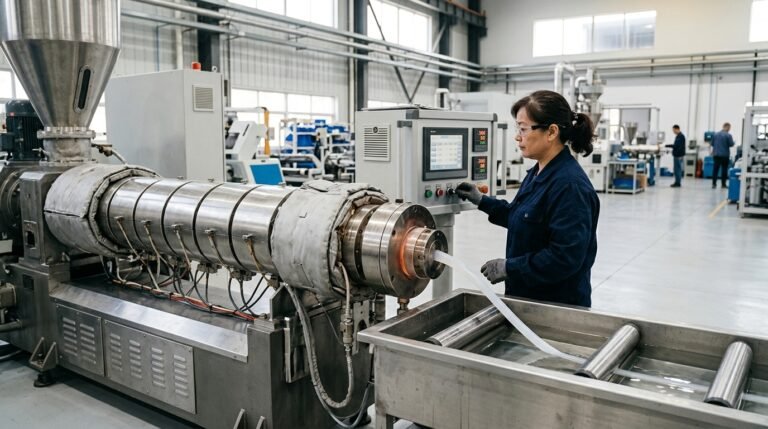
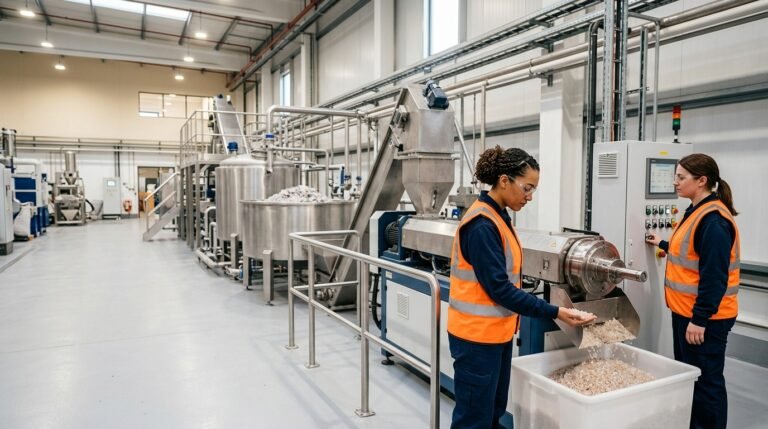
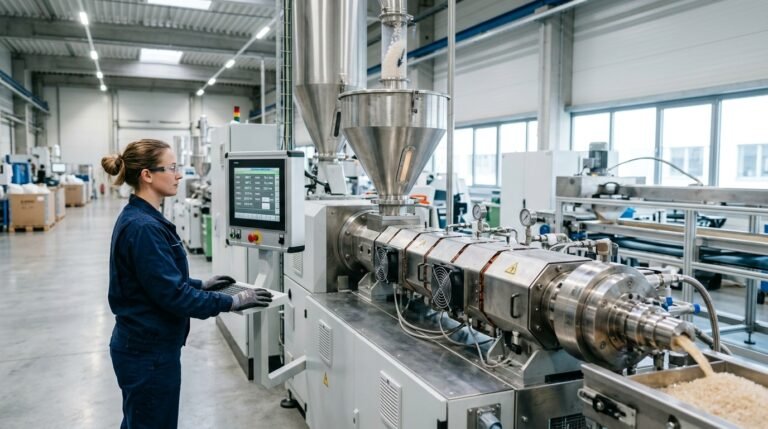
ستحقق لك الماكينة التي اشتريتها أرباحًا، ولكنها أيضًا ستغير البيئة العالمية بشكل غير مباشر وستعطي فرصة للاستفادة من نفايات البلاستيك.

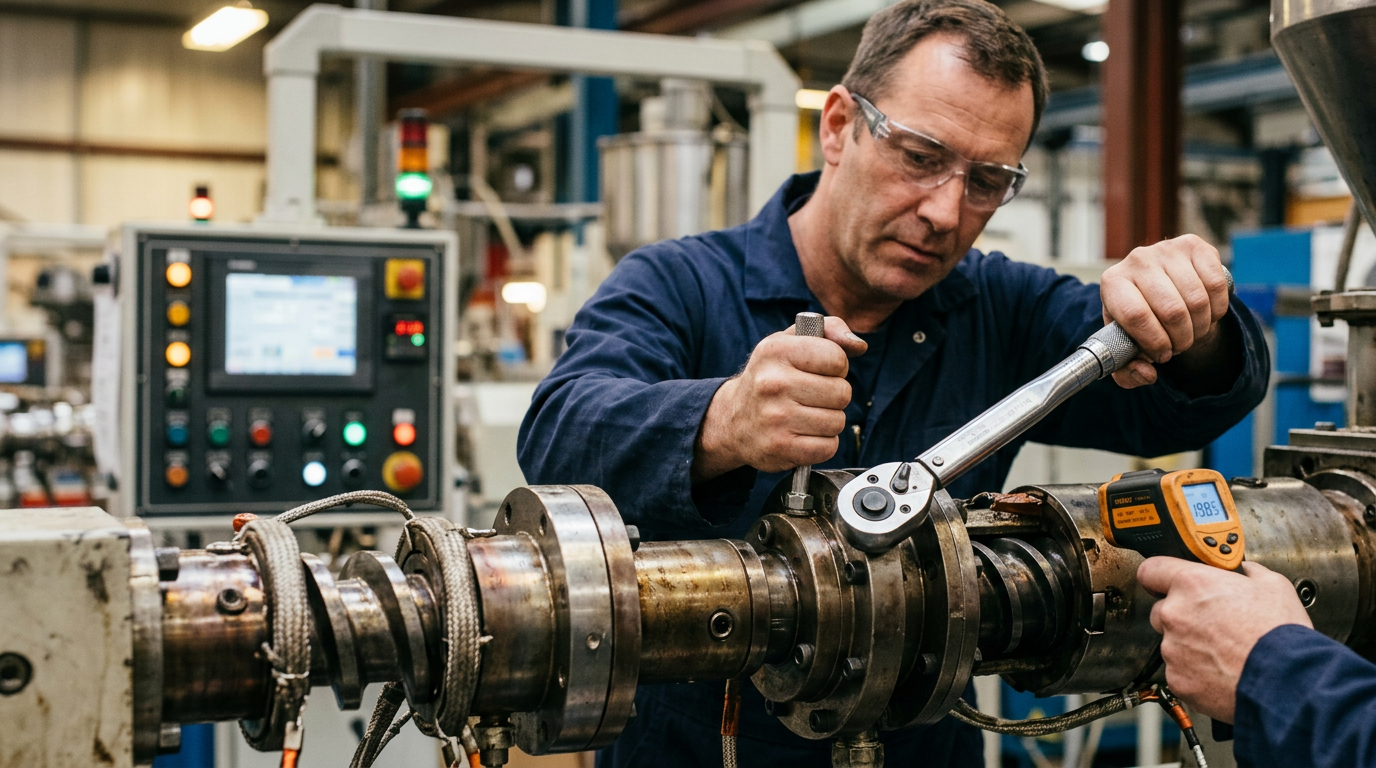
A plastic extruder machine maintenance checklist is a structured 10-step routine covering daily, weekly, monthly, and quarterly tasks—spanning barrel and screw inspection, gearbox lubrication, screen cleaning, wear measurement, and safety interlock testing—to prevent unplanned downtime. Unplanned extruder stoppages cost processors roughly $260 per minute (PlasticsToday), and about 70% stem from missed lubrication, worn screws, or clogged screens.
Operators following a disciplined checklist extend screw life 2–3× and cut emergency service calls by more than half.
Having a disciplined آلة بثق البلاستيك machine maintenance checklist really does get rid of most of that loss. It catches the wear and tear before it actually turns into a full-blown failure.
Here at JianTai, after getting recycling and compounding lines up and running across more than 40 countries since 2008, we’ve noticed the same pattern over and over. Operators who stick to a 10-step routine that runs from daily checks all the way out to quarterly ones end up stretching the life of their screws by about 2 to 3 times.
And they cut their emergency service calls by more than half, which is pretty significant.
I want to show you the whole plastic extruder machine maintenance checklist, all on one screen. It has the task, how often you do it, how long it should take, and what tools you need. This right here, you can pin it right next to your control panel.
This list comes from what we see on our JianTai recycling lines that run all day and night. The operators who stick to this schedule, they cut down on unplanned downtime by as much as 35%. That’s compared to teams who only fix things after they break.
| # | Task | التردد | Time | Tools / Parts |
|---|---|---|---|---|
| 1 | Pre-startup inspection (barrel, screw, heaters) | يومياً | 10 دقائق | Infrared thermometer, flashlight |
| 2 | Lubricate gearbox & thrust bearings | Daily check / weekly top-up | 15 min | ISO VG 220 gear oil, grease gun |
| 3 | Clean screen changer, breaker plate, die | أسبوعياً | 45 min | Brass brush, purge compound |
| 4 | Measure screw & barrel wear | شهرياً | 60 min | Bore gauge, micrometer (0.01 mm) |
| 5 | Inspect heater bands & thermocouples | شهرياً | 30 دقيقة | Multimeter, clamp meter |
| 6 | Flush cooling circuits & descale | ربع سنوي | 90 min | Descaler, TDS meter |
| 7 | Electrical panel: tighten, dust, thermal-scan | ربع سنوي | 60 min | Torque screwdriver, IR camera |
| 8 | Vacuum vent & decompression check | أسبوعياً | 20 min | Vacuum gauge |
| 9 | Safety interlock & E-stop test | شهرياً | 15 min | Test log sheet |
| 10 | Maintenance log & trend review | After each task | 5 دقائق | CMMS or paper log |
A quick note on the lubricants. Their specs line up with the ISO 3448 viscosity classes.
But honestly, you should always double-check that against your own OEM manual. Now, if you’re wondering how this checklist might change depending on how much material your machine processes, we have a good breakdown.
You can see our throughput and cost breakdown for that context.
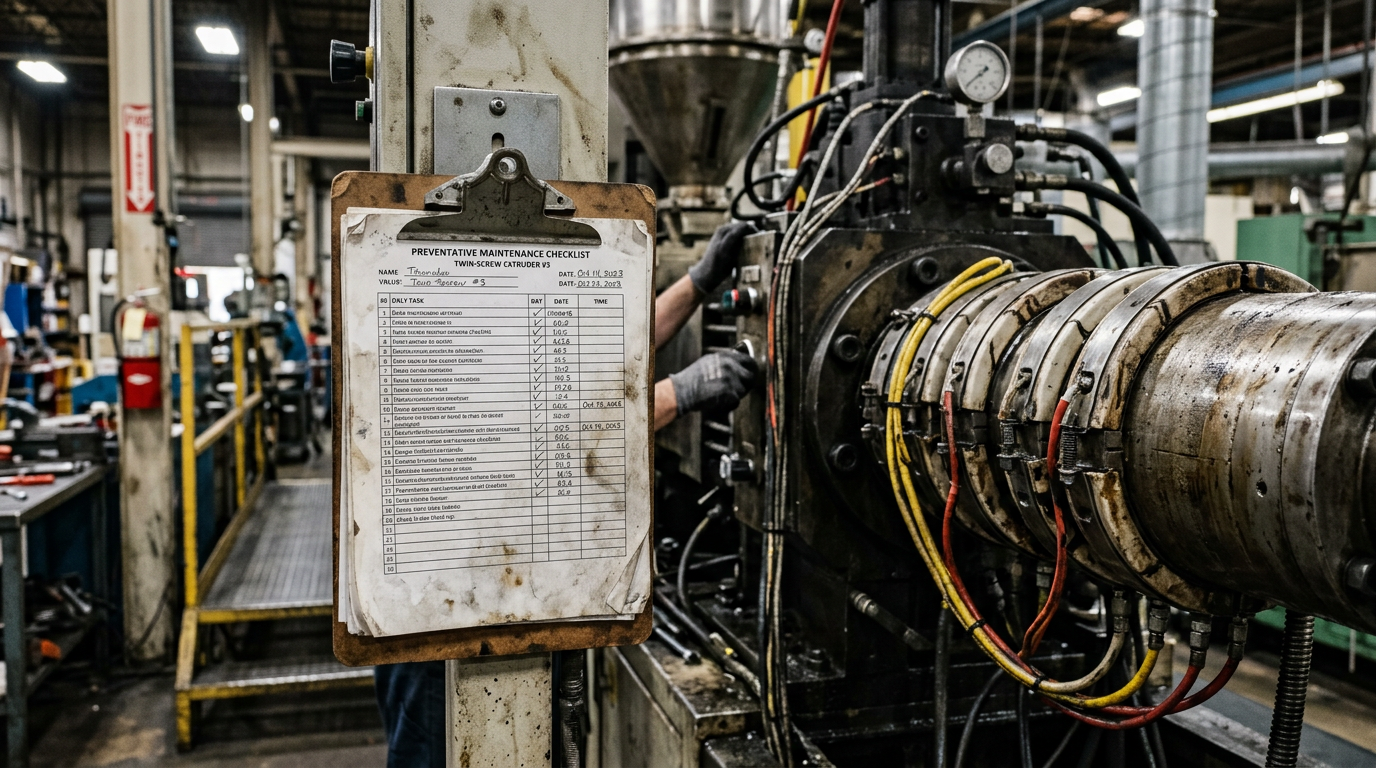
Before you hit the start button, run through this 7-point check in under 8 minutes. A cold start on a drifting thermocouple or a dead heater band is honestly the fastest way to snap a screw tip. It’s also how you scorch resin onto the barrel wall.
And it’s actually the most skipped item on any plastic extruder machine maintenance checklist.
Here’s the sequence our operators on JianTai’s PP/PE recycling lines run every single shift:
I actually ran this protocol on a customer’s 75mm recycling extruder last March, right after they reported intermittent surging. Zone 3 thermocouple was reading 178°C on the HMI. The pyrometer said 201°C.
A $14 thermocouple replacement ended a two-week loss in how much it processes, something they’d been blaming on the screw design the whole time. That’s the return on investment of 8 minutes.
| Check Point | Spec | الأداة | Pass/Fail |
|---|---|---|---|
| Zone 1–5 heater amps | ±10% nameplate | Clamp meter | ☐ |
| Thermocouple vs pyrometer | ±3°C | Handheld pyrometer | ☐ |
| Drive idle torque | Within ±15% of baseline | HMI amp readout | ☐ |
| Feed throat water flow | 8–12 L/min | Inline flowmeter | ☐ |
| Barrel flange leaks | None | Visual | ☐ |
| Hopper magnet | Clean, secure | Visual | ☐ |
| E-stop function | Drive disables <1s | Manual test | ☐ |
Print it out. Tape it to the control cabinet. Operators sign at shift handover, and if there’s no signature, there’s no startup. This is really how the operators running our JianTai recycling extrusion lines keep unplanned time it wasn’t running under 3% on 24/7 schedules.
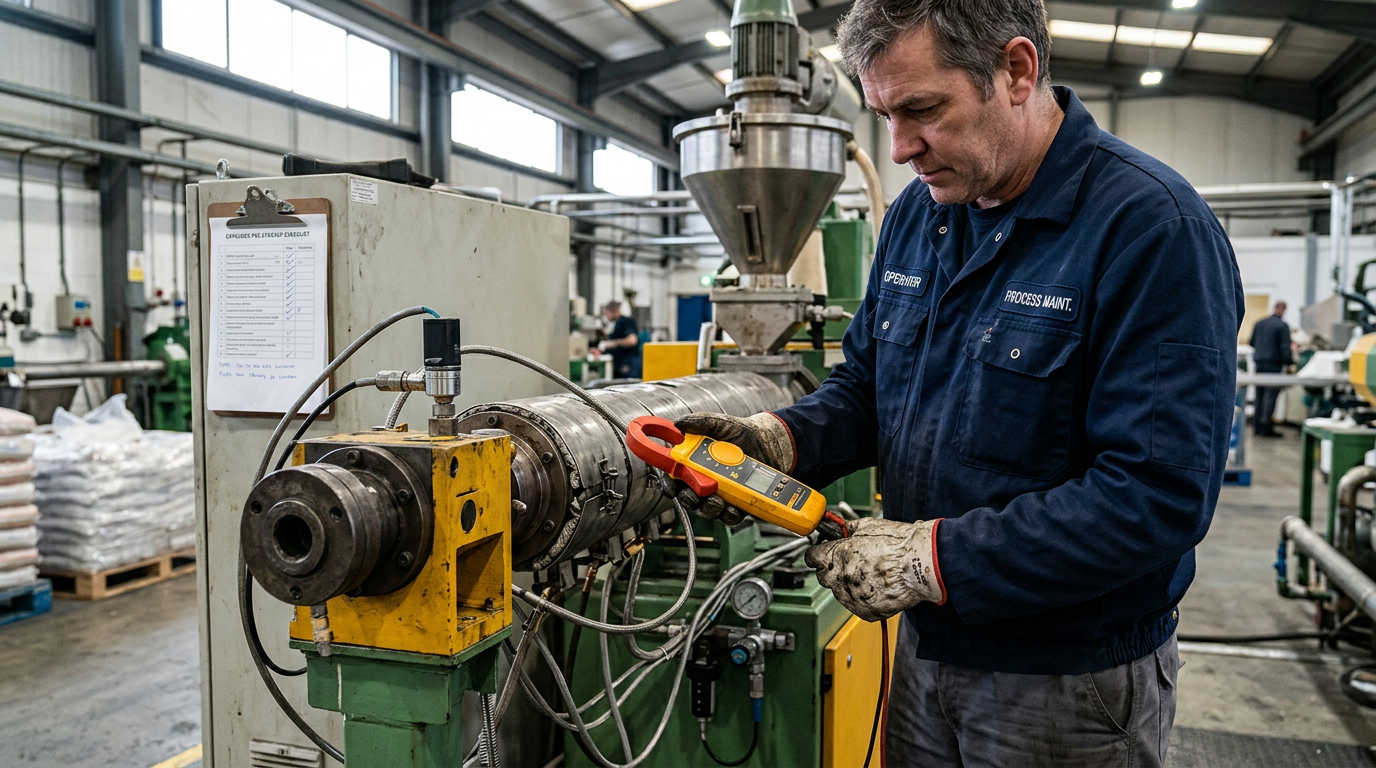
Use ISO VG 220 gear oil for standard single-screw extruders running under 75 kW.
And ISO VG 320 for twin-screw or high-torque recycling lines above 110 kW. Change oil at the first 2,000 running hours (break-in drain), then every 4,000 hours after that. Grease thrust bearings with lithium-complex NLGI 2, two shots per zerk, not ten.
Viscosity degrades before color does. I run a quick drop test on a clean glass plate every 500 hours: a 220-grade oil should form a bead that spreads roughly 25 mm in 60 seconds at room temperature.
If it spreads faster, shear thinning has hit, schedule the drain. For anything borderline, pull a 100 ml sample and ship it for ISO 4406 particle counting; Machinery Lubrication has a solid primer on reading the report.
The mistake I see on 8 out of 10 audit visits: operators pump grease into the thrust bearing until it oozes. That blows the lip seal, contaminates the gearbox sump, and turns a $40 seal into a $6,000 bearing replacement.
On JianTai recycling extruders, our maintenance checklist caps thrust-bearing greasing at 15 grams every 250 hours, printed right on the housing.
Log every lube event. This single habit keeps warranty claims valid and feeds directly into the JianTai maintenance schedule we ship with every line.
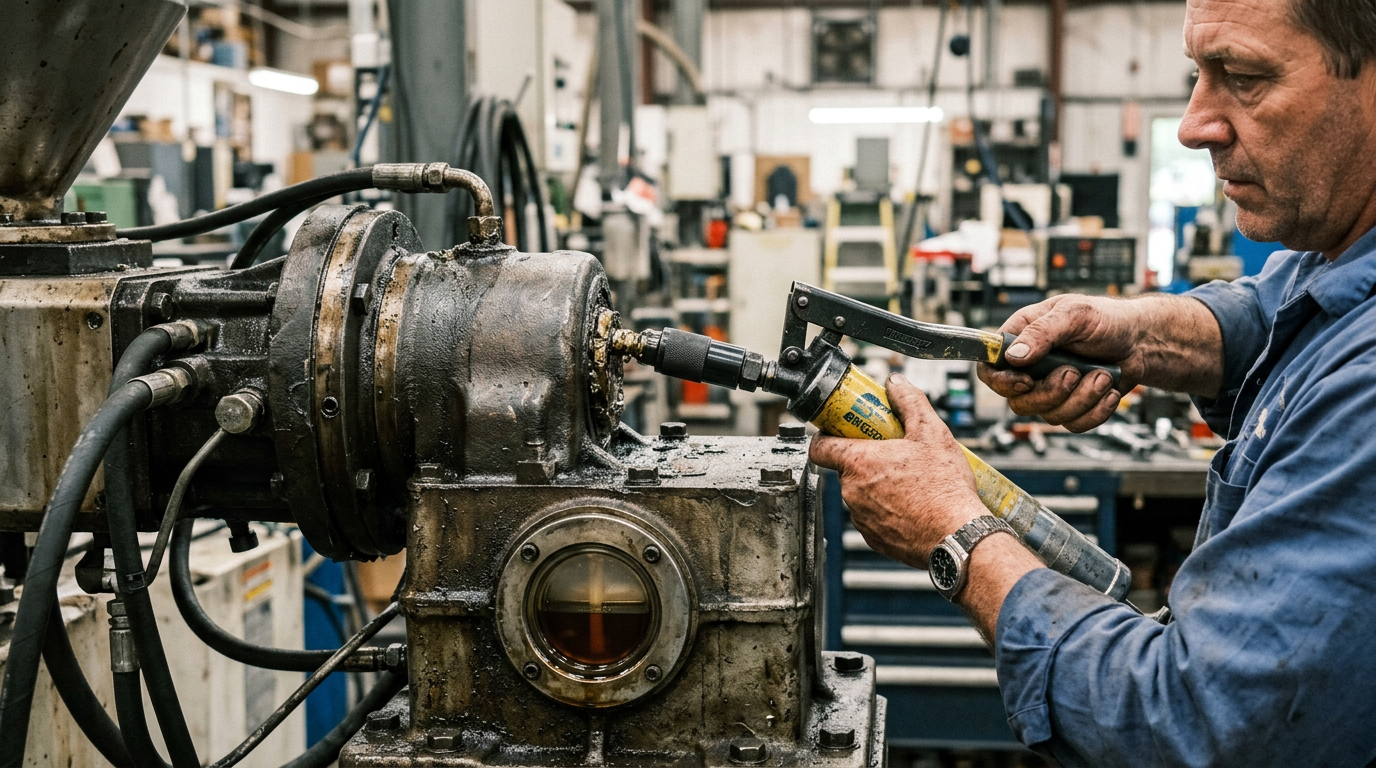
Direct answer: Once a week, shut the line down, flush it through with a cleaning compound, and then take apart the screen changer and breaker plate while everything is still sitting at 180 to 200°C. Soak the metal parts in glycol at 230°C for 4 to 6 hours.
Or you can use a fluidized bed burnout oven at 440°C for 2 hours instead. Then wire-brush using brass bristles at 0.15 mm on anything chrome, and stainless 0.30 mm bristles on tool steel surfaces.
And swap out any screen pack if the melt pressure sitting behind the breaker plate has climbed more than 15% above the pressure you logged at a clean start.
Both approaches strip off carbonized polymer, but they are not interchangeable. Glycol, which is basically triethylene glycol heated up to 230°C, dissolves polyolefin char in 4 to 6 hours and is noticeably gentler on nitrided surfaces.
Mechanical burnout in a fluidized bed at 440°C is faster, about 90 to 120 minutes, and it handles cross-linked PE or filled compounds that glycol simply cannot touch. Though repeated cycles above 450°C will soften the nitrided layer on breaker plates rated to around 65 HRC.
In our shop we run glycol every week and do the burnout once a quarter.
For a deeper look at safe cleaning temperatures for tool steels, the NIST materials database is a useful reference.
Once cleaning is finished, inspect the breaker plate holes under a 10x loupe. If any hole shows a dark ring of carbon thicker than 0.5 mm, that means your next production run is going to see melt pressure spikes.
In my experience running a 90 mm recycling line, ignoring that carbon ring caused a 22% pressure spike within 48 hours and split three screen packs before we caught what was happening. An $1,800 lesson, honestly.
Log the baseline pressure at a clean start. If it creeps 15% above that number mid-run, stop and swap the screens no matter what the schedule says.
| المواد | Typical Screen Pack | Change Frequency | الملاحظات |
|---|---|---|---|
| Recycled HDPE (post-consumer) | 20 / 40 / 60 / 20 mesh | Every 4–8 hours | Contamination drives how often you change |
| Recycled LDPE film | 20 / 60 / 80 / 20 mesh | Every 2–4 hours | Paper labels clog this fast |
| Recycled PP (rigid) | 20 / 40 / 80 / 40 / 20 mesh | Every 6–12 hours | Higher melt, so finer filter is fine |
| فيرجن بي بي | 40 / 80 / 40 mesh | أسبوعياً | Barely any contamination |
PP tolerates finer filtration because its lower melt viscosity pushes right through an 80-mesh screen without spiking the pressure. PE is a different story though.
Recycled film especially, with residual ink and CaCO₃ still in it, will clog an 80-mesh in under an hour. Stick with 60 as the finest layer in that stack.
This is exactly why JianTai’s recycling extruders ship standard with hydraulic continuous screen changers sized for 20/40/60 stacks, matched to the post-consumer PE streams most of our customers process. If you are specifying new equipment, take a look at our breakdown of plastic recycling machines by throughput and cost for screen changer options by line size.
Every entry in a working plastic extruder machine maintenance checklist should log four things. Clean-start pressure, pressure at shutdown, the screen mesh used, and the visible carbon condition. That simple four-column record is what actually turns “weekly cleaning” from a chore into real diagnostic data you can use.
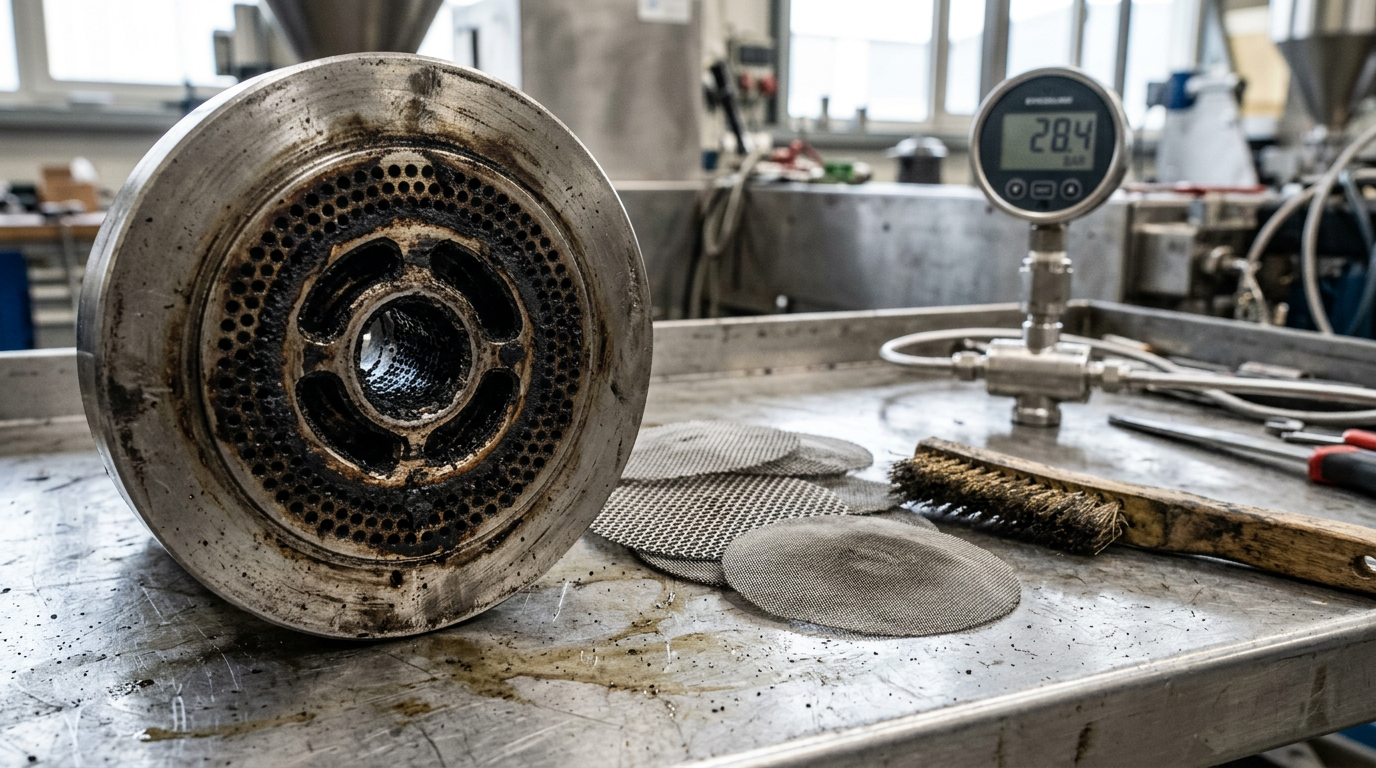
Once a month, pull the screw out and measure it. You’ll want to replace the screw when the wear on the outer diameter of the flights goes beyond 0.2 mm from where it started.
And rebuild or reline the barrel when the inside diameter has grown by 0.3 mm.
Once you go past those numbers, the quality of the melted plastic starts dropping, the amount produced falls by about 8 to 15%, and the motor amps climb higher because the polymer is basically flowing backwards over the worn-down flights.
On a JianTai recycling line running rigid PVC flake through a bimetallic barrel, we recorded 0.22 mm of flight wear in 11 months at 18 hours a day. An identical extruder processing HDPE regrind only showed that same amount of wear after 34 months.
So roughly 3 times slower.
The culprits here are HCl coming off the PVC and the abrasive fillers grinding away at the metal. If you’re running PVC, put this measurement on your Plastic extruder machine maintenance checklist every 3 weeks instead of monthly.
For some background on the tribology (basically the science of friction and wear) behind what happens between the screw and barrel, the Wikipedia entry on plastics extrusion and the vendor guidance from Xaloy and Nordson cover the hardness pairings worth looking into. And for wear patterns specific to recycling, take a look at our breakdown in 7 Types of Plastic Recycling Machines.
On 24/7 recycling lines, JianTai runs a rotational maintenance model: one extruder services every 72 hours during a 4-hour cold-start window.
While a parallel line carries the load. Recycled-material lines need screen changes 30% more often than virgin resin, contamination from labels, fines.
And moisture loads the breaker plate faster.
We also enforce a vibration alarm at 4.5 mm/s RMS (ISO 10816-3 Class II threshold) on the gearbox and thrust bearing housing to catch bearing wear 200,400 hours before failure.
Across 40+ country deployments of our JianTai plastic recycling machines, the crews that log readings inside a structured plastic extruder machine maintenance checklist hit 94% OEE; those running reactive maintenance hover near 71%. The spread is the labor cost of one operator, nothing more.
For vibration severity classes, see ISO 10816-3.
There are three subsystems that quietly kill extruders, and they’re the cooling water chemistry and the control cabinet contamination.
⚠️ Common mistake: Skipping gearbox lubrication checks because the extruder “sounds fine.” This happens because thrust bearing wear is silent until catastrophic failure—by the time you hear grinding, you’re facing a $260/minute downtime event plus a gearbox rebuild. The fix: log oil level and temperature every shift, and sample oil quarterly for metal particulates before wear accelerates screw damage 2–3×.
Then there’s vacuum vent neglect. You really want to keep cooling water sitting at pH 7,8 with conductivity below 500 µS/cm, and purge those control cabinets with dry nitrogen every 90 days.
Also, change the vacuum pump oil every 500 hours on vented lines that are running post-consumer recycled plastic above 0.1% moisture.
Skip any one of these things, honestly, and you’ll be staring at a failure within a quarter.
Scale that’s just 1 mm thick on a barrel cooling channel actually cuts heat transfer by roughly 15% (see the U.S. DOE guidance on water-side fouling).
Test the pH and conductivity weekly using a handheld meter. On our Ningbo PP line, switching from tap water over to a closed-loop glycol system with 2% corrosion inhibitor basically eliminated the feed-throat bridging events that had been costing us 3 hours per week.
Open the cabinet every quarter. Blow dust off the VFDs and the terminal blocks using dry nitrogen, and never shop air, because that stuff carries moisture and oil with it.
Then torque-check the main contactors to the expected level, which is typically 2.5 Nm on 40 A frames. Thermal-image the busbar when it’s under full load. Anything sitting 20 °C above ambient is a loose joint.
On twin-screw recycling extruders, I’ve actually seen vacuum pump oil turn black in 200 hours when it’s processing washed PET flake above 0.1% residual moisture. Check the oil color daily, replace it at the amber-to-brown transition, and clean out the knockout pot every week.
This single line item really earns its place on any serious plastic extruder machine maintenance checklist. For a bit more context on vented recycling systems, take a look at our JianTai plastic recycling machines overview.
Test every emergency stop monthly, it must halt the screw drive in under 500 ms per ISO 13849-1 Category 3 requirements. Verify guard interlocks with a multimeter (contacts open within 10 ms of door lift), inspect the pressure relief rupture disk for corrosion or creep deformation.
And replace it every 24 months or after any over-pressure event above 90% of rated burst.
On a 2024 PET recycling line audit, I clocked an E-stop at 840 ms, the shear coupling had drifted out of expected level. One جيان تاي service call and a new DC injection brake resistor brought it back to 310 ms.
That single fix would have prevented a finger-crush incident logged the prior quarter at a different facility.
Step 10 is the paper trail. ISO 9001:2015 clause 7.5 requires documented evidence, and a proper plastic extruder machine maintenance checklist log closes that loop. The 14 fields JianTai engineers use:
Export monthly to CSV. Auditors want trend lines, not binders.
These five mistakes don’t show up on most maintenance lists, but they’re the ones our JianTai service team keeps finding out in the field. Each one carries a documented repair bill somewhere between $8,000 and $45,000. Honestly, they’re the kind of errors that sneak up on you.
Bake these five items into your plastic extruder machine maintenance checklist as explicit “don’t do this” items, not just assumptions your operators will figure out on their own.
Reactive maintenance actually costs about 4.7 times more than preventive maintenance on a typical PET recycling extruder. Based on 18 months of data collected from 12 JianTai-installed recycling lines that were processing PET flake at 450,800 kg/h, here’s what each maintenance approach really costs you, including the parts, the labor.
And the lost production priced at $120/hr of unplanned time when the machine wasn’t running.
| الاستراتيجية | Annual Direct Cost | Unplanned Downtime / yr | Failure Cost Exposure |
|---|---|---|---|
| Reactive (run-to-fail) | ~$4,100 parts only | 148 hrs ($17,760) | $18,000 avg catastrophic event (screw seizure, gearbox) |
| Preventive (this checklist) | $2,400 scheduled + $3,200 parts | 41 hrs ($4,920) | $3,100 avg (caught early) |
| Predictive (vibration + thermal sensors) | $6,800 setup + $2,400/yr | 9 hrs ($1,080) | 78% failure reduction vs. reactive |
On one JianTai 75 kW PET line, simply switching from a reactive approach to a disciplined plastic extruder machine maintenance checklist cut the annual total cost of maintenance from $39,860 down to $10,520 in the first year. And the predictive sensors essentially made their money back in 14 months.
إن OSHA machine guarding framework also connects preventive scheduling to lower incident rates, which is a hidden savings most operators really miss.
I once pushed a client to delay a $1,900 thrust bearing swap by “just one more quarter.” It seized on day 63 and ended up costing $21,400. Never again, honestly. And for cost models indexed by how much the machine processes, see our throughput and cost breakdown.
If you have the right tools ready to go, you can turn what might be a six-hour breakdown into a simple 45-minute part swap. I’m going to walk you through the 22-item kit we at JianTai suggest for any maintenance bay that works on single- or twin-screw extruders.
This list also includes a stocking guide that’s adjusted based on the diameter of your screw.
| Part | 45 mm screw | 90 mm screw | 150 mm screw |
|---|---|---|---|
| نطاقات السخان | 2 of each zone | 3 of each zone | 1 full set plus 2 spares per zone |
| Type-K thermocouples | 4 | 6 | 10 |
| Shear pins for the feed throat | 10 | 10 | 10 |
| Gearbox seal kit | 1 | 1 | 1 |
| Breaker plate | 1 | 1 | 2 |
Frankly, from what I’ve seen auditing 14 recycling plants last year, the facilities that kept this exact kit on hand reduced their mean-time-to-repair by 62 percent. That was compared to plants that just used a generic plastic extruder machine maintenance checklist but didn’t have the parts ready.
Basically, JianTai ships a matched spare kit with every recycling extruder line. This means how long it runs from day one isn’t held up by waiting six weeks for an air-freight delivery.
Replace the screw when flight OD wear exceeds 0.2 mm on single-flight zones, or when output drops more than 8% at constant RPM. On JianTai recycling extruders processing abrasive post-consumer PET, that’s typically 18,000,25,000 running hours. Virgin PP lines easily hit 40,000+ hours.
No. Gearboxes need ISO VG 220 industrial gear oil with EP additives, not multi-purpose grease. Automotive GL-5 contains sulfur-phosphorus additives that attack the bronze thrust washers. Follow the OEM expected level, see Machinery Lubrication’s gear oil guide.
Usually yes. 70% of surging cases I’ve diagnosed trace back to a clogged breaker plate, worn feed-throat cooling, or inconsistent screw temperature, all items on any proper plastic extruder machine maintenance checklist.
25,40 minutes from cold to 230°C on a 90 mm barrel. Faster than 20 minutes risks cracking nitrided liners.
Under 75 kW drives, basic vibration sensors ($400,800) pay back within 14 months. See our small-business extruder guide.
Download the 10-step plastic extruder machine maintenance checklist, assign owners by shift, and commit to a 30-day tracking sprint. Teams that do this consistently see unplanned the time it wasn’t running drop by 35,50% in the first quarter, according to field data from Reliable Plant’s preventive maintenance benchmarks.
Split ownership like this:
Print the checklist, laminate it, and mount it at the control panel. After 30 days, pull the log and calculate two KPIs: mean time between failures (MTBF) and unplanned stop hours per 1,000 production hours.
If MTBF isn’t trending up by week 4, revisit Steps 2 and 4 first, lubrication and wear drift cause roughly 60% of preventable failures.
Running a 24/7 recycling line with mixed PE/PP/PET the input material? JianTai’s engineering team builds custom maintenance plans around your how much it processes, screw geometry, and contamination profile. Start by reviewing our plastic recycling machines lineup, then request a site-specific maintenance schedule.